I get this question regularly — from clients before booking a hike, from friends visiting from abroad, from people who read about wolf sightings in the news and wonder if their walking holiday just got dangerous.
Are there wolves in Tuscany? Yes.
Is it dangerous? No.
But that two-word answer doesn’t capture what’s actually interesting here. The return of wolves to Tuscany is one of the most remarkable wildlife stories in Europe, and understanding it will change how you experience these mountains.
Yes, There Are Wolves in Tuscany
The Italian wolf (Canis lupus italicus) is present throughout the Tuscan Apennines. This isn’t speculation — it’s confirmed by camera traps, howling surveys, scat analysis, and direct observation by researchers and forestry authorities.
The wolf never completely disappeared from Italy, unlike in most of Western Europe. By the early 1970s, the population had collapsed to an estimated 100 individuals, clinging to survival in the most remote parts of the central and southern Apennines — Abruzzo, Calabria, the Sila massif.
Then Italy did something that mattered: in 1971, wolves received full legal protection. Hunting was banned. Poisoned bait — which had decimated the population — was outlawed. And slowly, over decades, wolves began to recolonize their former range.
By the 1990s, wolves had returned to the northern Apennines. By the 2000s, they were established in Tuscany. Today, Italy’s wolf population is estimated at 3,300 or more individuals, with packs documented across the entire Apennine chain, from Liguria to Calabria, and into the western Alps.
In Tuscany specifically, wolves are present in every province with significant mountain terrain. The Casentino forests, the Garfagnana, the Apuan Alps, the Pistoiese mountains, the Mugello, the Calvana ridge above Prato — all have documented wolf presence.
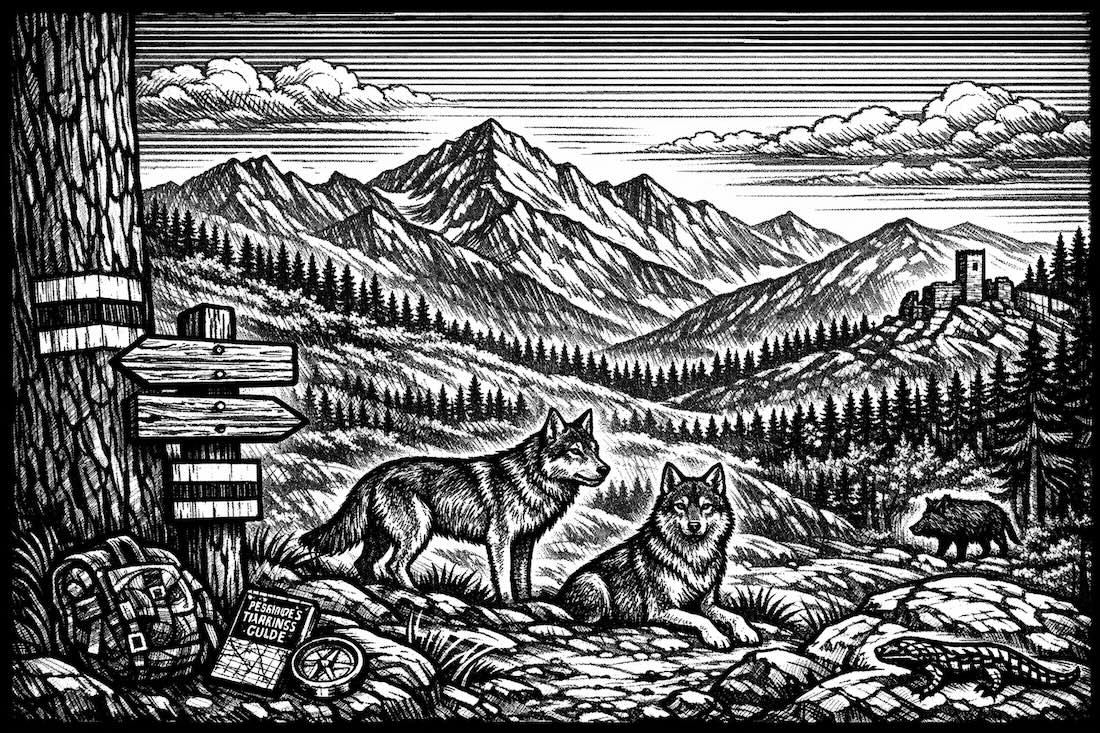
The areas where I guide — the mountains between Pistoia, Prato, and Lucca — are wolf territory. Acquerino Nature Reserve, where I lead many of my hikes, has had confirmed wolf presence for years. Camera traps in the reserve have recorded wolves moving through the beech and chestnut forests, usually at night.
Why You’ll Almost Certainly Never See One
Here’s the paradox: wolves live in these forests, but encountering one on a hiking trail is extraordinarily unlikely. I’ve been guiding in the Tuscan Apennines for years. I’ve found wolf scat, I’ve found tracks in mud and snow, I’ve heard howling at dusk. I have never seen a wolf in the wild.
This is normal. Wolves are among the most elusive large mammals in Europe. They’re intelligent, cautious, and profoundly aware of human presence. A wolf will typically detect you — by scent or sound — long before you have any idea it’s nearby, and it will move away.
Wolves are crepuscular and nocturnal. Most of their activity happens between dusk and dawn, precisely when hikers are not on the trails. During daylight hours, wolves rest in dense cover far from paths and roads.
Their territories are enormous. A pack in the Tuscan Apennines may cover 100-200 square kilometers. That’s a vast area of forest in which a handful of animals move quietly and deliberately. The density is low — you’re looking at perhaps 5-8 wolves per pack spread across a territory that would take you days to cross on foot.
To put it in perspective: you are far more likely to see a fire salamander on a rainy trail, hear a wild boar crashing through undergrowth, or spot a roe deer disappearing into the trees. Those encounters happen regularly. Wolf encounters simply don’t.
Are Wolves Dangerous to Hikers?
No. And this isn’t qualified optimism — it’s supported by data.
There have been zero fatal wolf attacks on humans in Italy in modern history. Across all of Europe, wolf attacks on humans are so rare that each case is individually documented and studied. The vast majority of recorded incidents involve wolves that were habituated to human food sources, rabid (rabies has been eliminated from Italy), or cornered and provoked.
A healthy wild wolf in the Tuscan Apennines has zero interest in you. You are not prey — wolves here feed primarily on wild boar, roe deer, fallow deer, and smaller mammals. You are not a threat they need to confront — they can simply leave, and they will.
Compare this to the animals that actually cause injuries in rural Tuscany:
- Wild boar (cinghiali): Large, common, and occasionally aggressive when surprised — particularly sows with piglets. They cause far more human injuries than wolves ever have. That said, attacks on hikers remain rare.
- Ticks: The real health risk in Tuscan forests. They carry Lyme disease and other tick-borne infections. I check for ticks after every hike — you should too.
- Wasps and hornets: More likely to cause a medical emergency (via allergic reaction) than any wild mammal.
- Vipers (Vipera aspis): Present but extremely shy. Bites happen, almost always when someone accidentally steps on or reaches near a basking viper. Rarely fatal with prompt medical treatment.
If you’re calculating actual risk on a Tuscan hike, wolves don’t make the list. Twisted ankles, dehydration, and getting lost are the real dangers — as I’ve written about in my guide to solo hiking in Tuscany.
What to Do If You See a Wolf
On the extremely remote chance that you do see a wolf, congratulations — you’ve had a genuinely rare wildlife experience.
Here’s what to do:
- Stop and observe. Don’t approach. Don’t run. Just watch.
- Make yourself visible. Stand tall. If the wolf hasn’t noticed you, speak calmly so it knows you’re there.
- Give it space. The wolf will almost certainly move away on its own. Let it.
- Don’t follow it. Resist the temptation to get closer for a photo.
- Enjoy the moment. Many wildlife researchers spend years in these forests hoping for this kind of sighting.
What NOT to do:
- Don’t leave food out, ever — this applies to picnic scraps, not just campsites. Habituating wolves to human food sources is the single most dangerous thing that can happen for both wolves and people.
- Don’t feed or approach wolf pups if you find them. The mother is nearby.
Why the Wolf’s Return Matters
The return of wolves to Tuscany is not just a conservation feel-good story. It’s reshaping the ecology of these mountains in measurable ways.
Before wolves returned, wild boar and deer populations had exploded. Without apex predators, these herbivores overgrazed the forest understory, damaged agricultural land, and altered plant community composition. Boar, in particular, had become a serious problem — rooting up meadows, destroying crops, and causing vehicle collisions.
Wolves are restoring balance. They regulate ungulate populations naturally. But perhaps more importantly, their presence changes the behavior of prey animals. Deer and boar move more frequently, spend less time in any one area, and avoid exposed positions. This “ecology of fear” allows vegetation to recover in places that were being hammered by overgrazing.
It’s called a trophic cascade, and it’s happening right now in the forests where I guide.
You won’t see it in a single hike. But over the seasons, if you pay attention, you’ll notice the forest is healthier, more diverse, more alive than it would be without its top predator.
Other Wildlife You Will Actually See
While wolves remain invisible, the Tuscan Apennines are rich with wildlife that you’ll encounter regularly on hikes:
Mammals:
- Wild boar (Sus scrofa): You’ll hear them before you see them. Common at all elevations, especially in oak and chestnut forests.
- Roe deer (Capreolus capreolus): Elegant and surprisingly common. Often seen at forest edges at dawn and dusk.
- Fallow deer (Dama dama): Present in several Tuscan parks and reserves.
- Red fox (Vulpes vulpes): Occasionally spotted on trails, especially early morning.
- Porcupine (Hystrix cristata): Nocturnal, but you’ll find their distinctive black-and-white quills on forest paths.
- Wild horses on the Calvana: Not technically wildlife, but a semi-wild herd roams the ridge above Prato — a remarkable sight.
Amphibians and reptiles:
- Fire salamander: One of the most striking creatures in these forests. Look for them on rainy days in autumn and spring.
- Vipera aspis: Italy’s only common venomous snake. Shy and rarely encountered on well-used trails.
- Green lizard (Lacerta bilineata): Bright green, surprisingly large, basking on sunny rocks and walls.
Birds:
- Buzzards (Buteo buteo): Circling overhead on thermals — the most common raptor you’ll see.
- Red kites: Increasingly common, with their distinctive forked tail.
- Jay (Garrulus glandarius): The forest alarm system. Their harsh screech tells you (and everything else) that something is moving through the trees.
Hiking in Wolf Country: City-by-City Guides
If this article has you thinking about hiking in the Tuscan Apennines rather than fearing them, here’s where to start depending on where you’re staying:
- From Florence: Best hikes near Florence and trekking near Florence — including trails in the Calvana and the mountains north of the city.
- From Prato: Best hikes near Prato — Acquerino, Calvana, and the Val di Bisenzio are all wolf territory and all extraordinary.
- From Pistoia: Trekking near Pistoia — the Pistoiese mountains offer some of the wildest terrain in northern Tuscany.
- From Lucca: Trekking from Lucca — from gentle valley walks to serious Apennine treks.
- From Pisa: Hiking from Pisa and day treks from Pisa — San Rossore for coastal wildlife, Monte Pisano for forest and hills.
- From Montecatini Terme: Hiking from Montecatini — a spa town perfectly positioned between the Pistoiese mountains and the Lucca hills.
- From Pescia: Hiking near Pescia — quiet Apennine valleys with minimal crowds.
For a broader overview of what these mountains offer, my guide to hiking in Tuscany covers trails, seasons, and what to expect.
The Real Question
The question “are there wolves in Tuscany?” usually means “should I be afraid?”
The answer is no. These mountains are among the safest hiking environments in Europe. The presence of wolves makes them more ecologically interesting, not more dangerous.
If anything, the wolf’s return is a reason to come, not a reason to stay away. You’re walking through a landscape that is healing — where an apex predator has reclaimed its place after centuries of absence, and where the forest is responding.
You probably won’t see a wolf. But you’ll walk through a forest that is richer because they’re there.
Want to Hike Through Wolf Country?
I guide year-round through the forests where wolves have returned — from easy trails for beginners to full-day treks deep into the Apennines. You probably won’t see a wolf, but you’ll understand why the forest feels alive.

or head to the contact page
Explore Hidden Tuscany
Guided hiking experiences combining expert trail knowledge, professional photography, and wilderness mindfulness.