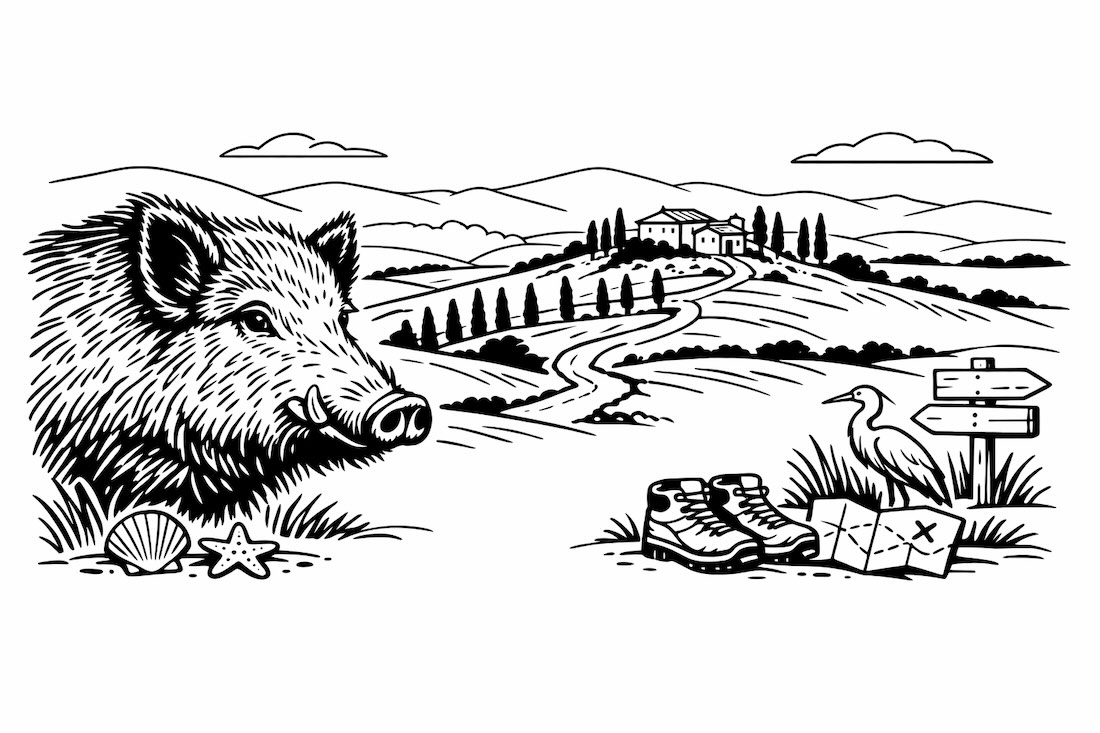
If you’re planning to hike in Tuscany, someone will eventually mention wild boar. Maybe a travel forum, maybe a well-meaning friend, maybe an article that makes them sound like a serious threat.
Let me save you the anxiety: wild boar are common, they’re large, and they will almost certainly not bother you.
I encounter them regularly. On guided hikes through Acquerino Nature Reserve, boar sightings — or more accurately, boar hearings — are a routine part of the experience. They crash through undergrowth, they root in the soil, they occasionally freeze and stare at you from twenty meters away.
Then they run.
That’s the pattern, almost without exception. You surprise each other, there’s a moment of mutual assessment, and the boar leaves — usually at speed, usually noisily, always away from you.
Yes, They’re Everywhere
Wild boar (Sus scrofa) are the most common large mammal in the Tuscan Apennines. They’re not rare, not elusive, not hard to find. The opposite, in fact — their population has exploded over the past few decades.
Estimates put Italy’s wild boar population at over one million, with Tuscany hosting one of the highest densities in the country. The reasons are straightforward: reduced hunting pressure in protected areas, abundant food in oak and chestnut forests, high reproductive rates, and the disappearance of their main natural predator — the wolf — for most of the 20th century.
The wolf’s recent return to the Tuscan Apennines is starting to rebalance this, but boar numbers remain very high.
You will encounter evidence of wild boar on almost any hike in Tuscany. Even if you don’t see the animals themselves, you’ll see their work:
- Rooted-up ground: Patches of forest floor, meadow, or trail edge that look like they’ve been ploughed. Boar use their powerful snouts to dig for roots, tubers, bulbs, insects, and fungi. The damage can be extensive.
- Mud wallows: Shallow depressions in wet areas where boar roll to cool down and remove parasites.
- Tracks: Distinctive two-toed hoofprints, broader and rounder than deer tracks.
- Tree rubs: Bark worn smooth at boar shoulder height where they scratch against trunks, often near wallows.
At Acquerino, where I guide most frequently, rooted-up ground is visible on practically every trail. In autumn, when boar are actively feeding on chestnuts and acorns, the forest floor can look like someone has taken a rototiller to it.
Are Wild Boar Dangerous?
The short answer is: very rarely, and almost never to hikers behaving normally.
The longer answer requires some nuance, because boar are large animals — an adult male can weigh 100-150 kg — and they do possess sharp tusks. They’re powerful, they’re fast, and they’re not inherently docile.
But they are inherently afraid of humans. This is the key point that gets lost in sensationalised reporting.
During my GAE (Guida Ambientale Escursionistica) certification course, we studied wildlife safety data from the Tuscany Region. The statistic that stuck with me: the animal responsible for the most attacks on humans in Tuscany is the domestic dog. Not boar, not wolves, not vipers. Dogs.
This isn’t surprising when you think about it. Dogs live alongside us, interact with us daily, and occasionally react aggressively. Wild animals, by contrast, have spent their entire evolutionary history learning to avoid us. Humans are the most dangerous predator on the planet, and wild animals know it.
Wild boar will avoid you if given the opportunity. In years of guiding through areas with high boar density, the interactions follow the same pattern:
- You hear crashing in the undergrowth
- You catch a glimpse of a large, dark, fast-moving animal
- It’s gone
That’s it. The boar detected you — often before you detected it — and left.
When Boar Can Be Dangerous
I don’t want to be dismissive. There are situations where boar behaviour changes, and being aware of them matters:
A Sow With Piglets
This is the most commonly cited risk, and it has some basis in reality. A female boar protecting her young is more likely to stand her ground than a solitary animal. Piglets are striped — brown with lighter horizontal stripes — and usually travel in a group close to the mother.
If you encounter a sow with piglets, the protocol is simple:
- Stop walking. Don’t advance toward them.
- Back away slowly. Give her a clear escape route.
- Don’t get between the mother and the piglets. This is the scenario most likely to provoke a defensive charge.
- Make yourself known. Speak calmly. Let her identify you as human, not predator.
In practice, even sows with piglets usually flee. The charge scenario is rare and typically requires you to accidentally corner her — which takes genuine effort on a forest trail.
A Wounded or Cornered Animal
Boar that have been hit by cars, injured during hunting season, or trapped in enclosed spaces can behave unpredictably. This is true of virtually any large mammal and isn’t specific to boar.
If you encounter a visibly injured boar, keep your distance and contact local authorities (Carabinieri Forestali: 1515).
Urban or Habituated Boar
In some parts of Tuscany — particularly near cities and suburban areas — boar have lost some of their natural wariness of humans. They raid bins, wander through gardens, and occasionally enter town centres. These habituated animals are less predictable than their fully wild counterparts.
This is not a hiking problem. On mountain trails, in nature reserves, in the forests where I guide, the boar behave like wild animals: cautious, alert, and eager to avoid you.
What to Do If You Encounter a Wild Boar
The protocol is almost identical to what I recommend for wolf encounters:
- Stop. Don’t run — running can trigger a chase instinct, and you cannot outrun a wild boar.
- Stay calm. Speak in a normal voice. Let the animal identify you.
- Give it space. Boar almost always want to leave. Make sure there’s a clear path away from you.
- Back away slowly if the boar doesn’t move. Don’t turn your back until you’ve created distance.
- If the boar charges: Step behind a tree. Boar are fast in a straight line but poor at turning. A tree trunk between you and a charging boar is effective protection. Climb if you can — boar cannot climb.
Realistically, you will never need steps 4 or 5. I include them for completeness, but in all my years of guiding through boar territory, I have never been charged, and I have never had a client in a threatening situation with a boar.
The Truth About Wildlife Danger in Tuscany
Let me put boar in context with other wildlife you might encounter on Tuscan trails, ranked by actual risk to hikers:
Ticks — The genuine health concern. Present in grass and low vegetation from spring through autumn. Can transmit Lyme disease and other tick-borne infections. Check yourself thoroughly after every hike. This is the one wildlife-related risk I take seriously on every single outing.
Wasps and hornets — More likely to cause a medical emergency than any mammal, particularly for people with allergies. The European hornet (Vespa crabro) is large and intimidating but generally non-aggressive unless you disturb a nest.
Vipers (Vipera aspis) — Italy’s only common venomous snake. Present but shy. Bites are rare and almost never fatal with prompt treatment. They bask on sunny rocks and pathsides — watch where you step and where you put your hands.
Wild boar — Large, common, almost always flee from humans. Risk is minimal with basic awareness.
Wolves — Present in the Apennines, zero fatal attacks in modern Italian history. You will almost certainly never see one.
Fire salamanders — Toxic skin secretions if handled, but entirely harmless if left alone. The most dramatic creature you’re likely to see on a rainy day.
The pattern is clear: wild animals in Tuscany are afraid of you. Every single one. The wolf, the boar, the viper, the fox — they all want to be somewhere else when they detect your presence. The animals that actually cause problems in the region are domestic dogs, ticks, and wasps. None of these are typically what people worry about when they ask “is it safe to hike in Tuscany?”
What Wild Boar Are Actually Good For
Beyond the safety question, boar play an interesting ecological role in Tuscan forests — even if their numbers are currently too high.
Rooting behaviour turns soil. When boar dig for food, they aerate compacted earth, bury seeds, and create micro-habitats for invertebrates and plants. In moderation, this is beneficial for forest health.
They disperse seeds. Boar eat enormous quantities of acorns, chestnuts, and other seeds. Some pass through their digestive system intact and germinate far from the parent tree.
They’re prey for wolves. The return of wolves to the Tuscan Apennines — which I’ve written about in my guide to wolves in Tuscany — is directly linked to boar abundance. Boar are a primary food source for wolf packs in this region.
They connect to Tuscan food culture. Wild boar meat (cinghiale) is central to Tuscan cuisine — ragù di cinghiale, pappardelle al cinghiale, wild boar salami. When you eat these dishes in a mountain restaurant after a hike, you’re tasting the same animal you heard crashing through the undergrowth that morning. There’s a satisfying circularity to that.
Encountering Boar at Acquerino
Since I guide regularly through Acquerino Nature Reserve, I can give you a specific sense of what boar encounters look like here.
Acquerino is dense mixed forest — beech, chestnut, oak, and some conifer plantations — at elevations between 400 and 1,000 meters. The forest floor is thick with leaf litter, fallen branches, and undergrowth. Perfect boar habitat.
In autumn, you’ll hear them before anything else. The sound of a boar rooting through dry leaves is distinctive — a sustained, rhythmic rustling, louder and more deliberate than wind or a small animal. If you stop and listen, you can often pinpoint the direction.
Occasionally, you see them. A dark shape moving between trees, surprisingly fast for something so heavy. Piglets are more visible in late spring and early summer — small striped forms following their mother through the undergrowth.
The most common sign is fresh rooting. Patches of overturned earth along the trail edge, sometimes extending several metres into the forest. In the morning, you can tell the boar were there overnight — the earth is dark and freshly turned.
I point all of this out to clients. Not as a warning, but as evidence of a functioning ecosystem. The boar, the wolves that hunt them, the oaks that feed them, the soil they turn — it’s all connected. Understanding these relationships transforms a walk through the woods into something richer.
Hiking in Boar Country: City-by-City Guides
Wild boar are present across the entire Tuscan Apennines and in most forested areas of the region. If you’re planning to hike, here’s where to start depending on where you’re staying:
- From Florence: Trekking near Florence — the Calvana ridge and mountains north of the city are all boar habitat.
- From Prato: Best hikes near Prato — Acquerino, Calvana, and the Val di Bisenzio have dense boar populations.
- From Pistoia: Trekking near Pistoia — the Pistoiese mountains, including Acquerino, are some of the wildest terrain in northern Tuscany.
- From Lucca: Trekking from Lucca — from valley walks to Apennine treks, boar are present at all elevations.
- From Pisa: Day treks from Pisa — Monte Pisano and San Rossore park both have boar populations.
- From Montecatini Terme: Hiking from Montecatini — positioned between the Pistoiese mountains and the Lucca hills.
- From Pescia: Hiking near Pescia — quiet Apennine valleys with plenty of wildlife.
- From Viareggio: Day trekking from Viareggio — the Apuan Alps and coastal parks.
For a broader overview of hiking in the region, start with my guide to hiking in Tuscany.
The Real Question
People ask “are wild boar dangerous in Tuscany?” when what they really mean is “should I be worried about hiking there?”
No. The Tuscan Apennines are one of the safest hiking environments in Europe. The wildlife is abundant, it’s fascinating, and it wants nothing to do with you.
The real risks on a Tuscan hike are the boring ones: getting lost on poorly marked trails, twisting an ankle on rocky terrain, underestimating distance and elevation. These are the things that actually send hikers to the hospital. Wild boar are not.
If anything, encountering boar evidence on a hike is a sign that you’re in a healthy, functioning forest. The rooted-up ground, the tracks in the mud, the distant crashing through undergrowth — these are the sounds and signs of a landscape that’s alive.
Enjoy them. And maybe order the pappardelle al cinghiale that evening.
Want to Hike Through Wild Boar Territory?
I guide year-round through the forests of the Tuscan Apennines — including Acquerino Nature Reserve, where boar sightings are a regular part of the experience. You’ll learn to read the forest, not just walk through it.

or head to the contact page
Explore Hidden Tuscany
Guided hiking experiences combining expert trail knowledge, professional photography, and wilderness mindfulness.