
I'm Stefano, and I guide people through the Tuscany most tourists never see. Want to hike in Tuscany with me?
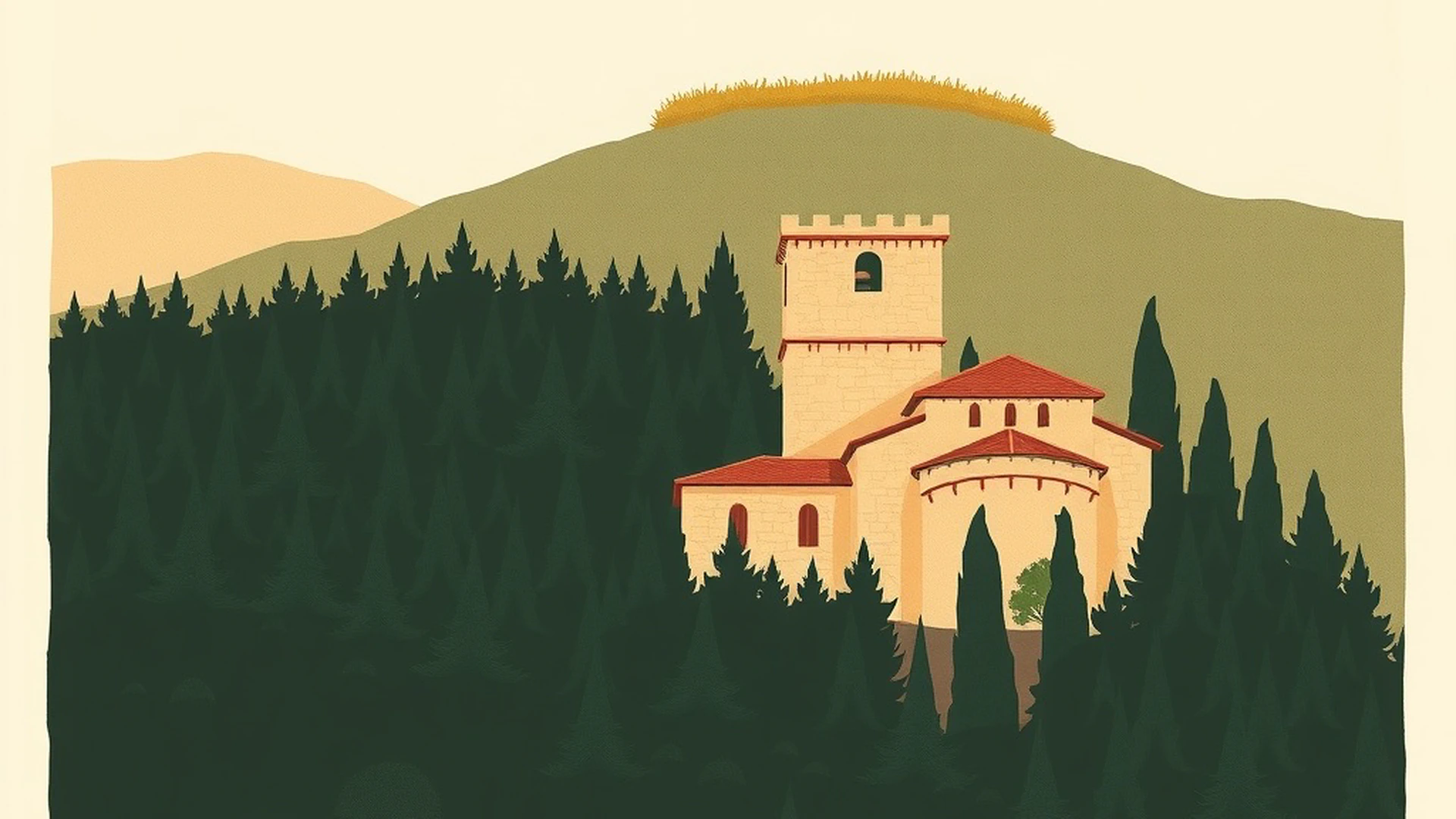
Milton put Vallombrosa into Paradise Lost. The fallen angels lie on the burning lake “thick as autumnal leaves that strow the brooks in Vallombrosa”, and for three centuries English readers have carried that image of a Tuscan valley carpeted in dead leaves. The joke is that Vallombrosa’s forest today is mostly silver fir, dark all year round, and that nobody can prove Milton ever got there on his Italian journey of 1638 and 1639. The plaque claiming he did went up in 1925. The valley doesn’t need him. East of Florence, on the Florence-facing slope of the Pratomagno, a Benedictine abbey has sat at around 950 metres for close to a thousand years inside a forest its own monks grew, and above the trees an open grass ridge runs for kilometres with a view down both sides of the Arno.
The Abbey
Giovanni Gualberto, a Florentine, withdrew to this valley in the 1030s and founded a monastery around 1038 that became the mother house of the Vallombrosan order, a stricter branch of the Benedictines. What stands now is mostly fifteenth to eighteenth century. The monastery buildings took their present shape in the late 1400s, the east tower went up in 1529 after the place was sacked, and Gherardo Silvani gave the complex its two facades in the 1630s and 1640s. The church inside is a medieval building dressed in seventeenth and eighteenth century decoration. The fishponds came in the 1700s, the frescoes inside between 1779 and 1781. A medieval bell tower survives from the earlier church.
A small community of monks is still there. The complex is open to visitors, with a museum of sacred art that opened in 2006, and the old monastic pharmacy, the Antica Farmacia, sells the herbal liqueurs and elixirs the monks still make from their recipes. I’d check opening hours before building a day around the interior; the forest doesn’t keep hours, the abbey does.
The Forest the Monks Made
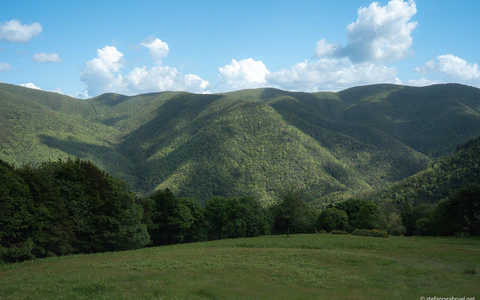
This is the real reason to come. The fir stands around the abbey aren’t a natural forest in the way the Apennine beechwoods further north are. The Vallombrosan monks planted and spread silver fir here over centuries, as timber and as a kind of devotion, and what you walk through is several hundred years of deliberate forestry. Beech takes over higher up, and foresters later added Douglas fir and Corsican pine in experimental plots.
That history made Vallombrosa the natural home for Italy’s first school of forestry. The Royal Forestry Institute opened in the former abbey buildings in 1869, with Adolfo di Bérenger as its first director, and the arboreta that grew out of his collection, started around 1870, are still there, seven of them now, with thousands of specimens from several hundred species. George Perkins Marsh, the American who wrote Man and Nature and one of the founders of modern conservation thinking, admired Bérenger’s work and died at Vallombrosa in July 1882 while visiting him. I find that a strange and satisfying thing to know while standing under trees that monks planted: the modern science of looking after forests was taught, for the first time in Italy, inside one.
The state has protected the forest since 1977 as a biogenetic nature reserve of a little under 1,300 hectares, looked after today by the Carabinieri’s biodiversity branch, who have a base here. The University of Florence still teaches forestry at the Paradisino, the monks’ old hermitage above the abbey, which did a spell as a hotel before it became a classroom. Its terrace looks over the whole forest and down the Arno valley.
Saltino and the Railway That Climbed the Hill
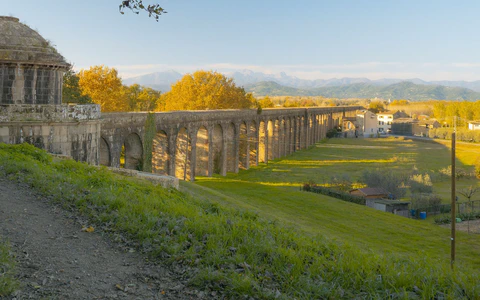
Just above the abbey sits Saltino, a resort that the Florentine and English upper classes built up at the end of the nineteenth century to escape the summer heat. Count Giuseppe Telfener opened a rack railway from Sant’Ellero, on the Arno, up to Saltino in September 1892, and for a few decades the hill filled with hotels. The resort faded after the First World War and the last train ran in 1924; a new walking trail now links Sant’Ellero and Vallombrosa. If you like your landscapes with a layer of vanished belle époque on them, this is the place.
The Pratomagno
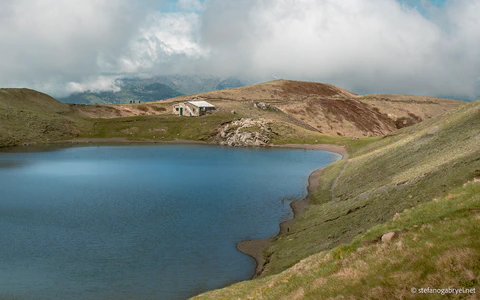
Above the forest the trees stop and the Pratomagno begins: a long ridge of bare grassland that runs north-west to south-east and separates the Florence side of the valley from the Casentino. Monte Secchieta, at 1,449 metres, is the top above Vallombrosa, with a forest road up from the abbey; a small ski station ran here until the mid-1980s and you can still see where it was. The ridge tops out further south-east at around 1,590 metres, where the Croce del Pratomagno stands, an iron cross nearly twenty metres tall, first raised in 1928, blown down in 1966 and rebuilt by 1969.
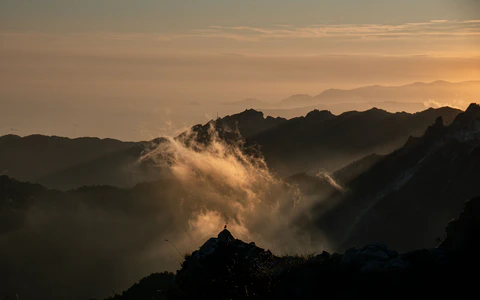
Up there the walking changes completely. The firs are gone, the wind arrives, and on a clear day the view takes in the Arno twice: the Florence side to the west, and the Casentino to the east with the Apennine ridge behind it. The same ridge, on its south-eastern end, looks straight down on the eroded pinnacles of the Balze del Valdarno.
A Day Here
- Season. The forest is at its best in May and June, when the beech is fresh, and in October, when the beech turns while the firs stay dark. It snows up here in winter, and the ridge is no place to be in bad weather.
- Ground. Forest tracks and paths through the fir and beech, steeper and more exposed once you climb out onto the grass of the Pratomagno.
- Combine it. The abbey and its pharmacy take an hour or so; the walking fills the rest of the day. The chapels on the hillside above the abbey make a short loop, past a rock spur called the Masso del Diavolo where, the story goes, a monk tempted by the devil threw himself off.
- From Florence. Vallombrosa sits above Reggello, east of the city on the Arezzo side. I’ve put the other mountain days from Florence, which all point north, in hiking near Florence; this one and the Balze are the two that point the other way.
Vallombrosa is where Italy first taught forestry as a science, and you can still read that in the trees. I don’t know what Milton saw in 1638, or whether he saw it at all. I do know which month I’d pick: October, when the beech turns and his line comes closest to being true.
Would you like to experience this?
Tell me when you’re in Tuscany and what you have in mind, and I’ll get back to you.Frequently asked questions
Looking for private hiking in Tuscany?
Browse my full collection of small-group, fully private hikes across the region.