There’s a plant that grows abundantly on old walls throughout Tuscany. It is especially common along the Nottolini Aqueduct near Lucca. Most people walk past it without noticing. Its round, coin-shaped leaves press against brick and stone in dense rosettes. They become invisible through familiarity.
Yet Umbilicus rupestris—wall pennywort, also known as navelwort—deserves closer attention. It’s not rare or threatened. But it’s remarkably successful at colonizing the spaces between human construction and wild nature. This plant thrives in wall crevices and thin soil. It shows how plants exploit spaces humans overlook.
Recognition: The Navel That Names It
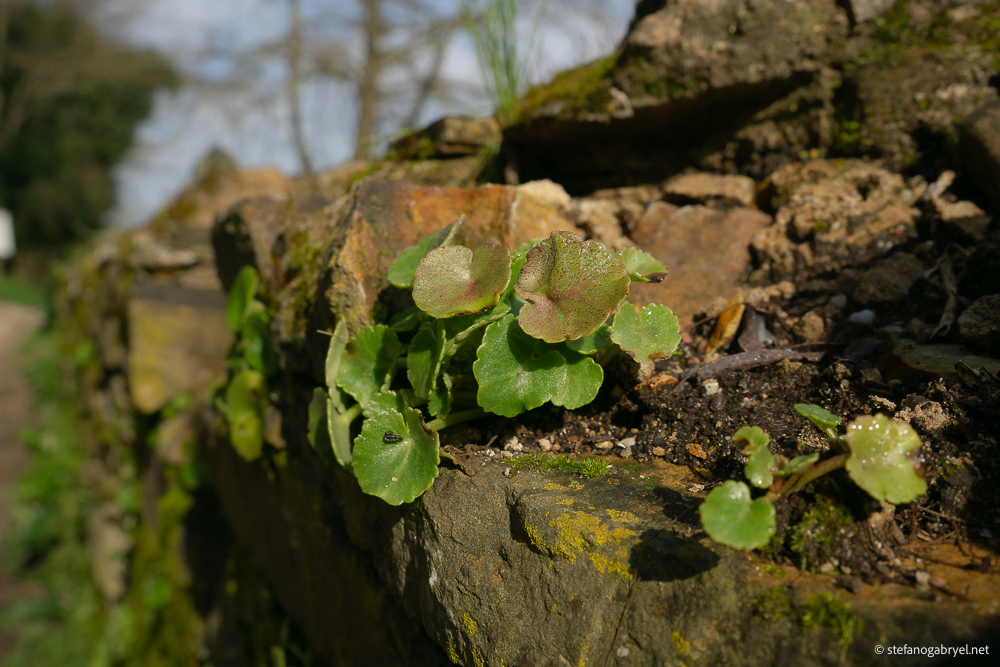
The common names tell you exactly what to look for. “Pennywort” refers to the coin-like shape and size of the leaves. They measure roughly 2-7 cm in diameter, perfectly circular. Each has a distinctive central depression where the leaf stalk attaches near the center of the leaf (a peltate leaf). This navel-like indent gives the plant its other common name. It also explains the scientific name (Umbilicus meaning navel in Latin).
The leaves are succulent—thick, fleshy, with a glossy surface that stores water. They’re deep green in shaded conditions. They may develop reddish tints when exposed to strong sunlight or drought stress. The leaves grow in basal rosettes. They radiate from a central point at ground level. Or more commonly, from where the plant has rooted in a wall crevice.
The flowers are equally distinctive. From late spring through summer, the plant sends up unbranched flower spikes. These appear typically April to July in Tuscany, occasionally earlier in mild winters. The spikes reach 10-40 cm tall. They bear numerous small, bell-shaped flowers that droop downward. They look like tiny green-to-pinkish lanterns. The overall effect suggests a slender candle with pale, hanging bells arranged around it.
After flowering, the stems persist through autumn, turning brown as the seeds ripen. Occasionally these dried stalks remain intact into winter. They stand alongside new leaf rosettes emerging for the following year.
Once you know these features, identifying wall pennywort becomes easy. You can recognize it even from a distance on stone walls or rock faces.
Habitat: Masters of Marginal Spaces
Umbilicus rupestris belongs to the stonecrop family (Crassulaceae). The family name derives from the genus Crassula, from the Latin crassus meaning ’thick.’ The name refers to the succulent nature of many members of the family. These plants specialize in colonizing places other plants find inhospitable.
Wall pennywort specifically thrives in:
- Crevices in old stone walls and brick structures
- Damp, shady rock faces and cliffs
- Roadside banks with exposed stone
- Tree bases and root crevices
- Gaps in roof gutters and between paving stones
The key requirements are minimal soil, some shade or dampness, and an anchorage surface. It’s a pioneering species. It’s one of the first to colonize bare rock or new walls. The succulent leaves allow it to tolerate periodic drought. Meanwhile, a preference for partial shade or periodically moist rock surfaces keeps it from competing with full-sun specialists.
In Tuscany, this means you’ll find wall pennywort abundantly on:
- Medieval city walls in towns like Lucca, Pisa, and Pistoia
- Old stone farmhouses and agricultural buildings
- Historic aqueducts and water infrastructure
- Stone retaining walls along mountain roads
- Ancient churches and monastery walls
Essentially, anywhere humans have stacked stone for centuries. Umbilicus rupestris has quietly colonized the cracks.
The Acquedotto del Nottolini: A Pennywort Paradise
Of all the places I’ve encountered wall pennywort in Tuscany, none compares to the Acquedotto del Nottolini near Lucca.
This 19th-century neoclassical aqueduct spans about 3 kilometers with approximately 460 brick and stone arches. It creates ideal conditions for Umbilicus rupestris on an extraordinary scale. The combination of factors is perfect:
Shade and moisture: The arches create constantly shaded sections where moisture accumulates. The structure originally carried water through elevated channels. This means the entire aqueduct has been exposed to dampness for nearly 200 years.
Age and weathering: Built between 1823 and 1851, the aqueduct has had two centuries for plants to colonize. The mortar between bricks has weathered and cracked. This creates countless crevices for root establishment.
Reduced competition: The vertical brick surfaces don’t support the full range of plants. Those that thrive on horizontal surfaces struggle here. This gives specialists like Umbilicus rupestris an advantage.
The result? Walls absolutely covered in wall pennywort rosettes. In prime sections, you can see hundreds of plants within a few meters. Their round leaves overlap like scales or coins pressed into the masonry. In spring, when the flower spikes emerge, the aqueduct walls become gardens of pale green candles. Functional 19th-century infrastructure transforms into living vertical meadows.
The Nottolini Aqueduct walk is one of the easiest places in Tuscany to observe this species up close. Walking the Nottolini in late spring or early summer, you move through what amounts to a three-kilometer gallery. Umbilicus rupestris displays every stage of its life cycle simultaneously. You see emerging rosettes, mature leaves, flowering spikes, and dried stems from previous years. For anyone interested in plant ecology, it’s a masterclass. It shows how certain species exploit very specific niches that human construction creates.
The accessibility makes it particularly valuable. Unlike cliff-dwelling populations that require climbing to observe closely, the Nottolini’s wall pennywort grows at eye level. It follows a flat, easily walked path. You can photograph it properly. You can observe the central leaf depression clearly. You can see how the flower spikes emerge. You can understand exactly what habitat conditions this plant prefers. All without scrambling up steep slopes or rock faces.
Edibility and Traditional Uses
Umbilicus rupestris is edible, though not commonly eaten in modern Italian cuisine. The leaves are the primary edible part. Harvest them in winter and early spring when they’re mild and tender.
Taste and texture: The leaves have a succulent, crisp texture. The flavor is often described as cucumber-like with a slight saltiness. Raw, they make acceptable additions to winter salads when other fresh greens are scarce. However, they can become slimy when cooked. The leaves contain mucilage. This explains the slightly slippery texture they develop when cooked. Most people who eat them prefer them raw.
The taste becomes stronger and less pleasant in summer. This occurs particularly once the plant has flowered. Energy goes into seed production rather than leaf growth. This is typical of many wild edible plants. The best eating quality comes when the plant is in vegetative growth, not reproductive mode.
Traditional medicinal uses: Historical herbalism attributed various properties to wall pennywort. The juice was considered diuretic and anti-inflammatory. Folk medicine employed it for treating skin conditions, cuts, chilblains, and inflammations. It was also used for various internal complaints including liver and kidney issues.
Modern herbalism largely ignores Umbilicus rupestris. It favors other Crassulaceae family members like houseleek (Sempervivum tectorum). This is interesting because wall pennywort is native to Britain and southern Europe. Houseleek was introduced. The medicinal applications of both plants were apparently similar enough that they substituted for each other in folk practice.
A practical note: While edible, wall pennywort growing on old walls in urban or roadside environments may have absorbed pollutants. Vehicle exhaust, runoff, or other contamination can accumulate in plant tissues. If you’re inclined to forage it, choose plants from clean rural locations. Stay away from roads and pollution sources.
Ecology and Life Strategy
Umbilicus rupestris employs a specific ecological strategy. Botanists call this its life history.
Perennial and evergreen: The plant maintains its leaf rosettes year-round. This allows it to photosynthesize whenever conditions permit. This is energetically expensive. But it’s advantageous in the mild Mediterranean climate. Winter days can still be productive for growth.
Seed and vegetative reproduction: The plant produces numerous tiny seeds from its flower spikes. Wind and water carry them to new locations. Once established, it can also spread vegetatively. New rosettes form near parent plants as they mature.
Stress tolerance: The succulent leaves and ability to grow in minimal substrate help it tolerate extreme conditions. Conditions that would kill most species. It can survive extended dry periods by drawing on stored water. It then resumes active growth when moisture returns.
Minimal competition strategy: Rather than competing directly with more aggressive plants in rich soil, Umbilicus rupestris specializes in places other plants can’t colonize easily. This is why you see it covering walls. But you rarely find it thriving in adjacent garden beds. It loses when competing with conventional plants. But it often becomes abundant in marginal habitats.
This strategy explains its success on structures like the Nottolini. The aqueduct provides thousands of linear meters of habitat. This habitat favors wall pennywort while excluding most competitors. The plant has essentially found an ecological niche that human construction creates. And it exploits that niche brilliantly.
Photography and Observation
From a visual perspective, Umbilicus rupestris offers compelling subjects at multiple scales.
Macro photography: The central depression in each leaf rewards close observation. So does the way the leaf stalk attaches. The subtle variations in green coloration create visual interest. The texture of the succulent surface photographs beautifully. The bell-shaped flowers, though small, photograph beautifully when backlit. They also look striking when captured in morning dew.
Pattern and texture: Dense colonies create remarkable visual patterns. Hundreds of coin-shaped leaves overlap in organic arrangements. The contrast between the geometric human-built walls and the organic plant growth creates interesting compositional tensions.
Life cycle documentation: Wall pennywort goes through distinct phases. Winter rosettes, spring growth, summer flowering, autumn seed production, dried winter stems. You can document the full annual cycle from a single location. Return to photograph the same population through seasons.
Context and habitat: Photographing wall pennywort in its setting tells stories. Growing from cracks in ancient stone. Colonizing historic structures. Creating gardens on vertical surfaces. These images show how nature and human construction interact over time.
The Nottolini provides all of these opportunities in one accessible location. The three-kilometer walk offers countless individual plants. You can observe, photograph, and study them all along a flat path. No climbing or difficult access required.
Distribution and Conservation Status
Umbilicus rupestris is native to southern and western Europe, North Africa, and Macaronesia. In Italy, it’s common throughout Tuscany and other regions with appropriate habitat. Essentially anywhere with old stone structures in areas receiving adequate moisture.
The plant is not threatened. Its ability to colonize human construction means it actually benefits from certain types of development. Every old wall, historic building, or stone structure provides potential habitat. As long as humans continue building with stone and brick, wall pennywort has a future. As long as some structures remain standing long enough to weather and crack.
This commonness is part of why it’s overlooked. We tend to value rarity. But there’s equal value in understanding abundant species. In recognizing what allows certain plants to thrive in landscapes we’ve thoroughly transformed.
Why This Matters
You might reasonably ask: why dedicate an entire article to a common plant that most people ignore?
Because Umbilicus rupestris teaches you to read landscape differently.
Once you recognize wall pennywort, you start noticing it everywhere. You begin understanding that old walls aren’t just architectural features. They’re habitats supporting specific plant communities. You recognize that shade, moisture, substrate, and time interact to create ecological niches. You see that “waste spaces” and margins between human and wild aren’t empty. They’re colonized by specialists adapted to exactly those conditions.
The plant anchors in cracks only a few millimeters wide. Its roots exploit thin pockets of soil between bricks. This isn’t abstract. It’s visible if you look closely.
This is what naturalists do. We learn to see what’s actually there. Not what we expect or what captures attention through rarity or drama. The common plants, the overlooked species, the “weeds” growing in cracks—these reveal as much about ecology as rare orchids or ancient trees. If you learn their stories.
Walking the Nottolini with eyes trained to see Umbilicus rupestris transforms the experience. You’re not just admiring 19th-century engineering. You’re witnessing how life colonizes stone. How 200 years creates habitat. How the spaces between bricks become gardens.
This is the deeper value of botanical knowledge. It changes what you see. Which changes where you can find beauty and interest.
Experiencing Wall Pennywort at the Nottolini
If you’re curious to see Umbilicus rupestris in the spectacular abundance I’ve described, the Acquedotto del Nottolini offers the most accessible and impressive location I know in Tuscany.
The walk is essentially flat. It follows the aqueduct for about 3 kilometers through countryside just outside Lucca. No climbing required, no difficult terrain. Just an easy path alongside one of the most plant-rich historical structures in the region.
Best timing for observation:
- Late winter/early spring (February-April): Fresh rosettes, tender edible leaves
- Late spring/early summer (May-July): Flowering spikes at peak
- Autumn (September-October): Seed production, mixed old and new growth
- Any season for observing the overall colonization and habitat relationships
The location is easily accessible by train from Lucca. It’s a 10-minute walk from the station. Or arrive by car with free parking at various points along the route. This makes it one of the most accessible botanical observation sites in Tuscany. Genuinely suitable for anyone interested in plants, regardless of hiking ability.
While I primarily guide photography-focused walks and mountain expeditions, I’m always happy to share knowledge about the flora we encounter. If you’re interested in a guided walk along the Nottolini that includes botanical observation alongside photography and history, that’s absolutely within my expertise.
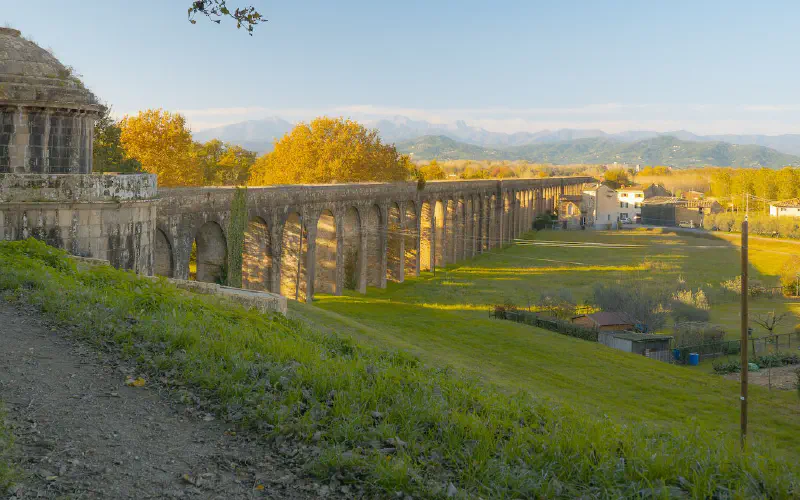
No car required: Walk the 400 arches of Nottolini Aqueduct from Lucca. Guided tour accessible by train. Discover 'Parole d'Oro'. Book now!
Walk the Nottolini with a Naturalist's Eye
Interested in exploring the Acquedotto del Nottolini with someone who can identify the plants, explain the ecology, and show you the details most walkers miss? I offer guided walks that combine photography, natural history, and the kind of close observation that transforms pleasant walks into genuine discovery.

or head to the contact page
Explore Hidden Tuscany
Guided hiking experiences combining expert trail knowledge, professional photography, and wilderness mindfulness.