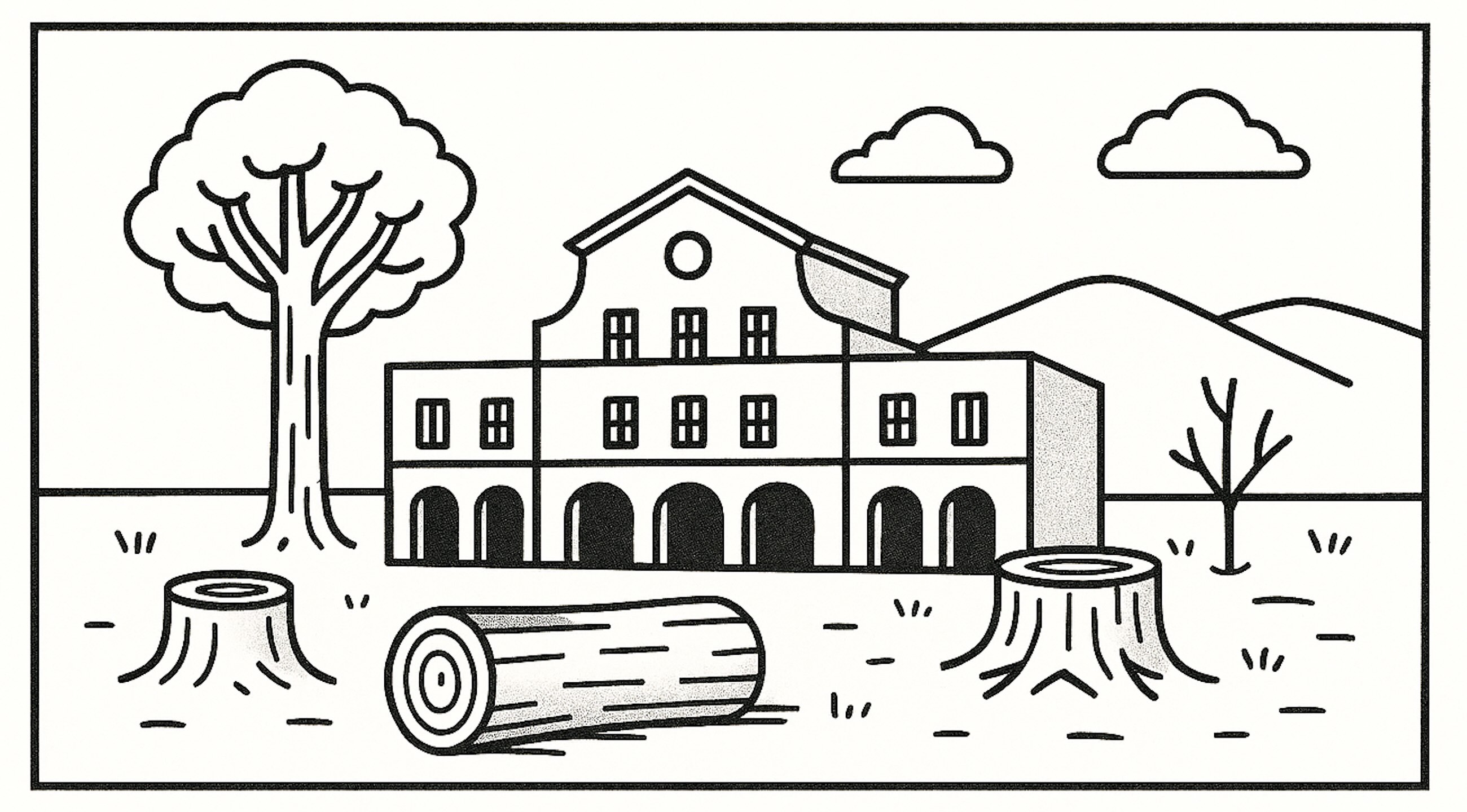
Last Friday, I attended an event at the Museo di Storia Naturale di Calci that challenged something I’ve heard repeated countless times: that Italy has more forests now than at any point since World War II.
The event featured journalist and activist Linda Maggiori discussing forest conservation and the screening of “Boschi Toscani: una scomoda verità” (Tuscan Forests: An Inconvenient Truth), produced as part of WWF’s regional project “Forests For Life Toscana.”
What I learned there matters to anyone who cares about the landscapes I guide through.
The Reforestation Narrative vs. Recent Data
The statement about forest increase since WWII is technically accurate when you look at the long historical arc. Post-war agricultural abandonment and migration from mountains to cities did allow forests to reclaim previously cultivated land across much of Italy, including Tuscany.
But that narrative obscures a more recent and troubling trend.
As Maggiori explained, when you examine the data from recent years—not the century-long trend, but what’s happening now—Italy and Tuscany have been losing forest hectares. The “more forests than ever” story has become a convenient talking point that prevents people from recognizing current forest loss.
This matters because it shapes policy, public perception, and the urgency with which we approach forest protection. If everyone believes forests are expanding, there’s less political will to protect what exists or to scrutinize what’s driving current losses.
Global Forest Watch: Making Forest Change Visible
Maggiori encouraged attendees to explore Global Forest Watch, a free platform developed by the World Resources Institute that uses satellite data to track forest change worldwide in near real-time.
I’ve since spent time with the platform, and it’s remarkable. You can zoom to specific regions—including the areas I guide through regularly—and see tree cover loss and gain data from 2001 to present. The data distinguishes between different drivers of loss: wildfire, logging, agriculture, infrastructure development.
In 2020, Italy had 7.0 million hectares of natural forest, extending over 23% of its land area. But the platform also reveals that the country has been experiencing ongoing tree cover loss, contradicting the simplistic “reforestation success story” narrative.
For anyone who works in these forests—guides, researchers, foresters, photographers—this kind of data accessibility matters. It allows us to move beyond anecdotes and general impressions to understand what’s actually happening to specific landscapes.
The tool isn’t perfect. It doesn’t distinguish between natural forest and tree plantations, and it can’t always differentiate co-located drivers. But it represents a significant step toward transparency in forest management and conservation.
Fondo Forestale Italiano: A Different Approach to Forest Protection
The second half of the event featured a representative from Fondo Forestale Italiano explaining their work, and this is where I want to focus attention.
Founded in 2018 and restructured as a foundation in 2023, Fondo Forestale Italiano takes an approach to forest conservation that differs fundamentally from typical reforestation projects.
They don’t just plant trees and walk away. They acquire land—through purchase, donation, or bequest—and commit to maintaining it as natural forest permanently.
This distinction is crucial. As their representative explained, Italy has thousands of hectares that were reforested in the past but then abandoned, leading to failure. Seedlings need protection from wild boar, irrigation during establishment, shrub control—ongoing care that many reforestation projects don’t budget for or commit to long-term.
More significantly, Fondo Forestale Italiano’s statutes legally prohibit commercial exploitation of the forests they protect. No cutting for timber, no biomass harvesting for energy production. The forests are maintained in their natural state, allowed to develop according to ecological processes rather than economic imperatives.
This matters in the current Italian policy context. The “Testo Unico sulle foreste e sulle filiere forestali” (Consolidated Act on Forests and Forestry Chains) interprets forests primarily as renewable energy sources—firewood and biomass. Combined with public incentives for biomass-fueled power plants, this creates significant pressure on Italian forests from industrial interests seeking to profit from those incentives.
Fondo Forestale Italiano operates through crowdfunding specific projects—each piece of land is presented as a project with detailed budget (purchase, fencing, planting or protection, ongoing care). If the project raises sufficient funds, they proceed; if not, the funds can be redirected or the project waits.
They’re currently working to protect the Bosco delle Sette Valli in Marsciano, Umbria—90 hectares of forest crossed by the Fersinone torrent, which maintains high naturality and supports 7-8 fish species in an area where most waterways have been degraded.
Why This Matters to a Hiking Guide
Someone might ask: why does a hiking guide care about forest policy and conservation initiatives?
Because the landscapes I guide through aren’t static postcards. They’re living systems under various pressures, and their future depends on the decisions being made now.
The forests at Acquerino, the beech woods of the Apennines, the chestnut groves and Douglas fir stands that I walk through weekly—these places exist within a larger context of land use policy, economic incentives, and conservation priorities.
When I bring clients into these environments, I want to offer more than just navigation and identification of species. I want to provide context about what these places are, how they came to be, what threatens them, and what’s being done to protect them.
Understanding forest dynamics, policy pressures, and conservation approaches makes me a better guide. It allows me to answer questions beyond “what’s that tree?” to address “why does this forest look like this?” and “will this still be here in twenty years?”
Friday’s event reminded me why staying engaged with these conversations matters. The forests I love and work in daily aren’t guaranteed to remain as they are. Their protection requires awareness, advocacy, and support for organizations like Fondo Forestale Italiano that are doing the difficult work of permanent conservation.
Looking at Data, Supporting Action
If you’re interested in forest conservation—whether because you hike in these environments, photograph them, or simply care about biodiversity and climate—I’d encourage two actions:
First, explore Global Forest Watch. Look at the regions you care about. Examine the drivers of forest loss. Understand what the data shows versus what the general narratives claim.
Second, consider supporting Fondo Forestale Italiano. They operate through crowdfunding specific projects, and if you pay taxes in Italy, you can donate your 5x1000 (CF: 91030740608) at no cost to yourself—the Italian State directs five per thousand of your tax to the organization.
The work of protecting forests is concrete, specific, and ongoing. It requires money, land acquisition, long-term commitment, and legal protection from commercial exploitation.
These aren’t abstract environmental issues. They’re questions about what the landscape of Tuscany and Italy will look like for the next generation, and whether the wild places that still exist will remain wild or be converted to other uses.
As someone who spends most of my working life in these forests, I have a stake in those questions. And so, if you care about these landscapes, do you.
Explore Hidden Tuscany
Guided hiking experiences combining expert trail knowledge, professional photography, and wilderness mindfulness.
Latest posts
 4 March 2026
Galium Aparine: Cleavers in Tuscan Hedgerows
4 March 2026
Galium Aparine: Cleavers in Tuscan Hedgerows 3 March 2026
Umbilicus Rupestris: Wall Pennywort in Tuscany
3 March 2026
Umbilicus Rupestris: Wall Pennywort in Tuscany 3 March 2026
Laurus Nobilis: Bay Laurel in Tuscan Landscapes
3 March 2026
Laurus Nobilis: Bay Laurel in Tuscan Landscapes 2 March 2026
Guided Tours for Exploring Marble Quarries in Apuan Alps
2 March 2026
Guided Tours for Exploring Marble Quarries in Apuan Alps 26 February 2026
Photographing Nottolini Aqueduct: Light & Geometry
26 February 2026
Photographing Nottolini Aqueduct: Light & Geometry