Last updated 23 April 2026
Truffle hunting is one of the most searched nature experiences in Tuscany.
Type the words into any travel platform and you will find hundreds of options—half-day outings, farm visits, dinners with freshly shaved truffle, dogs working through the undergrowth while you follow with a basket.
It looks like the perfect combination of countryside, tradition, and exclusivity.
And sometimes it is exactly that.
But not always.
Before you book, it is worth understanding how truffle hunting actually works—and what questions to ask.
How Truffle Hunting Really Works
The truffle—Tuber spp.—is a subterranean fungus.
It grows entirely underground, in a mycorrhizal relationship with specific trees: primarily oak, hazel, and linden at lower elevations; pine and larch in alpine zones.
Unlike mushrooms, which fruit above ground and can be spotted by any observant walker, truffles are completely invisible to human senses.
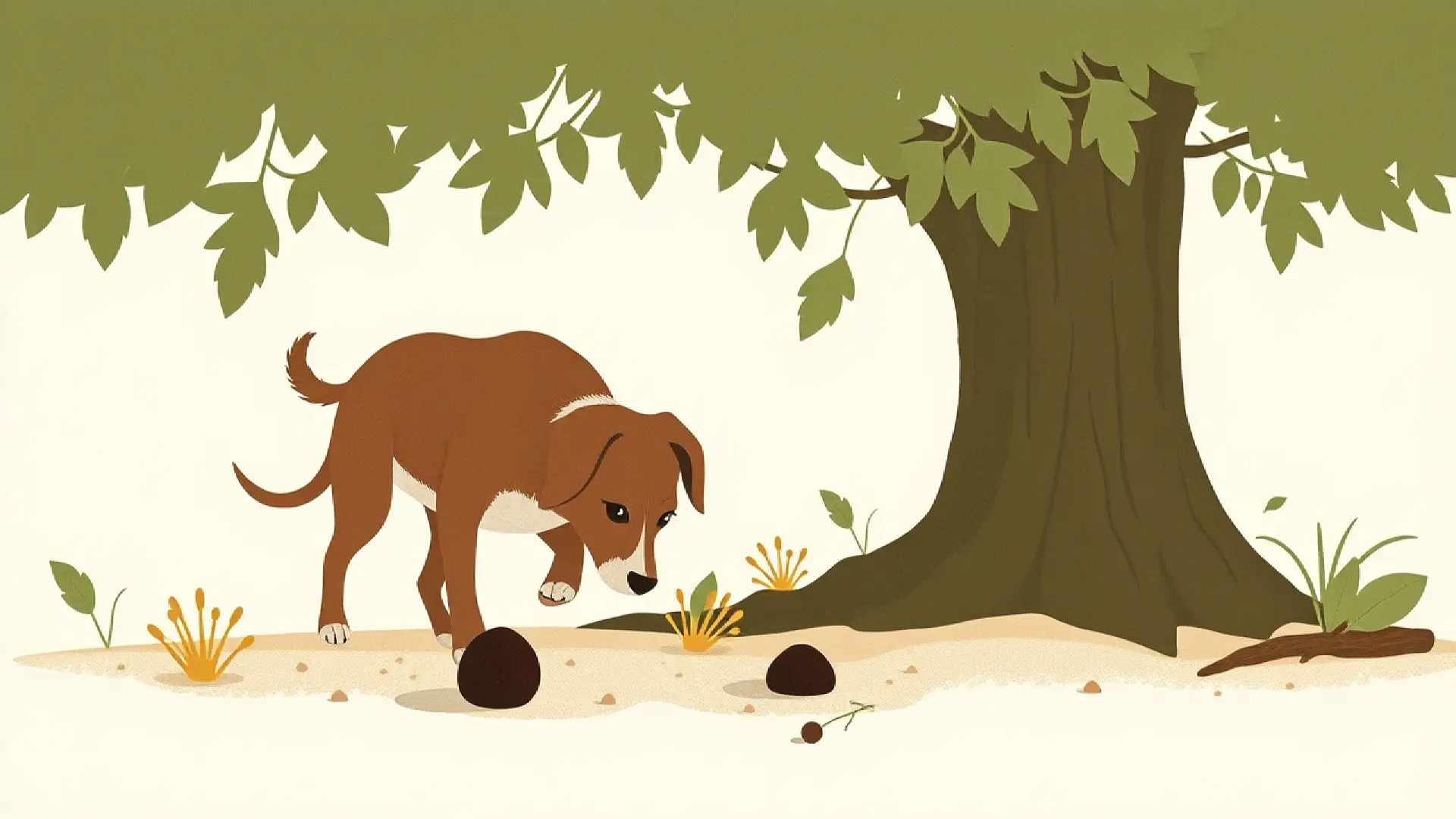
The only way to find them is through a trained dog.
The lagotto romagnolo is the traditional Tuscan breed for this work, though other dogs are used. Training a truffle dog takes years. A good truffle dog is a working animal with a specific and irreplaceable skill.
The hunter follows the dog, reads its signals, and excavates carefully when the dog indicates—removing the truffle without damaging the surrounding mycelium, so that future seasons are not compromised.
This is a genuine craft, passed down in families, requiring intimate knowledge of specific territories built up over decades.
Seasonality: Truffle Is Not Always Available
This is the practical detail that tourism marketing sometimes glosses over.
Tuscan truffles have specific seasons:
- Black truffle (Tuber melanosporum) — December through March
- White truffle (Tuber magnatum) — October through December, and only in limited areas of Tuscany; the primary Italian production zones are Piedmont and Umbria
- Scorzone (Tuber aestivum, summer truffle) — May through August; more widely available but less aromatic than the prized winter varieties
- Bianchetto (Tuber borchii) — January through April; common in coastal Tuscany
If someone offers you a white truffle experience in July, ask questions.
The honest answer is that Tuscany’s prime white truffle territory is limited, and the season is short.
The Authenticity Question
Many visitors report asking a question that has no comfortable answer: how do I know the truffle was actually found, rather than placed?
This is not a paranoid question. It reflects a real tension in experiential tourism.
The commercial pressure on truffle experiences is significant. Groups need to leave satisfied. A dog that has an off day, or a forest that simply hasn’t produced this week, creates a problem for an operator who has taken a booking fee.
An honest truffle guide will tell you clearly:
- Some days the dog finds nothing
- The territory determines what’s possible, not the booking
- You may walk for two hours and return empty-handed
That is what a genuine experience looks like.
If the find is guaranteed, or if the truffle appears with suspicious ease and perfect timing, it is worth reflecting on what you are actually paying for.
A staged encounter is not truffle hunting. It is theatre in a forest.
What I Offer Instead—And Why I Am Honest About It
I want to be direct here: I am a mushroom foraging guide, not a truffle hunter.
I do not work with truffle dogs. I do not guide truffle hunts.
What I offer is wild mushroom foraging through the forests of the Tuscan Apennines—porcini, chanterelles, black trumpets, caesars mushroom, and dozens of other species depending on season and terrain.
I mention this not to dismiss truffle hunting, which in its genuine form is a remarkable tradition worth experiencing.
I mention it because the two activities share a search space but are fundamentally different experiences.
And because the contrast is worth understanding clearly before you decide what you actually want.
The Fundamental Difference: Control
Here is the most honest way I can frame it.
Truffle hunting has a fixed actor at its centre: the dog. A highly trained animal with a specific skill is doing the essential work. Your role is to follow, observe, and appreciate. The outcome depends almost entirely on the dog’s nose and the day’s conditions.
Wild mushroom foraging places the knowledge at the centre. Reading the forest—soil indicators, tree associations, seasonal timing, micro-habitat preferences—is what leads you to productive areas. Nothing is guaranteed. The forest decides what it offers on any given day.
David Arora in Mushrooms Demystified describes foraging as an act of learning to read the environment as a system. Every plant, every tree species, every change in soil texture is information.
When we find a porcini together, it is because we read the forest correctly.
There is no placing a porcini under a log thirty minutes before arrival.
Either the mycorrhizal network has produced, given the rainfall and temperature of the past two weeks, in the specific soil conditions under the right tree—or it has not.
That is not a limitation. That is the point.
The value of genuine foraging is precisely its refusal to be scripted.
If You Still Want to Do Truffle Hunting
I respect the choice.
Here is what separates a legitimate truffle experience from a tourist package:
Ask whether the guide works a territory they own or have access rights to. A serious truffle hunter protects their ground and does not share it lightly.
Ask about the dog’s age and training history. A truffle dog is an investment measured in years, not a prop.
Ask what happens if nothing is found. The honest answer is: you still pay, because the expertise, the dog, and the time are the product—not the truffle itself.
Ask about the specific truffle species in season. If they cannot answer precisely, that tells you something.
The search volume for truffle hunting in Tuscany is enormous, and not all operators serving that search are equally honest about what they are selling.
What Both Experiences Share
Both truffle hunting and mushroom foraging, at their best, are forms of the same thing: learning to be in the forest with attention.
The dog teaches this with its nose. The guide teaches this with knowledge built over years of observation.
Both practices require slowing down, moving differently through terrain than you would on a standard trail, reading subtle signals that are invisible to someone passing through quickly.
Both connect you to food systems, ecological relationships, and seasonal patterns that most visitors to Tuscany never encounter because they are looking at the landscape rather than being inside it.
If you want to understand Tuscany as an ecosystem rather than a backdrop, either path leads somewhere worth going.
My path is the forest on its own terms.
No dogs. No guarantees. No placed mushrooms.
Just the forest, the season, and what the forest decides to offer.
Everything you need to know about guided mushroom foraging in Tuscany is here.
Frequently asked questions
Ready to move from photos to field identification?
Experience these fungi firsthand on a guided autumn hike through Tuscan woodlands — learn professional identification techniques, understand their role in the ecosystem, and photograph your own finds.
Attention!
While the content of this blog post is aimed at providing you with information as accurate as possible, it should be treated as what it is: simply a blog post on the internet.
Mushroom identification should only be performed by experts, as a mistake can lead to dire consequences. Attempting to identify a mushroom on your own, without prior experience, based solely on the content of this blog post is strongly discouraged.