Most areas of Tuscany offer one landscape to trek through.
Pistoia offers four.
Within an hour of the city center, you can choose between high Apennine ridges, dense protected forest, open mountain plateaux, and Italy’s largest inland wetland.
This terrain diversity is unusual—and largely unknown outside the region.
The word “trekking” captures something important here.
This is not a single-trail destination for a single type of walker.
It is a base from which multiple trekking experiences radiate in different directions, each demanding different footwear, different preparation, and offering a genuinely different encounter with the Tuscan landscape.
What follows is a guide to the terrain—and how to move through it.
Table of Contents
- High Apennine Trekking
- Forest Trekking: Acquerino and the Reserve Network
- Svizzera Pesciatina: Hill Trekking in the Quiet Valleys
- Ridge Trekking: Calvana and the Wild Horses
- Wetland Trekking: Padule di Fucecchio
- Choosing Your Trekking Day from Pistoia
High Apennine Trekking
The high Apennines north of Pistoia represent classic mountain trekking.
This is terrain that demands preparation—layers, proper footwear, and weather awareness.
The rewards are proportionate.
Monte Gennaio and the Ridge Walks
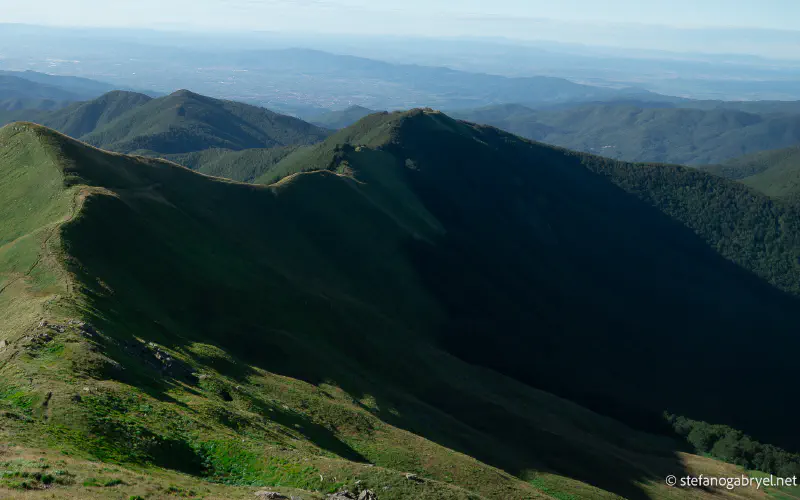
Monte Gennaio sits on the Tuscan-Emilian Apennine ridge.
The approach routes involve 600-800 meters of elevation gain and 4-6 hours round trip.
The summit delivers 360-degree views across Tuscany and Emilia-Romagna.
What makes this route interesting as a trekking experience—beyond the destination—is the terrain transition.
You move through chestnut and beech forest, then into high meadows, then onto exposed rocky ridge.
Three different ecosystems within a single morning.
Spring and early summer bring extensive wildflower displays on the upper slopes.
Autumn transforms the beech forest below into a full color progression from gold to deep amber.
Book a private guided ascent of Monte Gennaio. 360° summit views & expert trekking from Pistoia, Florence & Lucca. Reserve your mountain tour now!
Lago Scaffaiolo and Corno alle Scale
Further north, the trekking becomes more committed.
Corno alle Scale reaches 1,945 meters—the highest point in this section of the Apennines.
But the destination that justifies the effort for most trekkers is Lago Scaffaiolo: a glacial lake at 1,775 meters, cradled in a cirque below the summit.
The landscape here feels genuinely alpine—rare in the Tuscan Apennines.
Plan 5-7 hours for a comfortable round trip.
Weather changes quickly at this elevation. See my article on layered clothing for mountain trekking before heading up.
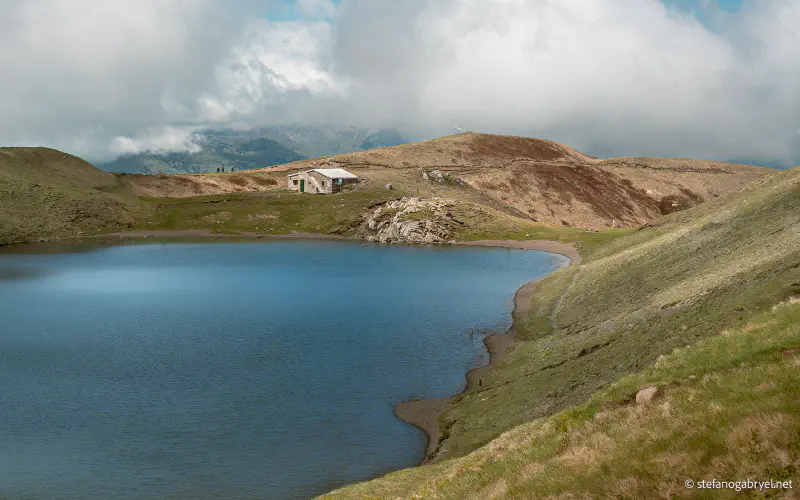
Book a private guided hike to Scaffaiolo Lake. 360° Apennine views & Rifugio visit. Expert tours from Lucca, Pistoia & Pisa. Reserve your trek!
Forest Trekking: Acquerino and the Reserve Network
Thirty minutes from Pistoia, a different kind of trekking begins.
The Acquerino reserve network doesn’t ask for elevation gain or technical confidence.
It asks for attention.
These are old forests—oak, chestnut, beech—where the trail is less important than the ability to read what surrounds it.
Riserva Naturale Biogenetica di Acquerino and Riserva Naturale Acquerino Cantagallo function as one continuous protected landscape, despite belonging to two different municipalities.
The trails range from easy meadow loops—suitable for families with young children—to longer forest routes with gentle elevation gain.
For mushroom trekkers, autumn at Acquerino is exceptional.
The habitat diversity—stream valleys, mixed broadleaf forest, high beech groves, mountain meadows—supports a wide range of species across the season.
I’ve written about Acquerino at length here.
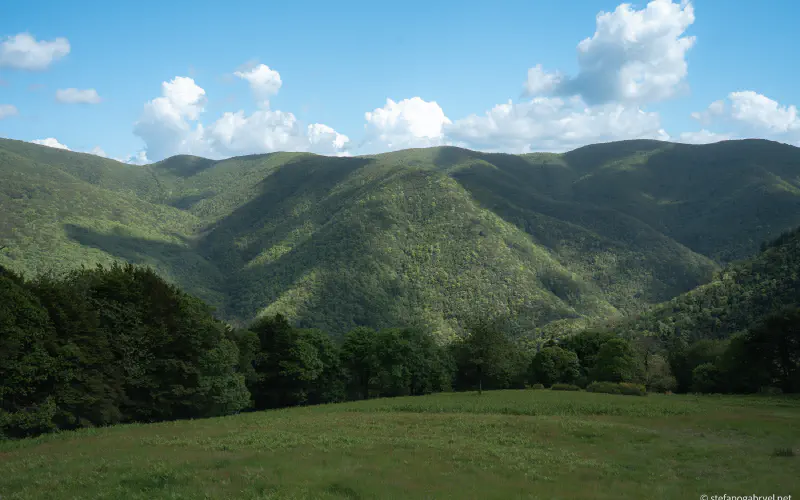
Book a private guided hike in Riserva Acquerino-Cantagallo. Expert trekking tours from Pistoia, Prato & Florence. Escape the crowds—reserve your tour!
Svizzera Pesciatina: Hill Trekking in the Quiet Valleys
Between Pistoia and the Pescia valley, the landscape shifts again.
The Svizzera Pesciatina—the “Swiss-like” hills of the Pescia area—offers a trekking character unlike either the high Apennines or the protected reserves.
This is cultivated, intimate landscape: wooded ridges giving way to valleys, small farms, chestnut groves, and the particular quiet of a region that receives very few visitors.
Trekking here is unhurried by nature.
The terrain rewards a slow pace and a willingness to follow paths that don’t always appear on standard maps.
I will be writing a dedicated article about the Svizzera Pesciatina—it deserves more space than this overview allows.
Ridge Trekking: Calvana and the Wild Horses
Between Prato and Florence—forty-five minutes from Pistoia—the Calvana ridge offers something that the high Apennines and the forest reserves do not: open sky in every direction, and wild horses.
A semi-wild herd roams the upper plateau of the Calvana.
They are not managed. They are not fenced.
They move across the open grassland on their own schedule.
The trekking on the Calvana ridge is moderate in difficulty. The lower trails pass through mixed oak and chestnut woodland. The ridge itself is open grassland with long views across Prato, Florence, and the surrounding valleys.
Monte Maggiore is the highest point. Reachable within a morning, with time on the plateau.
The combination of open ridge trekking, the chance of a genuine wildlife encounter, and the proximity to two major cities makes this one of the most rewarding—and underused—trekking destinations in the region.
I’ve written a full guide to trekking Calvana and Monte Maggiore here.
Wetland Trekking: Padule di Fucecchio
Here the terrain changes entirely.
No elevation gain. No forest trails. No mountain views.
The Padule di Fucecchio is Italy’s largest inland wetland—a nature reserve in the Valdinievole, between Pistoia and Florence, reachable in under forty minutes from the city.
Trekking here means moving along levee paths and boardwalks through reed beds, open water, and flooded meadows.
The experience is unlike anything else within reach of Pistoia.
The Padule is a major staging point for migratory birds. Herons, egrets, and waterfowl are present year-round. Autumn and spring migrations bring species that pass through no other part of Tuscany.
For anyone who treks with a camera, the light over open water—particularly in the early morning—is extraordinary.
The pace is different here. There is nowhere to climb toward.
The attention goes horizontal, not vertical.

I will be writing a dedicated article about the Padule di Fucecchio. It occupies its own category of Tuscan nature experience entirely.
Choosing Your Trekking Day from Pistoia
The practical advantage of Pistoia as a trekking base is not just proximity.
It is the range of choices available from a single location.
A fit trekker looking for mountain terrain heads north to the Apennines. A half-day trekker with children goes to Acquerino. Someone seeking open ridge and wildlife drives thirty minutes south to the Calvana. A birdwatcher with a camera makes for the Padule before dawn.
None of these require more than an hour by car.
The city itself—cathedral, medieval center, good food—is waiting when you return.
Pistoia doesn’t ask you to choose between cultural Tuscany and wild Tuscany.
It offers both from the same address.
Pistoia as a Regional Base
Pistoia’s position in the Tuscan landscape makes it more than a local trekking hub.
The cities within easy reach are themselves starting points for entirely different trekking territories.
Prato sits twenty minutes away—and from Prato, the Calvana ridge and the Bisenzio valley open up a completely separate network of trails.
Lucca is forty minutes west. The trails around Monte Pisano, the Nottolini Aqueduct walk, and the Serchio valley are all within reach of a Lucca base.
Montecatini Terme is twenty minutes south and sits at the edge of the Valdinievole—the same territory that leads toward the Padule di Fucecchio and the Pescia hills.
A trekker based in Pistoia for a week can cover terrain that would take three separate trips to access from Florence.
This is the argument for Pistoia that no guidebook makes—not because it isn’t true, but because guidebooks rarely think in terms of trekking logistics.
For a broader look at nature activities across the Pistoia area—including family-friendly options—see my full outdoor guide.
Plan Your Trekking Near Pistoia
Looking for a guided trekking experience—from mountain ridge to wetland boardwalk? Book a consultation call to discuss the terrain, difficulty, and timing that fits your trip.

or head to the contact page
Explore Hidden Tuscany
Guided hiking experiences combining expert trail knowledge, professional photography, and wilderness mindfulness.