After hundreds of hikes through Tuscan forests, there are still mushrooms that stop me in my tracks.
Sparassis crispa—the cauliflower mushroom, or “fungo cavolfiore” in Italian—is one of them.
Not because it’s particularly rare, though it’s certainly less common than porcini or parasols.
Not because it’s difficult to identify—quite the opposite, actually.
It’s because when you encounter one for the first time, your brain struggles to process what you’re seeing.
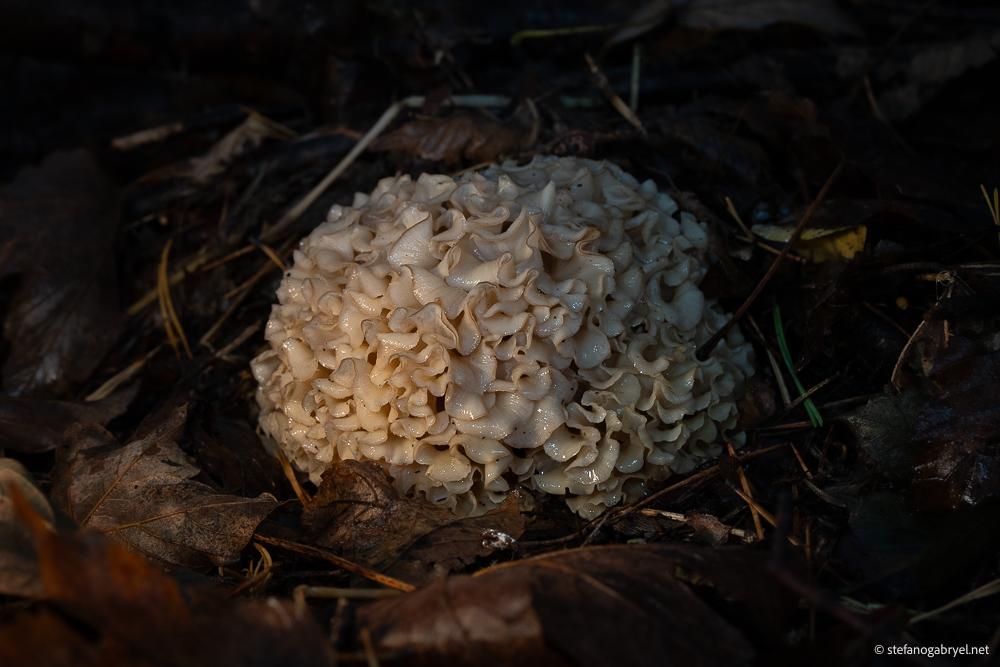
There, at the base of a pine tree, sits what appears to be a pale yellow-cream brain, or a head of cauliflower, or a sea coral that somehow ended up in the mountains.
It looks so unlike a typical mushroom that many people walk past without recognizing it as fungal at all.
And that’s a shame, because Sparassis crispa represents a triple reward: unmistakable identification, excellent eating, and the genuine thrill of discovering something truly spectacular.
What You’re Actually Looking At
Sparassis crispa belongs to a small genus of fungi that look nothing like the typical cap-and-stem mushroom form.
Instead of caps and gills, you get a mass of flattened, ribbon-like branches arranged in tight rosettes.
The overall structure is roughly spherical or brain-like, typically 10-40 centimeters in diameter, though exceptional specimens can reach 60 centimeters or more.
Color ranges from pale cream to butter yellow, sometimes with slight ochre tones on older specimens.
The branches are thin, wavy, and crisp-looking—hence the “crispa” in the scientific name, meaning curled or wavy.
The whole thing emerges from a short, thick, root-like base that connects to tree roots underground.
This isn’t a mushroom that grows scattered across the forest floor—each Sparassis is anchored to a specific tree’s root system.
Weight can be substantial.
A good-sized Sparassis might weigh 1-3 kilograms, occasionally more.
This is a mushroom that fills a basket all by itself.
The Pine Connection: Where to Find It
Unlike truly mycorrhizal mushrooms that form mutually beneficial partnerships with tree roots, Sparassis crispa is a parasite and brown rot fungus.
It attacks the roots and heartwood of living conifers, eventually weakening and killing its host tree.
In Tuscany, I find it almost exclusively associated with pine trees, particularly Pinus pinaster (maritime pine) and Pinus pinea (stone pine).
The mushroom grows at the base of living pines or from their root systems, often appearing to emerge directly from the ground near the trunk.
The fungus initially infects living trees through wounds in the roots, causing brown cubical rot that progresses from the roots into the heartwood of the lower trunk.
After the tree dies, Sparassis can continue living saprotrophically on the dead wood and stumps, which is why you’ll sometimes find it fruiting for years in the same location.
Occasionally you’ll find it on stumps or from buried roots of trees that have been cut, but the classic presentation is nestled against a living (often stressed or declining) pine’s base.
This pine specificity as a host makes searching more targeted:
If you’re hunting Sparassis, focus your attention on pine forests and the immediate vicinity of individual pine trees.
Mixed forests are less productive unless they have substantial pine components.
Pure beech or oak forests won’t host Sparassis at all.
Habitat characteristics I’ve noticed:
- Well-drained, sandy or acidic soils (typical pine habitat)
- Mature pine stands rather than young plantations
- Often the same trees produce Sparassis year after year if the mycelium remains healthy
- Elevations from sea level to mid-mountain zones where pines thrive
Seasonality runs late summer through autumn (August-November), with peak fruiting in September and October following good rainfall.
Unlike some mushrooms that fruit prolifically after rain and then disappear, individual Sparassis specimens persist for weeks, growing larger as they mature.
Identification: Genuinely Foolproof
Here’s the beautiful thing about Sparassis crispa: there is nothing else it can be confused with.
No toxic lookalikes exist.
No similar species grow in the same habitat.
If you find a large, cream-colored, cauliflower-like mass of wavy ribbons at the base of a pine tree, you’ve found Sparassis crispa.
Key identification features:
- Form: Cauliflower or brain-like mass of flattened, wavy branches
- Color: Cream, pale yellow, butter-colored (darkens slightly with age)
- Size: 10-40+ cm diameter
- Habitat: Base of pine trees or from their root systems
- Texture: Crisp, somewhat brittle when fresh
- Base: Thick, root-like attachment point
The only potential confusion might be with Sparassis brevipes (also called rooting cauliflower), which is similar but tends to have a more pronounced rooting base and slightly different branching.
However, both species are edible and choice, so even this confusion is inconsequential.
For beginner foragers, Sparassis is ideal because:
- Identification is visual and straightforward
- No dangerous lookalikes exist
- The distinctive appearance eliminates uncertainty
- Once you’ve seen one, you’ll never mistake it for anything else
Culinary Value: Worth the Search
Beyond the visual spectacle, Sparassis crispa justifies the search through excellent eating quality.
The flavor is mild, slightly nutty, with pleasant earthy notes.
It’s not as intensely flavored as porcini, but the texture is what makes it special.
When properly prepared, the ribbon-like branches have a pleasing firmness with slight crispness, somewhat reminiscent of egg noodles or al dente pasta.
This texture holds up well to cooking and provides interesting mouthfeel.
Traditional preparation methods:
Cleaning is the first challenge:
The intricate branching structure traps dirt, pine needles, and forest debris.
You cannot simply brush it off like you might with a porcini cap.
- Cut the mass into manageable sections
- Rinse thoroughly under running water, separating the branches to remove debris
- Some people soak briefly in salted water to encourage any hiding insects to emerge
- Pat dry or let drain before cooking
Cooking approaches:
- Sautéed with garlic and parsley: The classic Italian preparation that lets the texture shine
- Added to pasta: Cut into strips and tossed with pasta, olive oil, and garlic
- In risotto: Diced and added toward the end of cooking
- Soup ingredient: Adds both flavor and interesting texture
- Breaded and fried: Larger pieces can be treated like cutlets
What works well:
Simple preparations that don’t overwhelm the delicate flavor.
Garlic, olive oil, parsley, butter—these enhance rather than dominate.
What to avoid:
Heavy tomato sauces or strong spices that mask the mushroom’s character.
Overcooking, which makes the texture mushy rather than pleasantly firm.
The Experience of Discovery
Here’s what I tell people about finding Sparassis: the discovery itself is half the reward.
When you’re walking through a pine forest, eyes scanning for mushrooms, your brain is calibrated to spot familiar forms—the dome of a porcini cap, the shaggy cylinder of Coprinus, the orange of Lactarius.
Then suddenly, there’s this alien structure at the base of a tree.
Your first reaction might be “what is that?"—not immediately recognizing it as fungal.
The size alone creates impact—finding one good Sparassis can mean several meals, and the visual spectacle makes it memorable in ways that yet another basket of porcini might not be.
Why It’s Less Famous Than It Deserves
Given that Sparassis crispa is:
- Easy to identify safely
- Excellent eating
- Visually spectacular
- Reasonably findable in pine forests
Why isn’t it more celebrated in Italian mushroom culture?
Several factors explain this:
Regional distribution:
Sparassis is less common than truly widespread species like porcini or parasols.
Many foragers in areas without extensive pine forests might never encounter one.
Cultural momentum:
Italian mushroom hierarchy is deeply entrenched.
Porcini occupies the top tier, established species like ovoli and gallinacci fill the second tier, and everything else is somewhat secondary regardless of actual quality.
Breaking into that hierarchy requires cultural shift that doesn’t happen easily.
The cleaning challenge:
While the eating quality is excellent, the cleaning process is genuinely tedious.
For busy foragers or those selling mushrooms commercially, species that can be quickly cleaned and prepared have advantages.
Lack of name recognition:
“Fungo cavolfiore” doesn’t have the same ring as “porcino.”
It’s descriptive rather than prestigious, which affects perception.
My Recommendation
If you’re exploring pine forests in Tuscany during autumn, keep your eyes on the bases of trees.
Not just scanning the open forest floor, but specifically looking at where trunk meets ground.
When you find your first Sparassis crispa:
- Take time to appreciate the structure before harvesting
- Photograph it in situ—the context of the pine tree matters for the image
- Consider taking only what you’ll use and leaving some for spore dispersal
- Remember the location—the mycelium may fruit there again next year
- Budget extra time for cleaning before you can cook it
And recognize that you’ve found something special, even if it’s not porcini, even if Italian mushroom culture doesn’t celebrate it as highly as it might deserve.
The forest contains multitudes, and Sparassis crispa is one of the spectacular ones.
Are you a beginner?
If you’re just beginning to explore mushroom foraging, Geoff Dann’s Edible Mushrooms is the field guide I recommend to all my clients. It’s an excellent starting point for learning safe identification. Read my full review here.
Want to learn in the field? Join me for a hands-on mushroom hunting experience ⬇️ ⬇️ ⬇️ ⬇️
Ready to move from photos to field identification?
Experience these fascinating fungi firsthand on a guided autumn hike through Tuscan woodlands. Learn professional identification techniques, understand ecosystem roles, and capture your own stunning mushroom photography.
Attention!
While the content of this blog post is aimed at providing you with information as accurate as possible, it should be treated as what it is: simply a blog post on the internet.
Mushroom identification should only be performed by experts, as a mistake can lead to dire consequences. Attempting to identify a mushroom on your own, without prior experience, based solely on the content of this blog post is strongly discouraged.
Explore Hidden Tuscany
Guided hiking experiences combining expert trail knowledge, professional photography, and wilderness mindfulness.
Latest posts
 4 March 2026
Galium Aparine: Cleavers in Tuscan Hedgerows
4 March 2026
Galium Aparine: Cleavers in Tuscan Hedgerows 3 March 2026
Umbilicus Rupestris: Wall Pennywort in Tuscany
3 March 2026
Umbilicus Rupestris: Wall Pennywort in Tuscany 3 March 2026
Laurus Nobilis: Bay Laurel in Tuscan Landscapes
3 March 2026
Laurus Nobilis: Bay Laurel in Tuscan Landscapes 2 March 2026
Guided Tours for Exploring Marble Quarries in Apuan Alps
2 March 2026
Guided Tours for Exploring Marble Quarries in Apuan Alps 26 February 2026
Photographing Nottolini Aqueduct: Light & Geometry
26 February 2026
Photographing Nottolini Aqueduct: Light & Geometry