I should be upfront about my perspective.
I’m a tall man in my forties, born and raised in this region. I’ve spent years walking these mountains alone, in every season, in every condition. Tuscany feels safe to me — profoundly safe — in a way that has very little to do with bravery and everything to do with familiarity.
So when someone asks me “is it safe to hike alone in Tuscany?” I want to give an honest answer, not a reassuring one.
The honest answer is: yes, it’s safe in ways that matter, and complicated in ways that most travel advice ignores.
What You Don’t Need to Worry About
Let me start with the fears that bring people to this question, and dismiss the ones that don’t hold up.
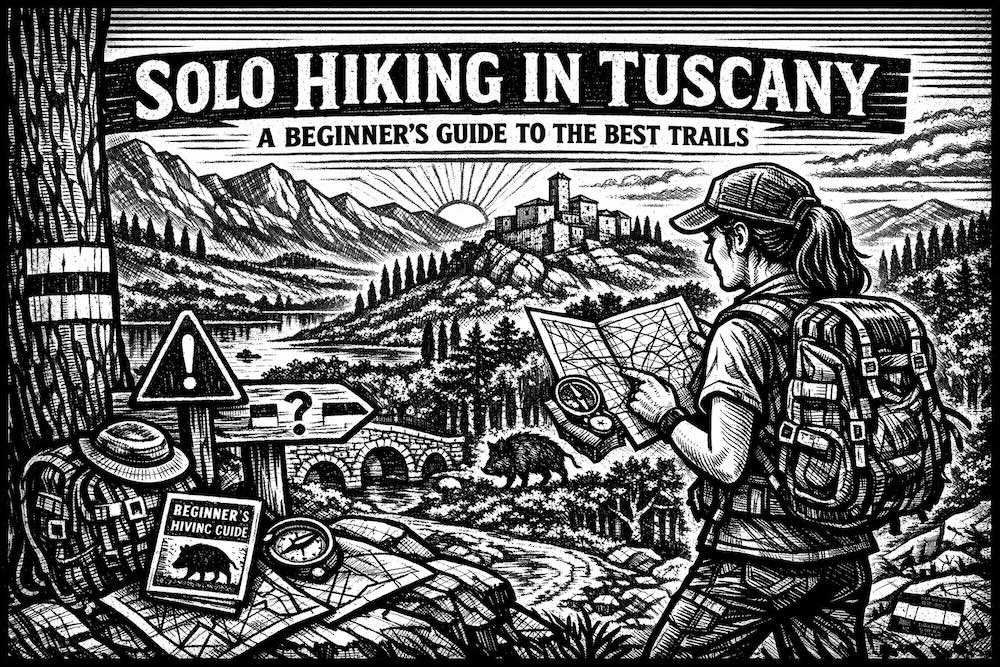
Wildlife won’t hurt you. There are wolves in the Apennines. They avoid humans completely. In years of guiding through wolf territory, I’ve never encountered one on the trail. Wild boar are present — they’re large, they’re loud in the undergrowth, and they will not attack you unless you corner a sow with piglets, which requires extraordinary effort. Snakes exist but are shy and rare on well-trodden paths. The fire salamander is the most dramatic creature you’re likely to see, and it’s entirely harmless.
Violent crime on hiking trails is essentially non-existent. This isn’t me being naively optimistic — it’s a statistical reality. Tuscan mountain trails don’t have a safety problem in the way that some urban areas might. The people you encounter on these paths are other hikers, mushroom hunters, forestry workers, and the occasional mountain biker. Nobody is there to cause trouble.
You won’t be completely isolated. Even on the quieter trails, you’re rarely more than a few hours’ walk from a road or village. This isn’t wilderness in the Patagonian sense. It’s a densely settled, deeply civilised region where the mountains happen to be close to the cities. Mobile phone coverage exists on most ridges and many valleys, though not everywhere.
Tuscany is, by most reasonable measures, a safe place to walk alone.
What You Actually Need to Worry About
The real risks of solo hiking in Tuscany have nothing to do with other people or animals. They’re about navigation, terrain, and your own preparation.
Getting Lost
This is the genuine risk, and it’s more common than anyone admits.
Tuscany’s trail marking system — the red-and-white bands maintained by CAI (Club Alpino Italiano) — works well on major routes. The GEA, the main ridgeline paths, the approaches to popular destinations like Lago Scaffaiolo — these are well-signposted.
But away from the main routes, marking quality drops dramatically.
Paint fades. Trees fall and take markers with them. Junctions that were clear five years ago become ambiguous as vegetation grows in. Side trails appear that aren’t on any map. The trail you’re following confidently at 800 metres becomes a vague suggestion at 1,200 metres.
I know these mountains well enough to read the terrain when markers disappear. A solo visitor, even an experienced hiker, doesn’t have that luxury.
The practical consequences of getting lost in Tuscan mountains are rarely dramatic. You won’t die of exposure in summer — you’ll be uncomfortable and late. But you might spend two extra hours bushwhacking through undergrowth, descend into the wrong valley, or end up on a road far from your car as daylight fades.
That’s not dangerous. But it transforms a good day into a bad one.
Poor Trail Conditions
Not all marked trails are maintained equally. Some paths are pristine. Others haven’t been cleared in years.
Fallen trees across the trail. Sections where erosion has turned a path into a gully. Muddy stretches after rain that require careful footing. Overgrown summer vegetation that obscures the route entirely.
None of this is insurmountable for an experienced hiker. All of it is stressful for someone who doesn’t know whether the difficulty is normal or a sign that they’ve gone wrong.
Weather at Altitude
The Apennine ridge generates its own weather. Fog can materialise in minutes at 1,500 metres, reducing visibility to twenty metres and making trail markers invisible. Summer thunderstorms arrive fast and hit hard at altitude — lightning on an exposed ridge is the one genuinely dangerous situation you can encounter in these mountains.
At lower altitudes — the Nottolini Aqueduct, Ripafratta, most of the Acquerino forest — weather is inconvenient but not dangerous.
Above the treeline, it demands respect and attention.
The Risk Nobody Talks About: Wasted Time
Here’s the thing that doesn’t make it into safety articles but matters enormously for solo travellers.
Planning a hiking day in an unfamiliar region takes time. A lot of time.
Which trail? Which trailhead? Where do I park? How do I read the CAI difficulty rating — is an “E” trail manageable for me or not? Which app has accurate maps for this area? Is there water on the route? Is the path even open, or did a landslide close it last winter?
Every hour you spend researching logistics is an hour you’re not spending in Tuscany.
I watch solo visitors arrive at trailheads with printouts of three different route descriptions, none of which quite match the reality on the ground. They’ve spent their evening reading hiking forums instead of eating dinner in a good restaurant. They’ve worried about the wrong things and missed the things that actually matter — the light at a certain hour, the seasonal behaviour of the forest, the unmarked side path that leads to the best viewpoint.
The practical cost of navigating alone isn’t danger. It’s friction. And friction erodes the experience you came for.
Practical Advice for Solo Hikers
If you’re hiking alone in Tuscany, here’s what actually helps.
Choose Your Trails Carefully
Stick to well-marked main routes, especially on your first few days. The CAI classification system rates trails from T (tourist — easy) through E (escursionistico — moderate) to EE and EEA (expert only). As a solo hiker without local knowledge, T and E-rated trails are your domain. I’ve explained the full marking system here.
Lower-altitude trails are more forgiving. The car-free hikes accessible by train near Pisa and Lucca — the Nottolini Aqueduct, Ripafratta — are ideal for solo visitors because the navigation is simple and help is never far.
Mountain routes above 1,500 metres require more caution alone. Not because they’re technically extreme, but because the consequences of a wrong turn or a weather change are greater when nobody knows your plan.
Tell Someone Your Plan
This is the single most important safety habit for solo hikers, and the one most people skip.
Before you leave, tell someone — your hotel, a friend, anyone — where you’re going and when you expect to return. If your plans change, update them. It’s not dramatic; it’s basic.
Carry the Right Tools
- A charged phone with offline maps. Download the area in advance — coverage is patchy in valleys.
- Water. Mountain springs exist but aren’t guaranteed on every route. Carry more than you think you need.
- A headlamp. Not because you’re planning to walk in the dark, but because getting back late is the most common consequence of navigation errors. It weighs nothing and changes everything.
- Layers. Mountain weather in Tuscany can shift from warm sunshine to cold fog within an hour. My layering guide covers this in detail.
Know Your Limits — And Be Honest About Them
The most dangerous solo hiker isn’t the cautious beginner. It’s the confident intermediate who overestimates their navigation skills.
If you’re an experienced hiker from the Alps or Scandinavia, Tuscan trails will feel straightforward. If your hiking experience is limited to well-signposted national parks, these mountains demand more self-reliance than you might expect.
There’s no shame in choosing the easier trail. A relaxed day on a route you’re confident about is infinitely better than an anxious day on one you’re not.
For Solo Female Hikers Specifically
I’m aware that my experience as a man shapes my sense of safety. The question “is it safe to hike alone?” carries different weight depending on who’s asking.
What I can tell you from guiding solo female clients:
The trails themselves present no gender-specific risks. The people you encounter on Tuscan mountain paths — shepherds, other hikers, forestry workers — are overwhelmingly friendly and helpful. Italian mountain culture is, in my experience, welcoming in a way that feels genuine rather than performative.
The lower-altitude, train-accessible routes are the easiest starting point. Not because the mountains are dangerous for women, but because proximity to towns and public transport provides a baseline of comfort that makes the first solo day less stressful.
Several of my solo female clients have told me the same thing: the first hike alone felt like a bigger step than it turned out to be. By the second day, the anxiety had been replaced by a specific kind of satisfaction that only comes from navigating somewhere unfamiliar under your own power.
If the idea of going alone feels like too much to start with, that’s exactly what a guide is for. One guided day gives you the local knowledge, trail familiarity, and confidence to continue on your own. Think of it as an investment in independence, not a substitute for it.
The Case for a Guide — Even If You’re Capable
I’m a hiking guide, so obviously I have a professional interest here. But the argument isn’t about safety — it’s about quality of experience.
A solo hiker who spends two hours planning, thirty minutes finding the trailhead, and fifteen minutes wondering if they’ve missed a turn will have a decent day.
The same hiker, arriving with someone who knows the terrain, the ecology, the seasonal patterns, and the unmarked paths that lead to the best spots, will have an extraordinary day.
That’s the real difference. Not “can you do it alone” — of course you can. But “will the experience be as rich as it could be?”
For many solo travellers, one guided day at the beginning of a trip transforms every subsequent solo day. You learn how the trail system works, what the markers mean, where the water sources are, how the weather moves through the valleys. You gain a framework that makes independent hiking not just possible but confident.
If you’re considering it, here’s what to look for when choosing a local guide. And for a complete overview of what the region offers on foot, my guide to hiking in Tuscany covers the full picture.
The Mountains Are Waiting
Tuscany is safe enough that the question barely needs asking.
The real question is: do you want to spend your limited time planning logistics, or do you want to spend it walking?
Both are valid. But only one leads to the experience you actually came for.
Planning to Hike Tuscany Solo?
Whether you want a guided first day to learn the terrain, or just honest advice about which trails suit your experience level, book a consultation. No pressure — just practical local knowledge.

or head to the contact page
Explore Hidden Tuscany
Guided hiking experiences combining expert trail knowledge, professional photography, and wilderness mindfulness.