Walk the trails of Riserva Acquerino on a rainy spring evening and you might suddenly stop as you round a bend. There, crossing the forest path, moves something that looks almost artificial. Too boldly patterned to be real.
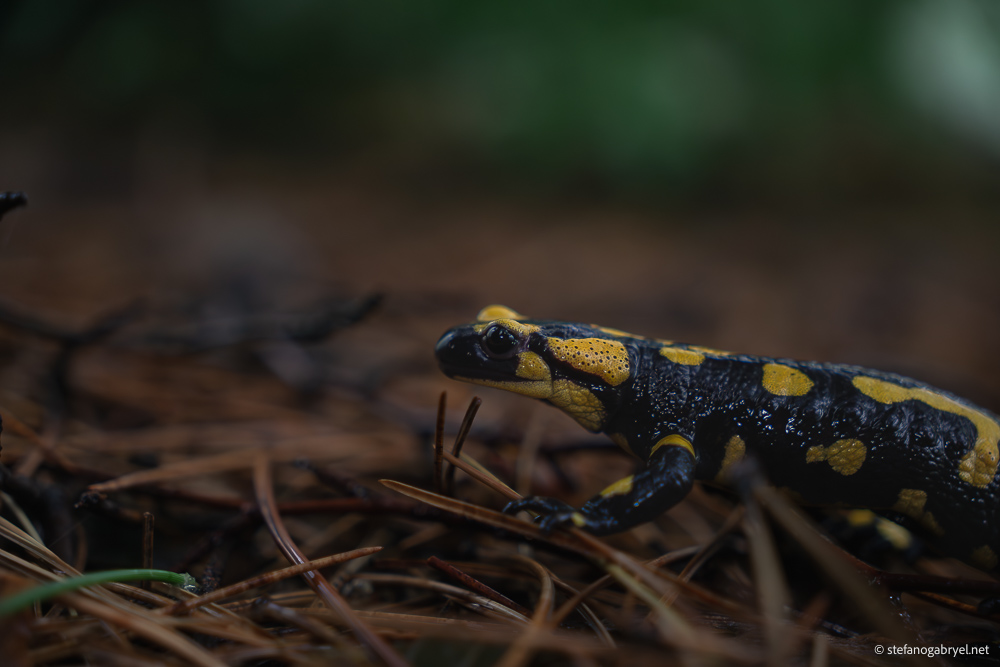
Black skin marked with brilliant yellow spots or stripes. A body about 15–20 centimeters long. Moving with the distinctive slow, swaying gait of a salamander. This is Salamandra salamandra—the fire salamander—one of Europe’s most striking amphibians.
In Tuscany, fire salamanders inhabit the forested mountains of the Apennines. Places like Acquerino provide ideal habitat: dense deciduous forests with clean streams. Altitude between 400-1,200 meters. Abundant moisture and cover. These are the conditions fire salamanders require.
Recognition: Black and Yellow Warning
The fire salamander’s coloration makes identification immediate. The body is black—deep, glossy black. Overlaid with yellow markings that vary dramatically between individuals.
Some specimens show discrete yellow spots scattered across the body. Others display large blotches or irregular patches. Still others have stripe-like patterns. In the Italian Apennine populations (subspecies S. s. gigliolii), the yellow often appears as distinctive stripes running lengthwise down the body.
Occasionally, orange or red replaces or mixes with the yellow. But the basic pattern remains: dark base color with bold, contrasting markings.
The coloration serves a specific function: warning. This is aposematism—honest signaling of toxicity. The bright pattern tells potential predators: “Don’t eat me. I’m poisonous.”
The salamander’s skin secretes toxic compounds. Primarily alkaloids called samandarin. If threatened, the toxin can be expelled from glands along the back and may be sprayed short distances if the animal is severely threatened. It causes burning and irritation to mucous membranes. For small predators, it can be lethal.
For humans, the toxin is an irritant but not dangerous unless ingested. Fire salamanders should generally not be handled. If contact occurs, wash your hands afterward and avoid touching your eyes or mouth.
The body is stout and robust. The head is broad with prominent eyes. The skin appears smooth and moist, not warty like toads. The tail is roughly cylindrical, shorter than the body length. Four legs, each with distinct toes. The overall impression is of a thick-bodied, slow-moving amphibian built for life on the forest floor.
Habitat: Forest Floors and Clean Streams
Salamandra salamandra belongs to the family Salamandridae. This includes newts and several terrestrial salamander genera. The genus Salamandra contains six species. All are found in southern and central Europe, North Africa, and western Asia.
The fire salamander is the most widespread species in the genus. It ranges across most of central and southern Europe. In Italy, it’s found throughout the northern and central Apennines. Not in Sicily or Sardinia. Absent from the Po Valley lowlands. But common in suitable mountain habitat from Liguria to Abruzzo.
The habitat requirements are specific:
- Deciduous or mixed forests (beech, chestnut, oak)
- Altitude typically 250–1,000 meters (higher in southern ranges)
- Clean, cold streams or springs for larval development
- Abundant ground cover (fallen logs, rocks, leaf litter)
- High humidity and shade
- Minimal disturbance
The salamander is nocturnal and secretive. During the day, it hides beneath logs, rocks, or in crevices. It emerges at night to hunt. Or during daytime on rainy days when moisture levels are high.
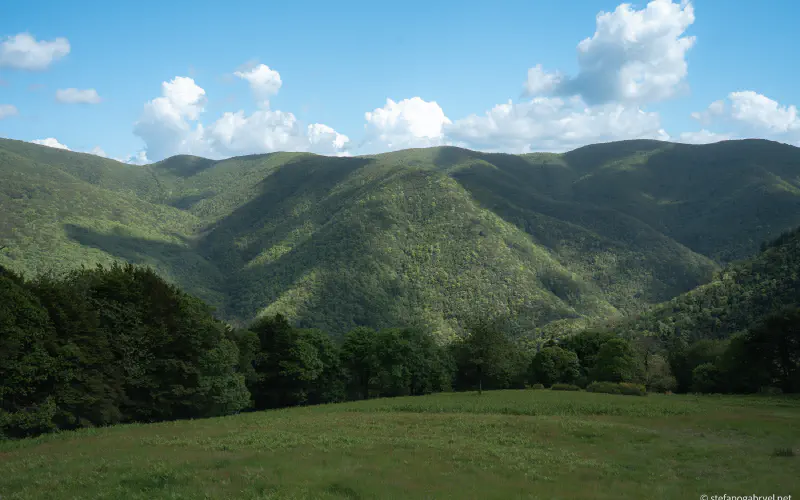
In the Tuscan Apennines, fire salamanders thrive in old-growth forests. Particularly those with mixed beech and chestnut. The forests at Acquerino, with their streams fed by mountain springs, provide ideal conditions. The abundant fallen logs and rocks offer countless hiding places. The canopy keeps ground humidity high. The streams remain cold and clean year-round.
Life History: Unique Reproductive Strategy
Most amphibians lay eggs in water. The eggs hatch into aquatic larvae. The larvae eventually metamorphose into terrestrial adults.
Fire salamanders do something different. They’re ovoviviparous. This means the female retains the eggs inside her body. The embryos develop internally, nourished by their yolk reserves. When development reaches a certain stage, the female deposits larvae—not eggs—into water.
The larvae are already well developed when released into the water. They have external gills, functional legs, and can swim and feed immediately. This strategy gives them a significant advantage. They bypass the vulnerable egg stage when mortality is typically highest.
Reproduction follows a seasonal pattern. Mating occurs on land during spring or autumn. The male deposits a spermatophore (sperm packet). The female picks it up with her cloaca. Fertilization occurs internally.
Gestation lasts several months. When ready to give birth, the female seeks a suitable water body. Cold, clean streams or springs. Ponds with no fish (which would eat the larvae). She deposits anywhere from 12 to 70 larvae, depending on her size and condition.
The larvae are carnivorous. They feed on aquatic invertebrates—insect larvae, small crustaceans, worms. Development in the water takes 2-5 months. Eventually, they metamorphose into juvenile salamanders. They leave the water and begin terrestrial life.
Sexual maturity takes 2-4 years. Fire salamanders are long-lived. Individuals commonly reach 10-14 years in the wild. In captivity, individuals have lived for more than 50 years. This longevity is exceptional for amphibians of this size.
Behavior: Slow and Deliberate
Fire salamanders move with characteristic slowness. They’re not built for speed. Their strategy is stealth, camouflage under cover, and chemical defense if discovered.
The hunting method is simple. The salamander moves slowly through leaf litter and ground debris. When prey comes within range, it strikes with surprising speed. The tongue shoots out, capturing the prey. Or the salamander simply snaps with its jaws. The vomerine teeth hold the prey while it’s swallowed.
The diet consists of invertebrates:
- Earthworms (particularly favored)
- Slugs and snails
- Insects and their larvae
- Spiders
- Millipedes and centipedes
- Occasionally small newts or young frogs
Fire salamanders are opportunistic. They eat whatever suitable prey they encounter. In areas where earthworms are abundant, they dominate the diet. In forests with many slugs, slugs become primary food.
Activity patterns follow moisture and temperature. The salamanders are most active when conditions are cool and wet. Spring and autumn nights after rain. During summer heat and winter cold, activity decreases. They retreat to underground refuges where temperature and humidity remain stable.
Individuals often spend their lives within a home range of roughly 100–200 square meters. Studies tracking individuals over years show they return to the same hibernation sites repeatedly. They may spend their entire lives within a small area of forest if conditions remain suitable.
The Mythology: Fire and Folklore
The name “fire salamander” derives from ancient European folklore. People believed salamanders could survive in fire. The name “salamander” was historically associated with the idea of a creature that could live in fire.
The myth had a simple origin. Fire salamanders often hide inside fallen logs. People gathered these logs for firewood. When thrown onto fires, the logs heated rapidly. Salamanders hiding inside crawled out to escape. To observers, it appeared the salamanders came from the fire itself.
Of course, their thin, permeable skin offers no protection from heat. They were simply fleeing certain death. But the myth persisted for centuries. It appears in medieval bestiaries. Alchemists used the salamander as a symbol. The image entered heraldry and literature.
This folklore reflects something important. Fire salamanders have been noticed and named by humans throughout history. Their bold coloration makes them memorable. Their occasional appearance on rainy days brings them into contact with people. They’re not hidden, obscure species. They’re animals that humans have observed and wondered about for millennia.
Conservation: Threats Old and New
Salamandra salamandra is currently classified as Least Concern by IUCN. The species remains widespread and locally common. But this status masks significant concerns.
Habitat loss remains the primary threat. When forests are cleared or degraded, salamander populations disappear. The species requires specific conditions. Old-growth forests with intact stream systems. Remove either element and the salamanders vanish.
Water pollution affects reproduction. Salamander larvae require clean water. Agricultural runoff, industrial pollution, or sedimentation from construction can make streams unsuitable. Even if adult salamanders persist, failed reproduction eventually eliminates the population.
Roads cause direct mortality. Salamanders crossing roads on rainy nights are killed by vehicles. In some areas, this mortality is significant. Especially where roads bisect prime habitat.
Climate change may affect moisture regimes. If summers become drier and hotter, suitable habitat contracts. If precipitation patterns shift, streams may flow differently. Amphibians are particularly sensitive to environmental changes.
But the most serious recent threat is disease. A fungal pathogen called Batrachochytrium salamandrivorans (Bsal) has devastated fire salamander populations in parts of northern Europe. This chytrid fungus infects the skin. It causes deep ulcers and eventual death.
The pathogen was first detected in European fire salamanders in the Netherlands in 2010. Bsal spread through Europe via the pet trade. Infected salamanders were imported from Asia. Within years, some populations declined by over 95%. The fungus continues spreading across the continent.
Italy has not yet seen major Bsal outbreaks. But the threat remains. If the disease reaches Italian populations, consequences could be severe. Fire salamanders have no evolved defenses against this novel pathogen.
This makes every population valuable. Places like Acquerino, with healthy salamander populations in protected habitat, become increasingly important as refugia.
Finding Fire Salamanders
If you want to observe Salamandra salamandra in the wild, timing and conditions matter more than location.
Season: Spring and autumn are best. March through May. September through November. Summer sightings are possible, but salamanders are generally less active. Winter they’re hibernating underground.
Weather: Rain or immediately after rain. Salamanders emerge on wet nights. Or during daytime after heavy rainfall. Dry nights yield few sightings.
Time: Night, or daytime during/after rain. Bring a headlamp or flashlight for night observations. The eyeshine helps spot them.
Location: Forest trails near streams. Salamanders often cross trails when moving between cover. Areas near water attract them during breeding season. Check under logs and rocks during the day (replace carefully).
In Acquerino, fire salamanders are regularly encountered. The dense forests, clean streams, and abundant cover create ideal habitat. Walk the trails on a rainy spring evening. Move slowly. Watch the path ahead. Eventually, if conditions are right, you’ll see that unmistakable pattern.
Observation ethics are important. Don’t handle salamanders unnecessarily. Their skin is permeable and sensitive to chemicals, oils, and heat from your hands. If handling occurs accidentally, wet hands first and keep contact brief. Never remove them from their habitat. Never collect them. Enjoy the encounter, photograph if you wish, then leave them undisturbed.
Book a private guided hike in Riserva Acquerino-Cantagallo. Expert trekking tours from Pistoia, Prato & Florence. Escape the crowds—reserve your tour!
Why This Matters
You might reasonably ask why anyone would write extensively about a salamander.
Because amphibians are indicators. Their permeable skin makes them sensitive to environmental changes. Healthy salamander populations signal healthy forests. Declining populations warn of larger problems.
Fire salamanders, with their specific habitat requirements, indicate forest quality. They need old-growth conditions. Clean streams. Minimal disturbance. Their presence means the ecosystem functions properly.
They also connect us to landscape history. These salamanders survived the ice ages. They’ve lived in these mountains for hundreds of thousands of years. When you encounter one crossing a trail, you’re seeing a creature whose ancestors walked these same forests when glaciers covered the Alps.
That continuity matters. It reminds us that nature isn’t something we visit. It’s a process that predates us and will continue after us. Our role is to avoid breaking what we didn’t build.
Experiencing Salamanders at Acquerino
Riserva Acquerino supports healthy fire salamander populations. The reserve’s protected status prevents habitat degradation. The clean mountain streams provide breeding sites. The extensive forests offer abundant terrestrial habitat.
Walking Acquerino’s trails on a wet spring evening, you enter salamander country. The conditions that make hiking slightly uncomfortable—drizzle, mud, cold—are exactly what salamanders prefer. While you’re wishing for dry clothes, they’re active and hunting.
This is part of what makes naturalist observation valuable. You can’t see wildlife only when conditions suit you. You have to meet them where and when they actually live. Sometimes that means wet clothes and muddy boots.
While I primarily guide mountain hiking and photography expeditions, I’m always engaged with the wildlife we encounter. Salamanders, like plants, help us understand the landscape as something more than scenery.
If you’re interested in exploring Acquerino with someone who can identify what you’re seeing and explain why it matters, that falls directly within my expertise and interests.
Book a private guided hike in Riserva Acquerino-Cantagallo. Expert trekking tours from Pistoia, Prato & Florence. Escape the crowds—reserve your tour!
Explore Hidden Tuscany
Guided hiking experiences combining expert trail knowledge, professional photography, and wilderness mindfulness.