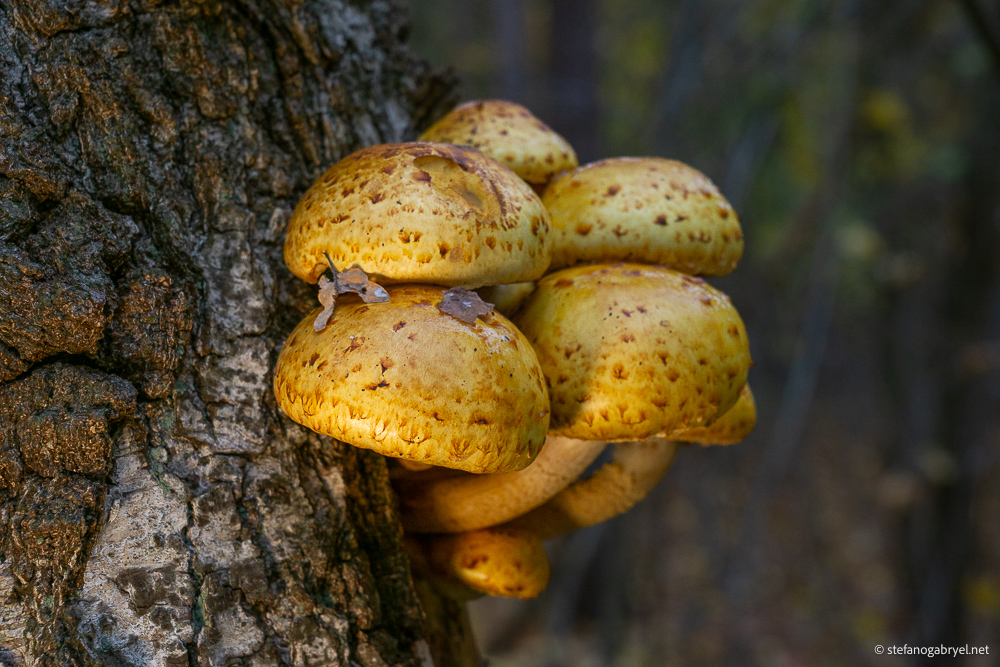
While mushroom hunters often focus on the prized edibles, some of Tuscany’s most visually striking fungi are those we admire rather than harvest. Pholiota squarrosa, known in Italy as “fiocco comune” (common tuft), is one such species—a spectacular saprobic fungus that transforms dead and dying trees into natural sculpture gardens.
A Distinctive Appearance
Pholiota squarrosa is impossible to mistake for anything else once you know what to look for. The entire mushroom—cap, stem, everything—is covered in recurved, shaggy scales that give it a distinctly spiky, almost aggressive appearance. These scales are typically darker brown against a paler yellowish background, creating a striking two-tone pattern.
The caps can range from 5-15 cm in diameter, often growing in dense, overlapping clusters that seem to erupt from the wood. The gills beneath start pale yellow and gradually turn rust-brown as the spores mature—a characteristic common to many Pholiota species. When young, a partial veil connects the cap edge to the stem, leaving a ring on the stem as the mushroom expands.
The overall effect is dramatic, particularly when backlit by forest light filtering through the canopy.
Habitat and Ecology
This is a wood-loving species, specifically saprobic, meaning it feeds on dead or dying wood rather than forming partnerships with living trees. I regularly encounter large clusters growing at the base of standing dead trees, on stumps, and sometimes on living trees that are stressed or declining—particularly beech, oak, and various conifers throughout the Appennines.
The fruiting season runs primarily from late summer through autumn, with September and October being particularly productive months in Tuscan mountain forests. After sustained rainfall, entire colonies seem to appear overnight, transforming a previously bare tree trunk into a cascading display of scaled caps.
Unlike mycorrhizal species that require specific tree partners, Pholiota squarrosa is more opportunistic, which means you might encounter it across various forest types throughout my guiding territory—from the chestnut woods of Riserva Acquerino to the mixed forests of the Appennino Pistoiese.
Edibility: A Word of Caution
While some European sources list Pholiota squarrosa as edible when young and well-cooked, it’s not a species I recommend for the table. Many people report digestive upset from consuming it, and the flavor is generally considered mediocre at best. More importantly, it can be confused with other Pholiota species, some of which are toxic.
The real value of this mushroom lies not in consumption but in observation and documentation.
A Photographer’s Subject
From a photographic standpoint, Pholiota squarrosa offers extraordinary opportunities. The textural quality of those recurved scales creates depth and visual interest that few other fungi can match. I particularly enjoy photographing them in their natural context—showing how they interact with the substrate, capturing the way light catches the scales, or documenting the full life cycle from button stage through spore release.
The clustered growth habit means you can compose images showing the social nature of the species—multiple caps at different developmental stages, all emerging from the same point. Use a macro lens to capture the scale detail, or step back with a wider lens to show the ecological context.
Overcast conditions work beautifully for this species, preventing harsh shadows between the scales while maintaining the subtle color gradations from yellow to brown.
Reading the Forest
Encountering Pholiota squarrosa during a hike teaches us to read the forest’s story. These mushrooms are indicators—their presence signals deadwood, decomposition, nutrient cycling. They’re part of the forest’s cleanup crew, breaking down lignin and cellulose, returning nutrients to the soil, making space for new growth.
This is the deeper dimension of mycology that I bring to my guided expeditions. It’s not just about identifying species, but understanding their roles, appreciating their beauty, and recognizing how they weave into the larger ecological narrative of Tuscany’s mountain forests.
Are you a beginner?
If you’re just beginning to explore mushroom foraging, Geoff Dann’s Edible Mushrooms is the field guide I recommend to all my clients. It’s an excellent starting point for learning safe identification. Read my full review here.
Want to learn in the field? Join me for a hands-on mushroom hunting experience ⬇️ ⬇️ ⬇️ ⬇️
Ready to move from photos to field identification?
Experience these fascinating fungi firsthand on a guided autumn hike through Tuscan woodlands. Learn professional identification techniques, understand ecosystem roles, and capture your own stunning mushroom photography.
Attention!
While the content of this blog post is aimed at providing you with information as accurate as possible, it should be treated as what it is: simply a blog post on the internet.
Mushroom identification should only be performed by experts, as a mistake can lead to dire consequences. Attempting to identify a mushroom on your own, without prior experience, based solely on the content of this blog post is strongly discouraged.
Explore Hidden Tuscany
Guided hiking experiences combining expert trail knowledge, professional photography, and wilderness mindfulness.
Latest posts
 4 March 2026
Galium Aparine: Cleavers in Tuscan Hedgerows
4 March 2026
Galium Aparine: Cleavers in Tuscan Hedgerows 3 March 2026
Umbilicus Rupestris: Wall Pennywort in Tuscany
3 March 2026
Umbilicus Rupestris: Wall Pennywort in Tuscany 3 March 2026
Laurus Nobilis: Bay Laurel in Tuscan Landscapes
3 March 2026
Laurus Nobilis: Bay Laurel in Tuscan Landscapes 2 March 2026
Guided Tours for Exploring Marble Quarries in Apuan Alps
2 March 2026
Guided Tours for Exploring Marble Quarries in Apuan Alps 26 February 2026
Photographing Nottolini Aqueduct: Light & Geometry
26 February 2026
Photographing Nottolini Aqueduct: Light & Geometry