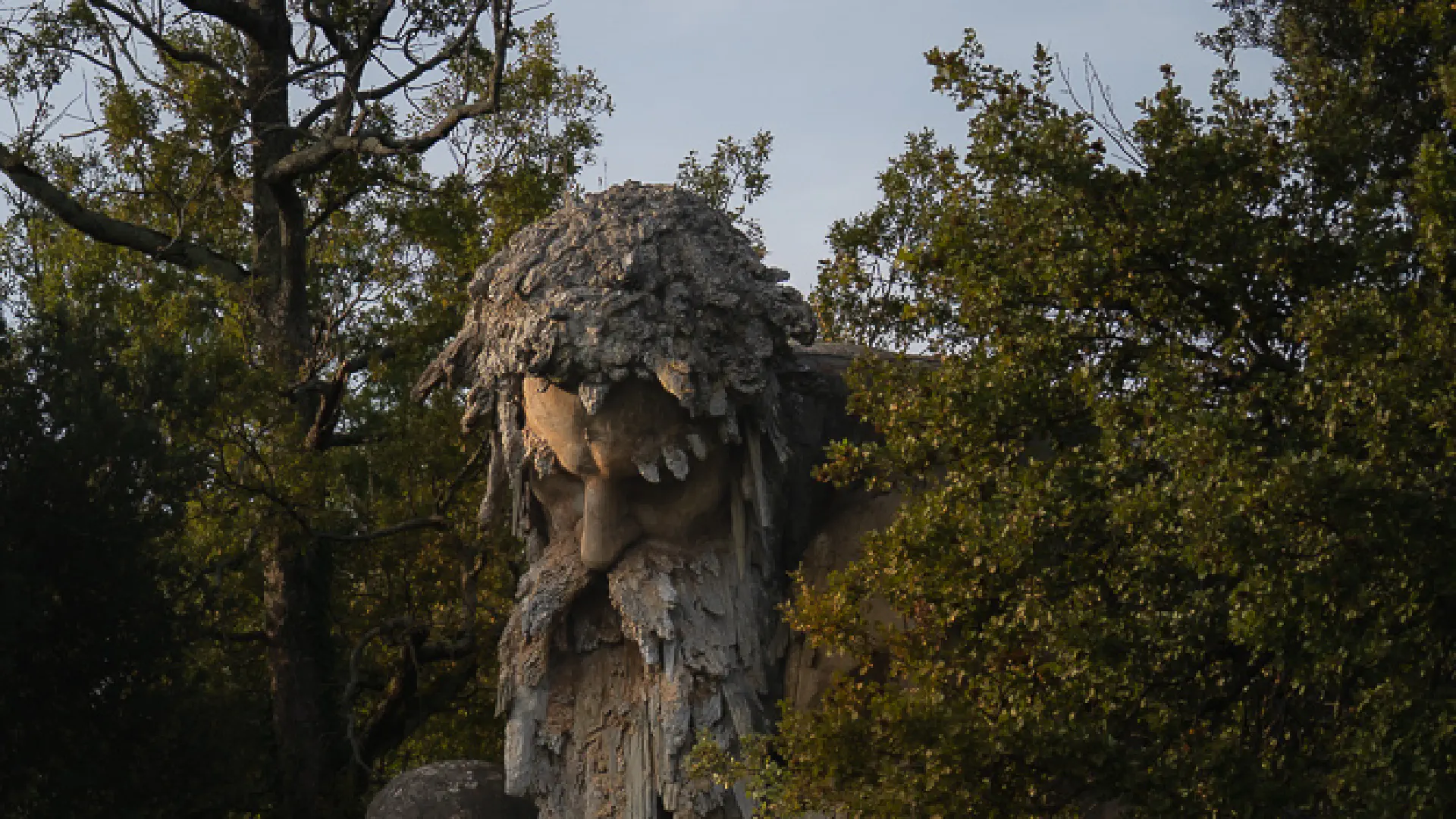
Twelve kilometres north of Florence, off the Via Bolognese, there is a park that contains one of the strangest and most photogenic things in Tuscany.
Not a palazzo. Not a vineyard. A giant.
The Colosso dell’Appennino — the Apennine Colossus — was built by Giambologna in 1580 for Francesco I de’ Medici. It is roughly ten metres tall, made of stone and brick, and it emerges from the hillside as if the hill itself is alive: a bearded figure crouching over a pool, head bowed, shoulders carrying the weight of the mountains. Water once flowed through its body. Grottos are built inside it.
It is one of the most extraordinary objects in Tuscany. Almost no one knows it exists.
All gallery images are original photographs taken by me.
What Pratolino Actually Is
The Parco Mediceo di Pratolino was originally a Renaissance wonder garden — built by Francesco I as a retreat and filled with automata, fountains, trick waterways, and theatrical grottos designed to impress and surprise. The Colossus was the centrepiece of that world.
Most of the original garden was demolished in the nineteenth century and replaced with an English-style landscape park: broad lawns, mature trees, a lake, winding paths. The Colossus survived. So did a few of the original grottos and the Palazzina della Limonaia.
The park is now managed by the Metropolitan City of Florence. It opens on weekends and public holidays from spring through autumn. There are no ticket booths for the main park. There are almost no tour buses.
What you find when you arrive is a large, well-maintained English park that happens to contain a Renaissance sculpture so strange and monumental that it stops most people mid-sentence.
Why I Come Here
I know Pratolino well — I have photographed here many times, in different seasons and different light. A few things are consistently true.
The morning light on the Colossus is exceptional. The north-facing stone holds shadow differently from the surrounding hillside. In the first hours after the park opens, before families arrive and the paths become busy, the figure has a quality that is genuinely difficult to capture any other way.
The surrounding parkland has the soft, directional light that English landscape parks produce — designed, in the nineteenth century, to look like painting. Wide lawns with specimen trees. Water that reflects the sky. Paths that bend just enough to keep the next view hidden until the last moment.
For portrait photography, this is some of the best terrain I work in near Florence. The scale of the Colossus makes for extraordinary context in group or couple shots. The parkland provides the softer, more intimate settings. Within a single visit you can work in two completely different visual registers.
Practical Notes
Pratolino is in the municipality of Vaglia, about 20 minutes by car from central Florence via the Via Bolognese. There is no easy train access — a car is needed. Parking is available near the entrance.
The park opens on weekends and public holidays, roughly April through October. Check the current season’s hours before visiting, as they shift with daylight. Arrive early — by mid-morning on a sunny Sunday, families with children fill the main paths around the Colossus.
The best visits are in May and October. May brings the parkland into full leaf without summer heat. October offers lower-angle light and the colour of the mature trees against the stone.
A Photography Session at Pratolino
I offer candid portrait sessions at Pratolino for small groups and couples visiting Florence.
The session lasts two to three hours — long enough to work the Colossus in good light, move through the parkland, and find the moments that feel natural rather than posed. I shoot candidly: walking shots, conversations, the instants between the ones people expect.
You leave with photographs that look like Tuscany actually looks — not studio-lit against a famous backdrop, but real light, real place, real people in it.
The images I deliver are edited, high-resolution, and usable for print.
Details on the photography service and how to book are here.
Pratolino does not appear in most Florence itineraries. It is not on the tourist circuit, it does not have a gift shop, and you will not find it on the standard day-trip lists.
That, combined with one of the most singular objects in Renaissance sculpture, is exactly what makes it worth the twenty-minute drive.
If you are interested in the broader category of places in Tuscany that most visitors never reach, the guide to things to do in Tuscany beyond the obvious covers the full range — mountains, forests, and hidden history.