Most people driving through the Valdinievole between Pistoia and Florence never slow down.
They are missing Italy’s largest inland wetland—and one of Tuscany’s most quietly extraordinary nature reserves.
The Padule di Fucecchio is not dramatic in the mountain sense.
There are no peaks, no ancient beech groves, no exposed ridges.
But it offers something that mountains cannot: a completely different register of the natural world.
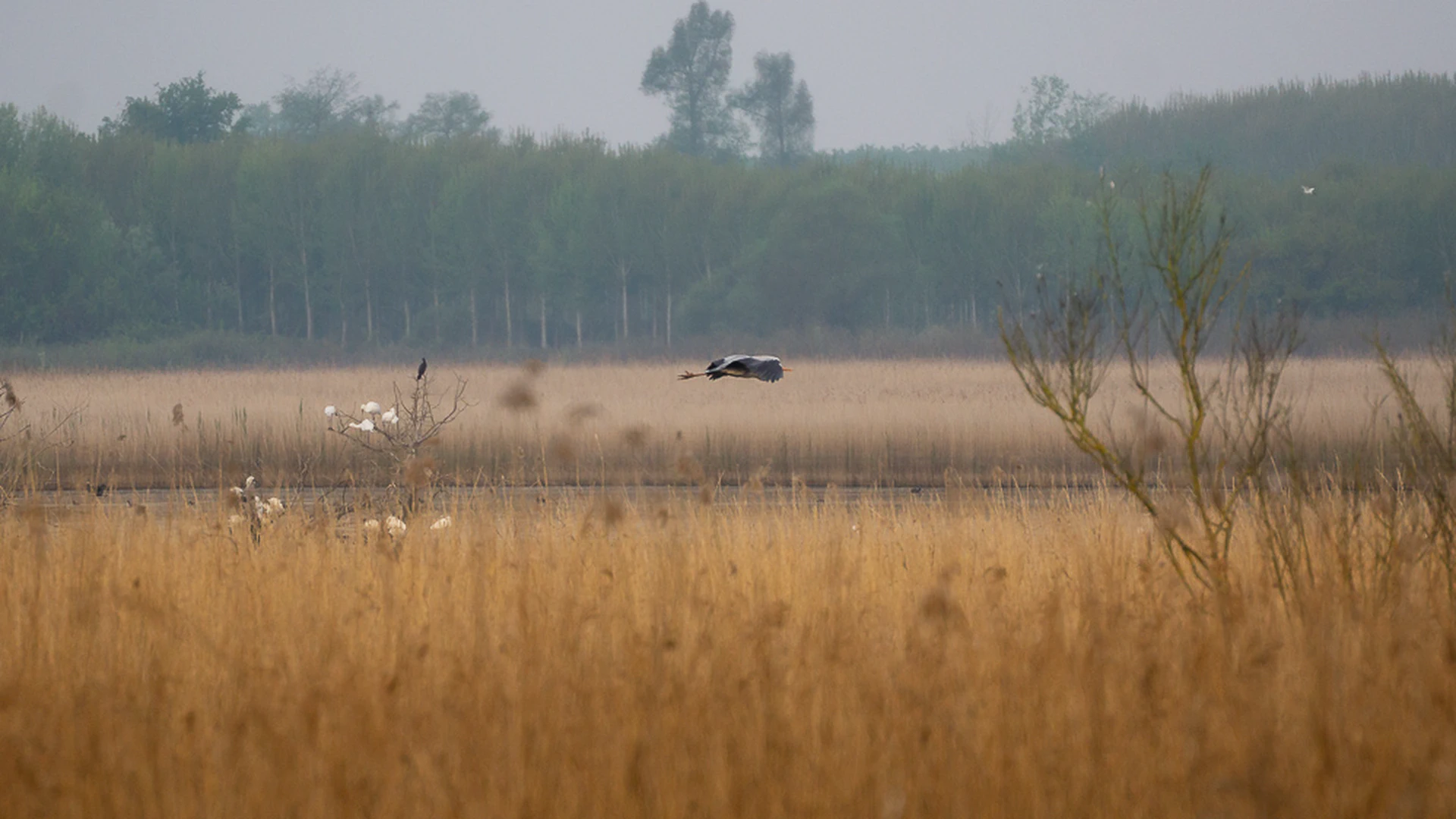
Herons standing motionless in shallow water. Egrets moving through reed beds with unhurried precision. Dawn light spreading flat across open water, unbroken to the horizon.
If you have never walked a wetland at first light, you don’t yet know what you’ve been missing.
Want the hidden, wilder Tuscany on your trip? A local’s Expert Brief sends you to spots like this.
What the Padule Di Fucecchio Is
The Padule di Fucecchio is a protected wetland reserve in the Valdinievole—the “valley of the Nievole river,” a lowland basin at the foot of the Pistoia and Pescia hills.
It is the largest inland swamp in Italy.
The wetland sits at minimal elevation—barely above sea level—and the landscape is entirely flat. It is fed by a network of drainage channels and by seasonal flooding from the surrounding agricultural land.
The reserve is managed by the Centro di Ricerca, Documentazione e Promozione del Padule di Fucecchio, a body dedicated to the conservation, study, and promotion of this wetland ecosystem.
The Padule occupies a critical position in the European migratory bird network. Its location in the heart of the Tuscan plain, midway between the Apennines and the Tyrrhenian coast, makes it an unavoidable staging point for thousands of birds moving between northern Europe and sub-Saharan Africa.
For resident species, it is permanent habitat. For migrants, it is a refueling stop on one of the longest journeys any creature makes.
The Birdlife
No ecosystem reveals its inhabitants as directly as a wetland.
In a forest, you hear before you see. On a mountain, wildlife keeps its distance.
At the Padule, the birds are simply there—in the water, above the water, at the water’s edge.
Herons, Egrets, and Breeding Colonies
The grey heron (Ardea cinerea) is the most visible permanent resident. It hunts with absolute stillness, then strikes with a speed that is startling the first time you witness it.
The little egret (Egretta garzetta) is among the most beautiful birds you will encounter here. Pure white against the green of the reeds, it moves with an elegance that makes it nearly impossible not to photograph. Its bright yellow feet—visible when it wades in clear shallows—are the field mark that identifies it from a distance.
I’ve written a full article about the little egret and where to find it in Tuscany.
The night heron (Nycticorax nycticorax) is present in the warmer months. Stocky and largely crepuscular, it rewards visitors who arrive before dawn.
In late spring and early summer, the Padule hosts mixed breeding colonies of herons and egrets. The sight of grey herons, little egrets, and night herons nesting in the same stand of trees above the water is one of the most striking natural spectacles in inland Tuscany.
Ducks, Rails, and Waders
In winter, the open water fills with wildfowl.
Teal, mallard, pochard, shoveler—the counts during cold weather run into the thousands.
The purple gallinule (Porphyrio porphyrio) has established a small but significant population here. Its iridescent blue-purple plumage and heavy red bill make it one of the most sought-after species for visiting birdwatchers.
Moorhen and coot are present year-round, providing constant activity across the channels.
During spring and autumn migration, wader species pass through: dunlin, common sandpiper, little stint. From late July through October, unexpected species can appear in the shallower sections.
The Marsh Harrier
Over the reed beds, the western marsh harrier (Circus aeruginosus) hunts.
It is one of the few large raptors adapted entirely to wetland environments. Its slow, tilting glide—low over the reeds—is immediately recognizable once you have seen it.
Breeding pairs are present. In spring, the display flights above the reserve are worth the entire journey.
Walking the Levees
The Padule is threaded by a network of raised embankments—levate—built over centuries to manage water levels and allow access across the wetland.
These paths are now the primary way to explore the reserve on foot.
The walking is unlike anything on a mountain trail.
You are at water level—sometimes with open water on both sides of the path. The sky takes up more of your field of vision than it ever does in a forest. The horizon is uninterrupted.
The pace adjusts naturally. There is nowhere to climb toward, so you slow down. You start to notice what is actually in front of you.
Reed beds rustle with warblers. The occasional splash announces a coot or a water rail. A heron lifts off from a dyke thirty meters ahead, its slow wingbeats impossibly unhurried.
The experience of a wetland walk is meditative in a way that mountain hiking is not. The effort is minimal. The absorption is complete.
Photography at the Padule
For photographers, the Padule operates on different principles from the mountain and forest environments I usually cover.
The light is everything.
The flat terrain means that the low sun of early morning and late afternoon skims across the water surface and illuminates subjects horizontally rather than from above.
The result, in the right conditions, is extraordinary.
Mist forms over the water in the colder months—particularly in autumn and winter. A heron silhouetted against pre-dawn mist, with the reed beds dissolving into the background, is the kind of image that cannot be manufactured elsewhere.
What the Padule rewards:
- Early arrival—the first hour after sunrise is consistently the most productive
- Patience—the best moments come to those who wait in one position
- A longer focal length—300mm equivalent is a minimum for bird portraits
- Wide angles for the sky and reflections—the horizontal landscape deserves space in the frame
As Marc Silber writes in Advancing Your Photography, the act of truly seeing—before the shutter—is the skill that separates memorable images from competent ones. Nowhere is that clearer than a wetland at dawn, where stillness and attention are the only equipment that matters.
All gallery images are original photographs taken by me.
The Seasons at the Padule
The reserve rewards visits at every time of year, but each season has a genuinely different character.
Spring (March–May) is when the Padule comes fully alive. Migratory birds arrive, breeding colonies establish, and the reed beds regenerate after winter. For a first visit, this is the season to choose.
Summer (June–August) brings heat and dense vegetation. The birds are present but harder to see through the thick growth. Arrive early—by mid-morning the activity drops and the heat becomes significant.
Autumn (September–November) is the season for migration and photography. The light shifts to warmer tones. The reed beds turn gold. The passage of waders and wildfowl brings species that will not be present at any other time of year.
Winter (December–February) is underrated. Waterfowl numbers peak in cold weather. Bare vegetation makes shy species more visible. The winter light—raking low across the water surface—produces images that summer cannot replicate.
Getting There
The Padule sits between the towns of Fucecchio, Ponte Buggianese, and Monsummano Terme, in the Valdinievole plain.
From Pistoia, the reserve is reachable in under forty minutes by car.
From Lucca, allow approximately fifty minutes. From Florence, roughly forty-five minutes.
The main access point and research centre is at Castelmartini, a hamlet in the comune di Larciano, where the primary visitor infrastructure and levee network are concentrated.
A Guided Walk Is Coming
I am preparing a guided experience at the Padule di Fucecchio.
This will be a slow, considered exploration of the levee network—designed for people who want to experience a wetland properly, with attention to light, timing, and the ecological rhythms of the reserve.
The route has been chosen specifically for the quality of morning light and the predictable behaviour of the resident species. Natural history and photography will both be part of the experience.
This is not a standard birdwatching excursion.
A booking option will be available here soon.
If you want to discuss a visit before it goes live, reach out directly.
Visit the Padule di Fucecchio
Interested in exploring Italy’s largest inland wetland with a guide who knows its rhythms? Get in touch to discuss timing, photography, and what to expect from a visit to the Padule.