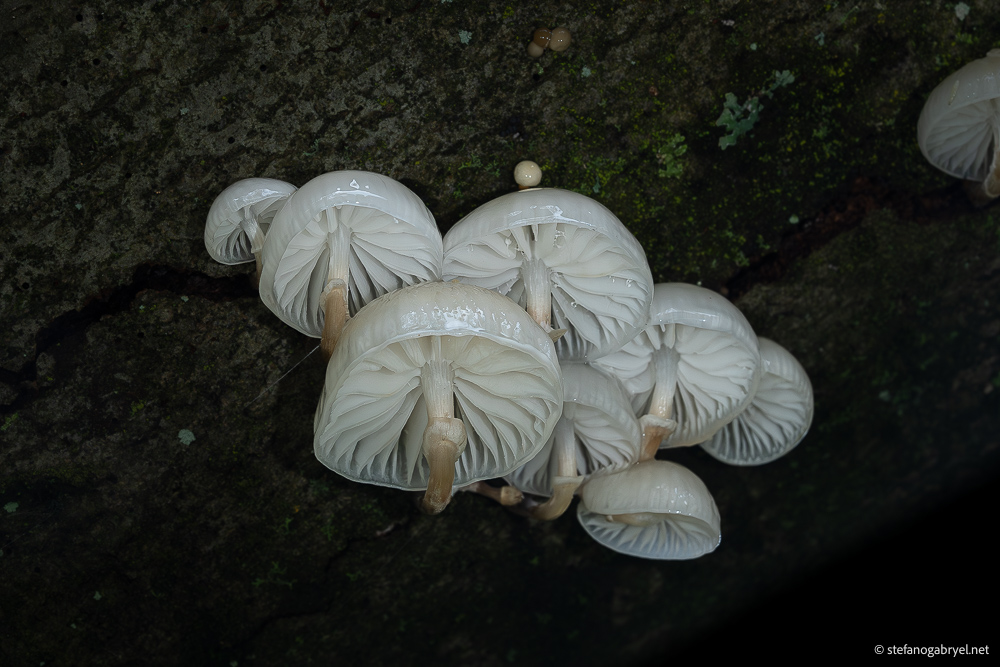
During autumn hikes through Riserva Acquerino, when the beech forests turn golden and the air carries that distinctive scent of decay and renewal, there’s one mushroom I encounter so regularly it feels like an old friend.
Oudemansiella mucida—also known by its older name Mucidula mucida—the porcelain fungus.
Called “fungo di porcellana” in Italian, the name captures something essential about this mushroom’s appearance.
That translucent, shiny white cap really does look like glazed porcelain, or perhaps a poached egg, gleaming on the grey bark of dead beech branches.
It’s beautiful in a delicate, almost fragile way that seems at odds with the robust decay happening around it.
But that delicate appearance is deceptive—this is a mushroom with chemical warfare capabilities that would impress any mycologist.
What You’re Seeing at Acquerino
The beech forests of Acquerino provide perfect habitat for Oudemansiella mucida.
This is a wood-rot fungus exclusively tied to beech trees—specifically Fagus sylvatica, the European beech that dominates the higher elevations of the reserve.
You won’t find porcelain fungus on pines, on oaks, on chestnuts.
Only beech, and only on dead wood.
The fruiting bodies appear in clusters on dead trunks, fallen branches, and—most spectacularly—on dead branches still attached high in the canopy of living beech trees.
On breezy autumn days at Acquerino, I’ve watched these small, translucent mushrooms detach from high branches and “parachute” down through the forest, dislodged by wind.
It’s an unexpectedly graceful sight—fungi as falling leaves.
The typical presentation is a group of 5-20 mushrooms clustered together on a section of dead beech wood. (like in the cover photo)
Each individual is 2-8 cm across the cap, with a slender stem 5-8 cm tall.
The caps are initially convex, flattening with age, covered in a layer of transparent mucus that makes them extraordinarily slippery to touch.
This slime—which gives the mushroom its species name “mucida” (from Latin for slimy or mucous)—is the defining characteristic.
In wet weather, the caps look almost liquid, like they’re melting.
In drier conditions, they retain a glossy, porcelain-like shine.
The color is typically translucent white to ivory, sometimes developing a slight ochre or grey tinge at the center as they mature.
The gills underneath are white, fairly well-spaced, and also somewhat slimy.
The stem has a delicate ring—like a white collar—and is white above this ring, often darker below.
The Taxonomic Journey: Two Names, Same Mushroom
If you look up this mushroom in different guides or online resources, you’ll encounter both Oudemansiella mucida and Mucidula mucida.
Both names refer to the same species, and the story of the name changes reflects the ongoing challenges of fungal taxonomy.
The mushroom was originally described in 1794 as Agaricus mucidus (back when most gilled mushrooms were lumped into the genus Agaricus).
In 1887, it was transferred to the genus Mucidula by mycologist Narcisse Théophile Patouillard.
Then in 1909, Austrian mycologist Franz von Höhnel moved it to Oudemansiella, where it remained for over a century.
Recently, molecular phylogenetic studies have suggested reinstating Mucidula mucida as the more accurate classification.
As of 2025, both names are in active use, with some authorities preferring one over the other.
For practical purposes, if you see either Oudemansiella mucida or Mucidula mucida in a field guide or online, you’re looking at the same porcelain fungus.
The genus name Oudemansiella honors Dutch mycologist Cornelius Anton Jan Abraham Oudemans (1825-1906).
The Chemical Warfare: Strobilurin Production
Here’s what makes Oudemansiella mucida more than just a pretty fungus: it produces powerful antifungal compounds called strobilurins.
These chemicals effectively eliminate competing fungi from the beech wood it colonizes.
When you see a dead beech trunk absolutely covered in porcelain fungus at Acquerino, with very few other mushroom species present, this isn’t coincidence—it’s chemical dominance.
The strobilurins produced by O. mucida deter or outright kill competing fungi, giving the porcelain fungus exclusive access to its substrate.
What’s remarkable is that this natural fungicide discovered in Oudemansiella mucida (and a related species, Strobilurus tenacellus) became the basis for an entire class of agricultural fungicides.
Modern strobilurin fungicides—now chemically synthesized and improved by industry—protect crops worldwide from fungal diseases.
The original compounds came from this delicate-looking mushroom.
It’s a perfect example of how studying fungal ecology leads to practical applications, and why protecting diverse forest ecosystems matters beyond pure conservation.
Edibility: The Slime Question
Porcelain fungus occupies an ambiguous space in culinary mycology.
Some sources consider it edible and even good after proper preparation.
Others claim it’s mildly toxic.
Still others suggest it’s edible but not worthwhile.
Reported flavor:
Those who advocate for eating porcelain fungus describe the flavor as surprisingly rich, with good “mushroomy” taste that’s pleasant when sautéed.
The texture, after removing slime and cooking, is reportedly decent.
Identification: Unmistakable When You Know What to Look For
Key identifying features:
- Habitat: Exclusively on dead beech wood (trunks, branches, high canopy branches)
- Form: Clustered groups of mushrooms with convex-to-flat caps
- Color: Translucent white to ivory, shiny and slimy
- Texture: Extraordinarily slippery mucus coating the cap
- Stem: Slender with a delicate ring (collar) near the top
- Gills: White, fairly well-spaced, slightly slimy
- Season: Late summer through early winter (August-December at Acquerino)
- Spore print: White
Potential confusion:
Honestly, there isn’t much that looks like Oudemansiella mucida once you’ve seen it.
The combination of translucent white caps covered in slime, growing in clusters exclusively on beech, is diagnostic.
Some white-capped mushrooms might superficially resemble it from a distance, but none share the specific habitat restriction, the extreme sliminess, and the translucent quality.
This is one of those “flagship species” that practically identify themselves.
What Porcelain Fungus Tells Us About the Forest
When I’m guiding mycology hikes at Acquerino and we encounter Oudemansiella mucida, I use it as an entry point to discuss forest ecology.
This mushroom is a white-rot fungus, meaning it breaks down both the cellulose and the lignin in wood.
This is ecologically important because lignin decomposition is one of the slowest processes in forest nutrient cycling.
Without white-rot fungi like porcelain fungus, dead wood would persist much longer, tying up nutrients that other organisms need.
The exclusive association with beech is also instructive.
It tells us something about the specificity of fungal adaptations—this isn’t a generalist decomposer that can work with any wood type.
It has evolved specifically for beech, and its strobilurin production is part of that specialization.
The presence of abundant O. mucida at Acquerino indicates:
- Healthy beech forest with adequate dead wood
- Natural forest processes proceeding without excessive management interference
- The kind of ecological complexity that supports specialized species
From a photography perspective, porcelain fungus offers something special.
That translucent, backlit quality of the caps creates opportunities for images that capture light in unique ways.
When photographing at Acquerino, I often position myself so light filters through the slimy caps, highlighting their porcelain-like translucence.
The contrast between the delicate white mushrooms and the dark, decaying bark creates natural compositional interest.
The Autumn Ritual at Acquerino
Here’s what happens almost every autumn hike through the reserve’s beech forests:
Someone spots the first cluster of porcelain fungus on a fallen log.
We stop to examine it, discuss the slime (everyone wants to touch it to confirm how slippery it really is), note the translucent quality.
I explain the beech association, the strobilurin production, the taxonomic naming complexity.
Then, once we’re all calibrated to recognize it, we start seeing it everywhere.
On standing dead trees, on fallen branches, occasionally high overhead on canopy branches.
The forest that seemed to have “some mushrooms” suddenly reveals itself as extensively colonized by Oudemansiella mucida.
This is part of what I love about guiding at Acquerino—the moment when pattern recognition kicks in and the hidden becomes visible.
The porcelain fungus was always there.
We just needed to learn to see it.
And once you see it, you can’t unsee it.
Every autumn walk through beech forests becomes punctuated by those gleaming white clusters, like pearls scattered across the bark.
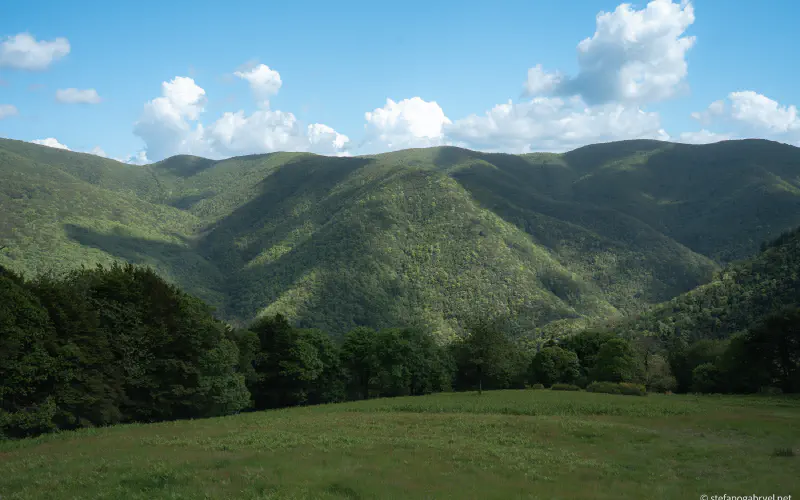
Book a private guided hike in Riserva Acquerino-Cantagallo. Expert trekking tours from Pistoia, Prato & Florence. Escape the crowds—reserve your tour!
The Bigger Picture
Oudemansiella mucida isn’t a mushroom that will make you rich or famous.
It’s not going to command premium market prices like porcini.
But it represents something I value about mycology and forest ecology: specialized adaptation, chemical sophistication, and unexpected beauty in the process of decay.
Those slimy white caps on dead beech wood are doing essential ecological work while producing compounds that became valuable to human agriculture.
They’re beautiful and functional, delicate and chemically aggressive, common and specialized all at once.
When I encounter them at Acquerino—which I do, reliably, every autumn—I stop to appreciate them.
Not always to photograph, not to harvest, just to acknowledge.
The forest is full of these small wonders that reward attention.
Porcelain fungus is one of them.
Are you a beginner?
If you’re just beginning to explore mushroom foraging, Geoff Dann’s Edible Mushrooms is the field guide I recommend to all my clients. It’s an excellent starting point for learning safe identification. Read my full review here.
Want to learn in the field? Join me for a hands-on mushroom hunting experience ⬇️ ⬇️ ⬇️ ⬇️
Ready to move from photos to field identification?
Experience these fascinating fungi firsthand on a guided autumn hike through Tuscan woodlands. Learn professional identification techniques, understand ecosystem roles, and capture your own stunning mushroom photography.
Attention!
While the content of this blog post is aimed at providing you with information as accurate as possible, it should be treated as what it is: simply a blog post on the internet.
Mushroom identification should only be performed by experts, as a mistake can lead to dire consequences. Attempting to identify a mushroom on your own, without prior experience, based solely on the content of this blog post is strongly discouraged.
Explore Hidden Tuscany
Guided hiking experiences combining expert trail knowledge, professional photography, and wilderness mindfulness.
Latest posts
 4 March 2026
Galium Aparine: Cleavers in Tuscan Hedgerows
4 March 2026
Galium Aparine: Cleavers in Tuscan Hedgerows 3 March 2026
Umbilicus Rupestris: Wall Pennywort in Tuscany
3 March 2026
Umbilicus Rupestris: Wall Pennywort in Tuscany 3 March 2026
Laurus Nobilis: Bay Laurel in Tuscan Landscapes
3 March 2026
Laurus Nobilis: Bay Laurel in Tuscan Landscapes 2 March 2026
Guided Tours for Exploring Marble Quarries in Apuan Alps
2 March 2026
Guided Tours for Exploring Marble Quarries in Apuan Alps 26 February 2026
Photographing Nottolini Aqueduct: Light & Geometry
26 February 2026
Photographing Nottolini Aqueduct: Light & Geometry