I'm Stefano, and I guide people through the Tuscany most tourists never see. Want to hike in Tuscany with me?
Last updated 2 November 2026
Search “off the beaten path Florence” and you get the same list every time.
A rooftop bar. The Bardini garden. A quiet church across the river in the Oltrarno.
These places are lovely. They are also ten minutes from the Duomo, inside the walls, and full by mid-morning.
The Florence almost no visitor sees is not a hidden corner of the city. It is the wild country that begins where the city ends.
Within thirty to sixty minutes of the cathedral, the crowds vanish. The hills rise. You can walk for hours without meeting anyone.
Want a Florence beyond the Duomo queues? A local’s Expert Brief sends you where the lists don’t.
The “Hidden” Florence That Isn’t Really Hidden
Every guide to secret Florence repeats the same handful of spots.
The artisan workshops of the Oltrarno. Piazza Santo Spirito in the evening. The terrace at San Miniato al Monte. The view from the Bardini garden.
They are worth your time. I am not dismissing them.
But they are still the city, seen from a slightly quieter angle. Genuinely off the beaten path means leaving the postcard behind, not finding a better seat in front of it.
For that, you have to go up and out.
Where the City Actually Ends
North and east of Florence, the land climbs fast.
Within an hour, vineyards give way to forested ridges, open grassland, glacial lakes, and a Renaissance giant standing alone in a forgotten park.
Some of it is reachable by bus or train. The rest needs a car. Almost none of it appears on a three-day itinerary.
Here is where I would start.
Pratolino and the Giant in the Woods
Twenty minutes north of the city by bus lies the park of Pratolino, the old Villa Demidoff estate.
At its heart stands the Appennino Colossus, a colossal 16th-century stone giant, crouched and brooding, built for the Medici and now half-swallowed by the trees.
It is one of the strangest and quietest sights near Florence. Most visitors have never heard of it.
I’ve written a full guide to Pratolino and the Medici giant.
Wild Horses on the Calvana Ridge
Between Prato and Florence, about forty-five minutes out, a long open ridge rises above the valley.
A semi-wild herd of horses lives on the Calvana plateau. They are not fenced and not managed. They move across the grassland on their own schedule.
The walking is moderate, the views run for miles, and you will likely have the ridge to yourself. Here is my guide to the Calvana and its wild horses.
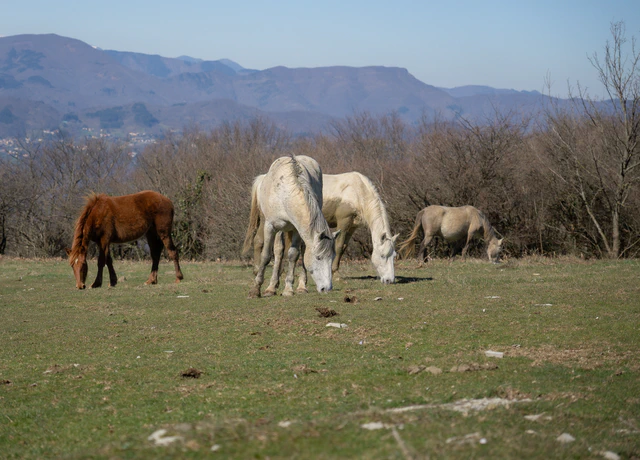
The Calvana
Hawthorn bushes dot the high pastures where the wild horses graze, and in spring they flower white. Almost nowhere else in Tuscany looks like this.
- About 5.5 hours
- €290 per group
Medium · 9.9 km (6.2 mi) · 560 m (1,837 ft) ascent
View this hikeDeep Forest an Hour North
Push a little further and you reach the Apennines proper.
The Riserva Naturale Acquerino-Cantagallo covers 1,867 hectares of forest and high meadow, with Monte Bucciana at 1,224 metres standing over it. The Bisenzio starts up here, in the Fosso delle Barbe and the Fosso del Trogola.
Wild boar, deer and foxes use these woods. Whether you’ll see one on a given morning isn’t something I’d bet on.

Acquerino-Cantagallo
The path climbs into ancient beech forest with the canopy closed overhead, and on most days we meet almost nobody.
- About 6 hours
- €240 per group
- Shorter or longer day on request
Medium · 9.5 km (5.9 mi) · 350 m (1,148 ft) ascent
View this hikeA Lake on the Ridge at 1,775 Metres
Higher still, the forest stops and the ridge takes over.
Lago Scaffaiolo sits in a hollow at 1,775 metres, right on the regional border. Rifugio Duca degli Abruzzi stands at the water’s edge. It opens seasonally.
The first forty minutes follow a wide gravel road, easy going and not much to look at.
This is real mountain country, and it stays empty even in August.

Lago Scaffaiolo
Once you’re up, the path runs along a broad, grassy crest to the lake, with Tuscany on one side and Emilia-Romagna on the other.
- About 6 hours
- €240 per group
- Shorter or longer day on request
Medium · 9.5 km (5.9 mi) · 370 m (1,214 ft) ascent
View this hikeI’ve mapped more of these routes in a separate guide to hikes near Florence.
Why Almost No One Goes
None of these places are secret. They are simply inconvenient for the way most people visit Florence.
A first trip optimises for the famous five: Duomo, Uffizi, Accademia, Ponte Vecchio, a day in Chianti. The hills do not fit.
And nature near Florence asks for a little local knowledge: which trailhead, which season, which bus, which weekends a road is closed to traffic. Without that, most visitors default to the guidebook.
That gap is exactly the space I work in.
What Changes When the City Drops Away
I guide in this terrain, and the shift is always the same.
The noise falls off within the first ten minutes. The pace slows. People stop photographing monuments and start noticing things: a buzzard overhead, the smell of a chestnut wood, the way light moves across an open ridge.
Florence is one of the densest concentrations of human beauty on earth. The country around it is the opposite: spacious, unhurried, almost untouched. You need both to understand the place.
A guided day means you skip the research and go straight to the good ground. You can explore the options around Florence here, or simply tell me what kind of day you want and I’ll plan it.
The off-the-beaten-path Florence is not hiding. It is just waiting on the other side of the hills.
See the Florence Beyond the Walls
I guide Acquerino-Cantagallo and Lago Scaffaiolo myself. Scaffaiolo needs a clear day, since there’s no shelter on the ridge, and the refuge by the lake gives its season as 1 June to 30 September. Acquerino starts far lower and keeps you under trees, so it holds up better when the forecast is poor. I walk both with children from twelve, and on Acquerino I can plan an easier day for a younger child, down to a one-year-old a parent carries. Write to me with your dates and the size of your group, and I’ll say which of the two fits the week you’re in Florence. If you don’t have a car, tell me when you write and I’ll help you find a solution.