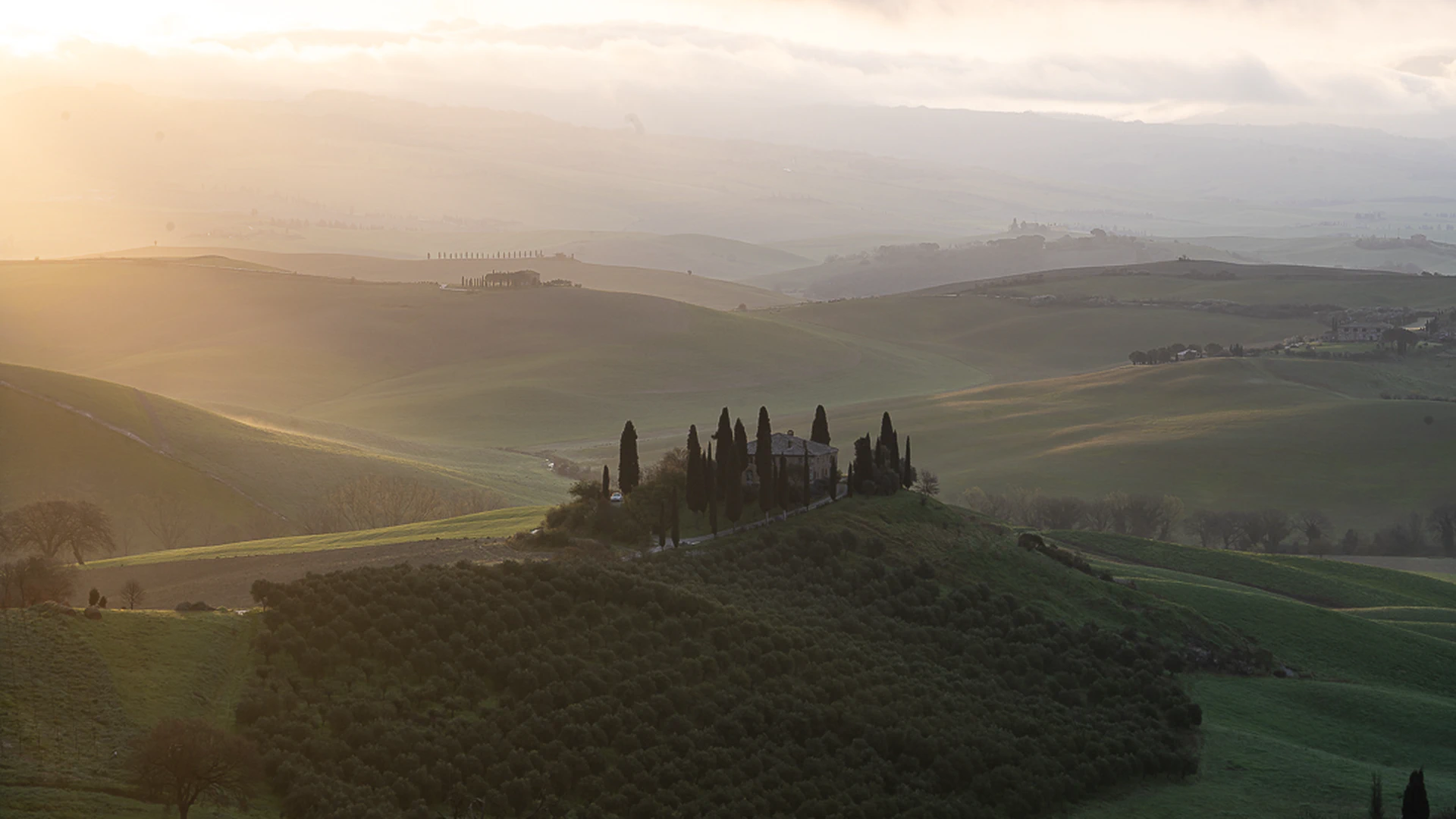
Val d’Orcia and Chianti are the two most photographed corners of Tuscany. Every rolling-hill-and-cypress frame you have seen was shot there, thousands of times over.
If you want photographs of Tuscany that do not look like everyone else’s, point the camera at the north-west, where marble mountains, aqueduct arches, and misty wetlands go almost unshot.
This is no knock on the Crete Senesi or the Val d’Orcia. They are beautiful, and if that is your trip, chase that light. But northern Tuscany offers a different set of subjects, and I photograph them for a living. Here is where I take the camera.
The Corchia marble galleries (Apuan Alps)
The Apuane are a mountain range quarried into white geometry.
Cut marble faces catch light like nothing else in Tuscany: high-key, almost abstract, blinding at midday and beautiful in the low sun of morning and late afternoon. A lone worker or machine gives you scale. I go deeper into photographing the marble quarries separately, but this is the signature subject of the whole area.
- Best light: early morning or the hour before sunset; avoid flat midday glare on the white.
- Access: the working quarries need care and permission. This is not a wander-in-alone location.
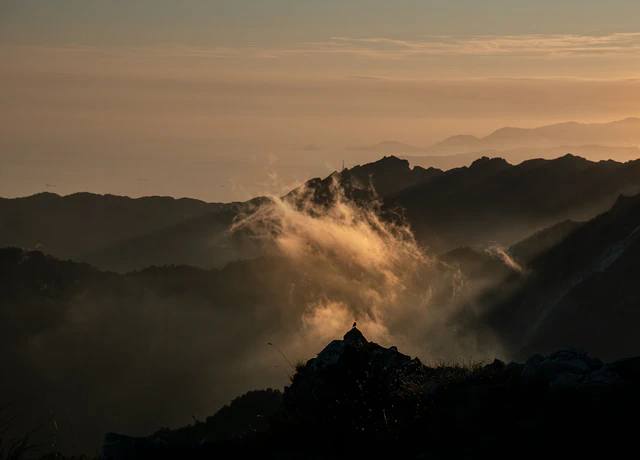
Marmifera del Corchia Private Tour: Marble Quarry Roads & Alpine Scenery
Hike a marble quarry road into the heart of the Apuan Alps, near Lucca, Pisa, Viareggio. A private guided adventure on the Marmifera del Corchia.
View this hikeThe Nottolini aqueduct arches (Monte Pisano, near Lucca)
A three-kilometre run of nineteenth-century stone arches marching across the plain toward Lucca.
The repetition is the picture: arch after arch, receding into haze, best at dawn when mist sits on the fields. I wrote a full Nottolini aqueduct photography guide with the exact spots and timing.
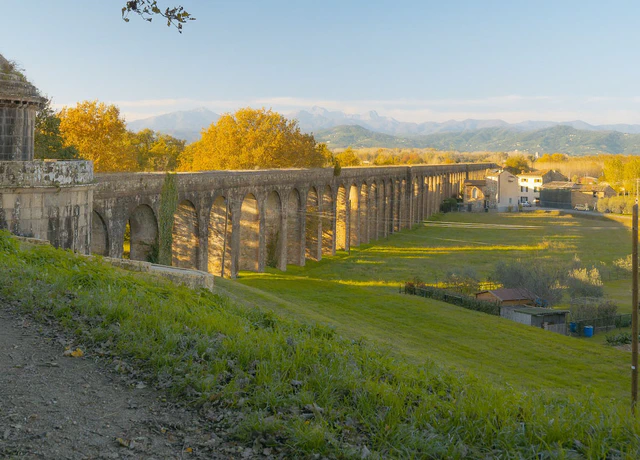
Nottolini Aqueduct Private Tour: Neoclassical Engineering & Sacred Springs
No car required: Walk the 400 arches of Nottolini Aqueduct from Lucca. Guided tour accessible by train. Discover ‘Parole d’Oro’. …
View this hikeMonte Pisano ridgelines
The ridge between Lucca and Pisa is a layered-horizon machine.
At dawn and dusk the successive ridgelines stack into blue-grey bands, with the plain and sometimes the sea catching light beyond. It is the closest thing the north-west has to Val d’Orcia’s rolling layers, without the crowd on the roadside.
Massaciuccoli wetland light
Flat water, big sky, and birds.
The lake and reedbeds south of Viareggio give you mirror reflections at first light and huge colour at sunset, plus herons and egrets for foreground life. It is a quiet, patient kind of photography. The nearby LIPU reserve at Massaciuccoli has hides that put you close to the water.
The Apennine forests in fog
Inland, the mountain forests are autumn’s best subject.
From October the beech woods turn gold and the valleys fill with fog, giving backlit, layered forest frames the open hills cannot. I cover the timing in autumn in Tuscany’s Acquerino forests.
All gallery images are original photographs taken by me.
Gear and light, briefly
You do not need much, but you need the right light.
A tripod for the blue-hour and long-exposure work, a polariser for the marble and water, and a longer lens for the ridge layers and the birds. The lightweight camera setup I carry on hikes covers the rest. As always, the location matters less than being there in the right hour.
Shoot it with someone who knows the light
The hard part of these locations is not the camera. It is timing and access.
Knowing which hour the marble glows, where the aqueduct mist sits, and how to reach a ridge for first light takes local knowledge. I guide photography-focused walks to exactly these spots, and I offer an outdoor photoshoot if you would rather be in the frame than behind it.
Photograph the Real Northern Tuscany
Want to shoot the marble, the arches, and the wetlands in the right light, with someone who knows when and where? Get in touch to plan a photography walk.