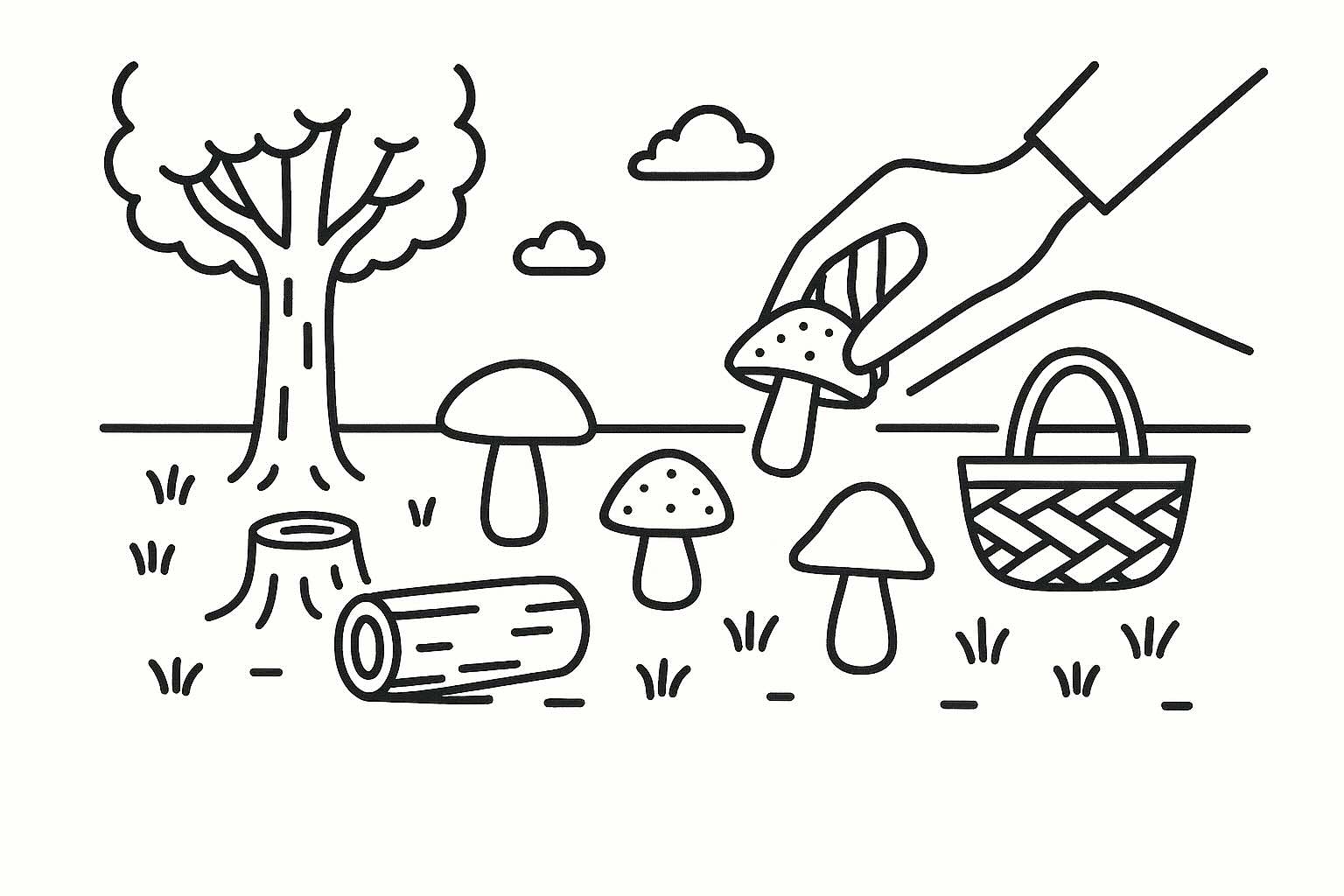
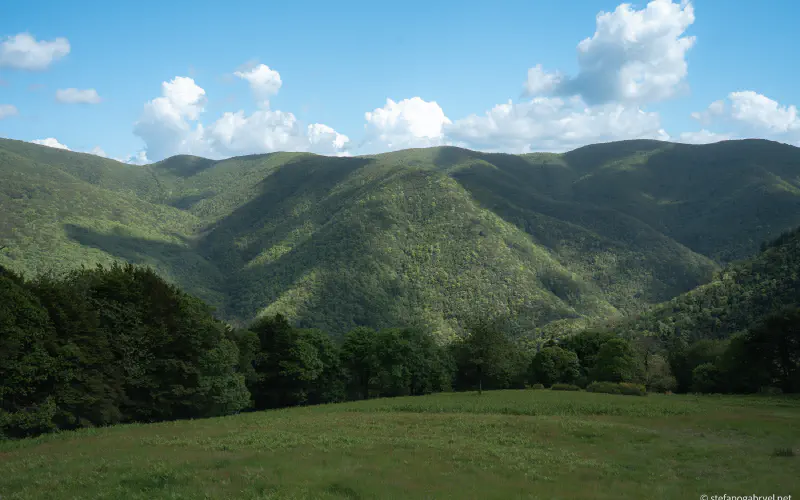
The Acquerino reserve is one of the most mycologically rich landscapes I work in regularly—a mosaic of beech, oak, chestnut, and fir creating extraordinary habitat diversity within a few kilometres. Different trees, different soil chemistry, different microclimates: and with that diversity, a remarkable variety of fungi, season after season.
This isn’t a guide to foraging independently—you’ll need a permit and local knowledge that takes years to build. But it is an attempt to explain what grows here, why it grows here, and what each species tells us about the ecosystem.
Understanding the fungi means understanding the forest.
Book a private guided hike in Riserva Acquerino-Cantagallo. Expert trekking tours from Pistoia, Prato & Florence. Escape the crowds—reserve your tour!
Three Ways a Mushroom Can Live
Before looking at specific species, it’s worth establishing the ecological framework, because not all mushrooms have the same relationship to the forest.
Mycorrhizal species form a physical partnership with living tree roots. The fungus extends the tree’s reach for water and minerals—especially phosphorus—while the tree feeds the fungus sugars it cannot produce itself. Without the tree, the fungus cannot fruit. Most of Acquerino’s prized edible mushrooms belong here.
Saprotrophic species (decomposers) feed on dead organic matter—fallen leaves, buried wood, decaying humus. They return nutrients to the soil and owe nothing to living trees.
Parasitic species attack living tissue, extracting nutrients from a host that would prefer not to cooperate. One of Acquerino’s most abundant autumn mushrooms occupies this uncomfortable niche—while also being one of the most delicious things the forest produces.
Knowing which category a mushroom belongs to tells you immediately where to look, which trees matter, and what the fungus is doing for (or to) the ecosystem.
Boletus edulis — The Porcino
Let’s begin with the obvious one, because no discussion of Acquerino and mushrooms can avoid it.
Boletus edulis is mycorrhizal, and its tree associations define where you’ll find it. At Acquerino, I look for porcini under beech and chestnut at mid-elevations, and under silver fir higher up toward the Pistoiese Apennines. I’ve written a dedicated guide to porcini in Tuscany covering identification and habitat in depth; here I’ll focus on the Acquerino-specific context.
The vegetation indicators matter enormously. Bracken fern (Pteridium aquilinum) colonises acidic soils—exactly the soil chemistry that Boletus edulis prefers. Where you see it growing at forest margins and clearings, you are in porcini territory. Bilberry (Vaccinium myrtillus) serves the same signalling function in the understorey.
Seasonality runs in two windows: a less reliable spring flush in May and June, and the main event in autumn—September through November—when cooling temperatures and post-summer rainfall trigger the most significant fruitings.
What we call a porcino is only the fruiting body—the real organism is an underground mycelial network that can persist for decades. When porcini return to the same spot year after year, you are revisiting the same individual. David Arora, in Mushrooms Demystified, calls Boletus edulis “the most universally esteemed of all wild mushrooms”—a claim easy to understand on any autumn morning in an Acquerino beech forest.
Cantharellus cibarius — The Chanterelle
I’ve covered chanterelles in full detail elsewhere, but they warrant mention here because Acquerino is excellent chanterelle habitat and they appear earlier in the season than most people expect.
Cantharellus cibarius is mycorrhizal, associating primarily with oak, beech, and chestnut. The golden trumpets appear from June through October, with peak fruiting in late summer to early autumn, often preceding the main porcini season. Look for them in dappled light on north-facing slopes, frequently in company with moss. They return to the same locations reliably over years—the mycelium is stable and persistent.
The same beech and oak zones that produce chanterelles also produce Craterellus cornucopioides, the black trumpet—a darker, later-season relative fruiting into November, equally prized by those who know how to find it. Where you find chanterelles in summer, it’s worth returning to the same trees in October.
Armillaria mellea — The Chiodino (Honey Mushroom)
Here is a mushroom that complicates the tidy categories we sometimes impose on nature.
Armillaria mellea—the chiodino—is primarily a parasite. It attacks the roots and base of living trees, eventually killing them. In the managed chestnut forests of Acquerino, it is a serious pathogen and a leading cause of chestnut decline. And it is absolutely delicious.
This tension between ecological harm and culinary excellence makes chiodini one of the more interesting species I encounter. Armillaria species are among the largest organisms on earth—a single individual in Oregon covers over eight square kilometres, estimated at 8,000 years old. What you see erupting at a chestnut stump base in October is the visible tip of something that may have been living in that wood for centuries.
Chris Maser, Andrew Claridge, and James Trappe discuss in Trees, Truffles, and Beasts the profound connections between fungi and forest dynamics. Armillaria sits at the complicated intersection of destruction and regeneration: it kills trees, but dead wood creates habitat, and canopy gaps allow new growth. The stumps it leaves behind become colonised by saprotrophic species in succession—including Calocera viscosa, the yellow stagshorn on conifer wood, and Oudemansiella mucida, the porcelain fungus on beech—both present at Acquerino, both made possible in part by what Armillaria left behind.
Seasonality: October and November, after the first significant cold. Large clusters at stump bases, root collars of living and dead trees, or from ground connected to buried wood below. Cook thoroughly—raw or undercooked chiodini cause gastrointestinal distress.
Russula species
Walk through Acquerino’s beech and chestnut forest in late summer and autumn, and you will find russule everywhere—in colours ranging from deep purple-red to vivid scarlet to pale ochre to pure white.
All are mycorrhizal, each species in specific partnership with particular tree hosts. Russula virescens—the greencracked russula, one of the most prized edibles in the genus—associates primarily with oaks. Russula cyanoxantha, the charcoal burner, favours beech. In the chestnut zones, Russula xerampelina appears with its characteristic shellfish smell. Seasonality runs from July through November, with peak diversity in August and September.
The Russula genus is remarkable for what it lacks: no veil, no volva, a brittle texture that shatters rather than tears. Working with russule requires real attention—the differences between edible and mildly toxic species are subtle. If you’re building your identification skills, my guide on how to identify poisonous mushrooms is worth reading before tackling this genus independently.
The ecological point that matters most: a diverse russula community is a sign of forest continuity. These species don’t colonise new plantations or recently disturbed ground—their mycelial networks develop over years and decades. At Acquerino, the russula diversity is one more indicator of why this reserve deserves protection.
Laccaria laccata — The Deceiver
Not every important mushroom at Acquerino is a prized edible. Some are ecologically essential and practically invisible to most foragers.
Laccaria laccata is mycorrhizal, with an unusually broad range of tree partners—beech, oak, birch, pine, fir—making it one of the most widespread mushrooms in the reserve. It earns its English name from its extraordinary variability: depending on moisture and light it shifts from orange-brown to pale buff to almost white, often looking like several different species on the same day. Its more visually striking relative, Laccaria amethystina, the amethyst deceiver, is also present at Acquerino—its vivid purple making it one of the few mushrooms that photographs beautifully even in poor light.
Season: late summer through late autumn. Modest culinary value, but significant ecological value: Laccaria is frequently among the first mycorrhizal fungi to colonise disturbed ground, re-establishing the fungal networks that more demanding species like porcini will later depend on.
Reading the Forest Through Its Fungi
What I find remarkable about Acquerino, walking it month after month, is how consistently the fungi serve as indicators.
Porcini tell me the soil is acidic, the tree partnership is stable, the moisture arrived at the right moment. Chiodini tell me a chestnut is under stress or recently died. A diverse russula community tells me this patch of forest has continuity. The presence of laccaria in a clearing tells me the forest is reclaiming ground.
Book a private guided hike in Riserva Acquerino-Cantagallo. Expert trekking tours from Pistoia, Prato & Florence. Escape the crowds—reserve your tour!
David Arora writes in All That the Rain Promises and More that mushroom hunting is “the perfect marriage of the outdoors, the chase, and the feast.” At its best, it’s also an education in how ecosystems function—not as a collection of individual organisms, but as a system of relationships, most of them happening underground, invisible, in the dark.
The reserve protects not just the trees you can see, but the fungal networks sustaining them—networks that took decades to develop and cannot be quickly recreated once disturbed.
Come in autumn with the right permits, move slowly, and pay attention to the ground. If you’d like to understand the reserve itself first, start with my guide to the Acquerino nature reserve—the landscape context makes everything described here make more sense.
Ready to move from photos to field identification?
Experience these fascinating fungi firsthand on a guided autumn hike through Tuscan woodlands. Learn professional identification techniques, understand ecosystem roles, and capture your own stunning mushroom photography.
Attention!
While the content of this blog post is aimed at providing you with information as accurate as possible, it should be treated as what it is: simply a blog post on the internet.
Mushroom identification should only be performed by experts, as a mistake can lead to dire consequences. Attempting to identify a mushroom on your own, without prior experience, based solely on the content of this blog post is strongly discouraged.
Explore Hidden Tuscany
Guided hiking experiences combining expert trail knowledge, professional photography, and wilderness mindfulness.
Latest posts
 4 March 2026
Galium Aparine: Cleavers in Tuscan Hedgerows
4 March 2026
Galium Aparine: Cleavers in Tuscan Hedgerows 3 March 2026
Umbilicus Rupestris: Wall Pennywort in Tuscany
3 March 2026
Umbilicus Rupestris: Wall Pennywort in Tuscany 3 March 2026
Laurus Nobilis: Bay Laurel in Tuscan Landscapes
3 March 2026
Laurus Nobilis: Bay Laurel in Tuscan Landscapes 2 March 2026
Guided Tours for Exploring Marble Quarries in Apuan Alps
2 March 2026
Guided Tours for Exploring Marble Quarries in Apuan Alps 26 February 2026
Photographing Nottolini Aqueduct: Light & Geometry
26 February 2026
Photographing Nottolini Aqueduct: Light & Geometry