
I'm Stefano, and I guide people through the Tuscany most tourists never see. Want to hike in Tuscany with me?
Last updated 29 September 2026
On 18 April 2024 Mark Williams of Galloway Wild Foods published a long piece on foraging trolls and pickshaming, his word for calling someone out in public over what they’ve foraged, usually under a photo and usually without asking a single question first. I read it from Tuscany, where mushroom foraging has been part of family autumns for generations. I recognised the tone of every comment he quotes. The culture behind those comments is the part I don’t recognise.
Mark has been foraging in south-west Scotland for 35 years, and on 21 September 2026 he published my guest post on how Tuscany keeps its mushroom woods full. That piece covered the rules. Here I want to pick up the other half of the conversation: what happens once the basket is full.
Pickshaming, as Mark describes it
In Mark’s definition, pickshaming means publicly criticising someone for their foraging, and it runs almost entirely on assumptions. His gentlest example comes from a sort-of friend who looks at his haul and says “Golly, what a lot of mushrooms”, in a tone Mark finds a bit judgy. What the friend doesn’t see, and doesn’t ask about, is the thousands of miles Mark has walked without finding anything, the six spots he’s been tending for fifteen years that produced that single bumper day, or the mushrooms he left standing to drop their spores.
Online it gets worse. The case study at the end of his article follows a commenter who called his rowan-bud harvest unethical and argued across two separate threads that the tree would never fruit if everyone took a few buds. She went quiet once Mark pointed out that she promoted cutting birch branches for sap on her own page. He also singles out the reply he finds hardest to deal with, where a commenter says they saw the same plants or mushrooms and left them for the bees. It grabs the moral high ground in one line. It also assumes the worst about the forager.
What a full basket gets you in Tuscany
Here the reaction to a big harvest goes one of two ways.
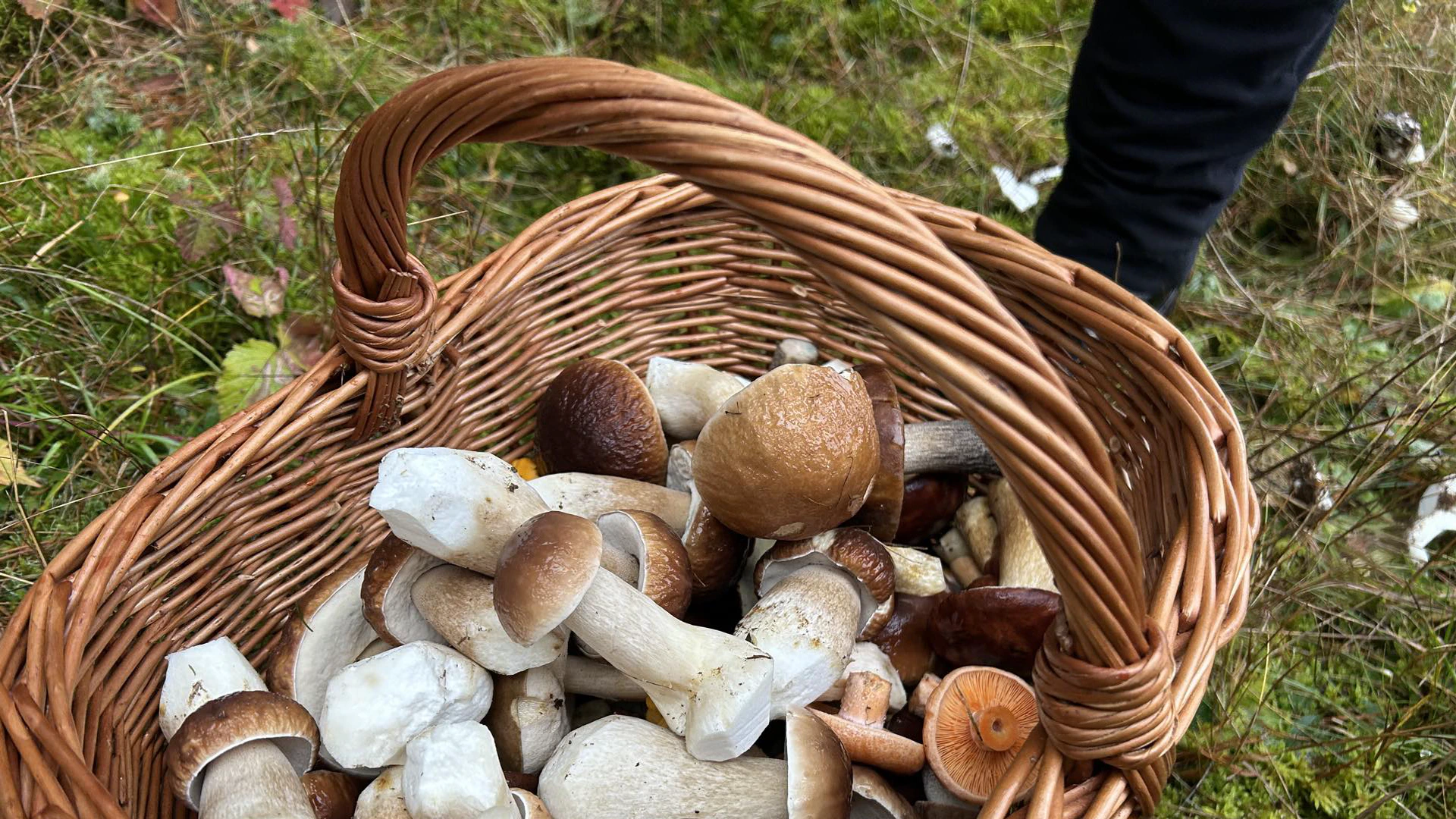
Among friends, you brag. Coming home with kilos of mushrooms is a story you tell, and that one time you found far more than usual gets retold for years. The more you can find and pick, the more there is to brag about. It’s a fishing story.
With everyone else, some foragers do the opposite and hide the basket so nobody sees what they’ve picked. A good fruiting spot is private knowledge, and a full basket in the wrong moment tells whoever sees it that the woods nearby are producing and roughly where to start looking. Some people are very jealous of their spots, and a hidden basket is simply what that jealousy looks like from the outside.
I can’t tell you which of the two reactions is more common. It depends on the person, and I’ve never counted. What I don’t come across here is the reaction Mark describes, the stranger who looks at your mushrooms and decides you’ve taken too much. Both Tuscan responses are about the spot, and the only question anyone’s actually asking is where you found them.
Why the argument never started here
My guess is that the law settled it before anyone could get angry about it online.
In Tuscany a resident pays €25 a year to the region for the right to forage, and visitors from outside pay €15 a day or €40 a week. You’re allowed three kilograms per person per day, carried in a rigid open basket, during set hours. The Carabinieri’s forest units patrol the productive valleys in season. Go over the limit and you get a fine and lose the excess. That stays between you and the officer. Stay under it and a full basket is legal by definition, because the question of how much is too much got answered in regional law, in public, decades ago, and nobody looking at your basket has anything to add. The details, and where to get the permit, are in my guide to mushroom hunting regulations in Tuscany.
The science had already reached the same place. At Chanéaz in Switzerland, Simon Egli’s team at the WSL harvested fenced plots every week from 1977 to 2003 and found no drop in later fruiting against the untouched plots. On a second site, the thing that did cut the crop was feet. I went through that study in cut or pull mushrooms, and Mark points to the same research in his own writing. So the fear sitting under a lot of pickshaming, that a heavy basket empties the woods, has been tested in a real forest for 26 years and didn’t hold up.
Who’s watching your basket
Mark’s own reply to a pickshamer is to ask, politely, what they eat that costs nature less than his wild harvest. It’s a good question, and it works because the people in his threads mostly come at foraging from outside it, as protectors of a nature they picture foragers taking from.
In Tuscany the people eyeing your basket are other foragers. All they want to know is where you found it, and you’re not going to tell them.

Come mushroom hunting in the Tuscan Apennines
A private day in the woods between Pistoia and Florence: identification in the field, the habitats each species needs, and time to photograph what you find. September to November, when the ground is actually producing.