I'm Stefano, and I guide people through the Tuscany most tourists never see. Want to hike in Tuscany with me?
Stand on the Lucca walls and look south, or on the Pisa Lungarni and look north-east, and you’re looking at the same thing: a long, dark, wooded ridge that fills the horizon and keeps the two cities from seeing each other. That’s Monte Pisano, and Dante used it for an insult. In the thirty-third canto of the Inferno, Count Ugolino dreams of being hunted on “the mountain because of which the Pisans cannot see Lucca”. Seven hundred years later the line is on a plaque at a saddle on the old crossing between the two plains, which the locals call the Passo di Dante, and the ridge still does exactly what the poet said it does.
Everything about Monte Pisano is modest on paper. Its highest point, Monte Serra, measures 917 metres. No part of it is a national or regional park. It has no glacier, no refuge culture, no famous summit. What it has is position: a mountain with a railway station at its foot on one side and a Renaissance city on the other, covered in olive terraces, chestnut groves and Mediterranean scrub, with two aqueducts walking off it in opposite directions.
What Monte Pisano Is
Geologists file it under the Tuscan sub-Apennines, a small block of old rock standing alone between the Arno plain and the Serchio plain. The rock itself has a name that travelled: Monte Verruca, the 537-metre spur between Calci and Vicopisano, gave its name to Verrucano, the term geologists now use for that whole family of ancient conglomerates and sandstones wherever they turn up. The Rocca della Verruca, the fortress on its top, is already recorded in a charter of 996. Pisans called it “the eye of the Pisans”, because from up there you watch the whole plain, and Florence fought them for it more than once.
Part of the stone for Pisa’s cathedral came off this mountain, from the quarries above San Giuliano Terme. So when you stand in the Piazza dei Miracoli, some of what you’re looking at was cut from the ridge behind you.
The towns around the base read like a ring: San Giuliano Terme, Calci, Vicopisano and Buti on the Pisa side, Lucca and Capannori on the northern side. Several small local protected areas were set up on the slopes, the Monte Castellare one above San Giuliano Terme among them. They protect pockets. The wider cover is the Natura 2000 site, a special area of conservation that takes in most of the massif, which is protection on paper and in planning rules rather than a park with gates.
Dante, Monks and Two Aqueducts
The Passo di Dante is the one everyone photographs, but the mountain’s history is mostly written in water and stone, and a lot of it is still standing.
- The Certosa di Calci. Carthusian monks founded it in 1366 on the Pisa side, and it grew into one of the largest monastic complexes in Tuscany. Today the University of Pisa keeps its natural history museum in the service buildings, including a drying loft about a hundred metres long, so you walk from a cloister into whale skeletons.
- The Medici aqueduct. Ferdinando I commissioned it and it was finished in 1613 under Cosimo II: a line of arches carrying spring water from Asciano, at the foot of the mountain, into Pisa.
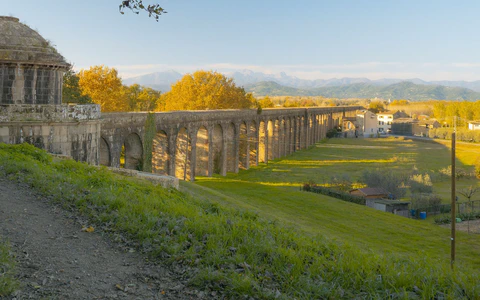
- The Nottolini aqueduct. Two centuries later Lucca built its own on the opposite side. Maria Luisa di Borbone commissioned it in 1822 from the architect Lorenzo Nottolini, and its 460 arches cross the plain from the Guamo springs to the city. I’ve written a whole guide to photographing it, and the walk along it is one of the days I run from Lucca.
- The Via degli Acquedotti. A signed long walk now links the two aqueducts over the ridge, Lucca to Pisa, so you can leave one city’s water supply and arrive at the other’s.
- San Giuliano Terme. Bagni di Pisa, as it was called, has been a spa since antiquity. Montaigne took the waters here in the summer of 1581 and wrote the place up.
Those are the dates. They’re what makes this ridge different from the Apennine forests further north, which are wilder and emptier: here every path crosses something someone built.
What Grows Here, and What Burned
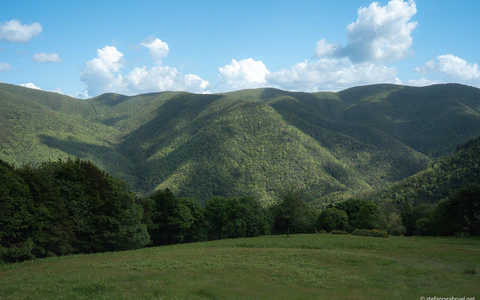
The lower slopes are olive terraces, dry-stone walls holding up trees that in places are centuries old. Higher up the pattern loosens: chestnut on the shadier, wetter sides, maquis and pine where the ground is dry and sun-facing, and the two mixed together more often than any tidy description allows. Porcini turn up in the chestnut woods through October in a good year, which tells you how much shade and leaf litter the upper slopes hold.
On the night of 24 September 2018 a fire started on Monte Serra and ran down towards Calci, Vicopisano and Buti. The first official estimate was 600 hectares; the later ones settled around a thousand, about 150 of them farmland, olive groves and vineyards. Pisa airport closed to make room for the firefighting aircraft. Prosecutors treated it as arson. I mention it because the scars are part of what you see from the Pisa side now, and because a burned Mediterranean hillside eight years on is its own lesson in what comes back first and what doesn’t.
Getting There Without a Car
This is the part that makes Monte Pisano unusual among Tuscan mountains. The Pisa to Lucca railway opened in 1846 and runs along the western foot of the ridge, with stations at San Giuliano Terme and Rigoli, and the paths climb almost from the platforms. I’ve gone into the train logistics in car-free hikes near Pisa and Lucca, and into how the ridge fits a Pisa-based trip in is Pisa worth visiting.
Both cities sit within easy reach, and either one makes a base. From Lucca the mountain is the view from the walls; from Pisa it’s the backdrop to the tower.
Who This Mountain Is For
Monte Pisano won’t give you altitude. It gives you a wooded ridge between two of the most visited cities in Italy where you can walk for hours within sight of the Leaning Tower and meet a handful of people, with an abbey, two aqueducts and Dante’s saddle to break the day up. The ground is Mediterranean, dry and stony underfoot, so I’d pick spring or autumn over July, when the Pisa plain bakes. I don’t know of another mountain in Tuscany where the train sets you down at the trailhead with a medieval city at either end of the line.
Would you like to experience this?
Tell me when you’re in Tuscany and what you have in mind, and I’ll get back to you.Frequently asked questions
Looking for private hiking in Tuscany?
Browse my full collection of small-group, fully private hikes across the region.