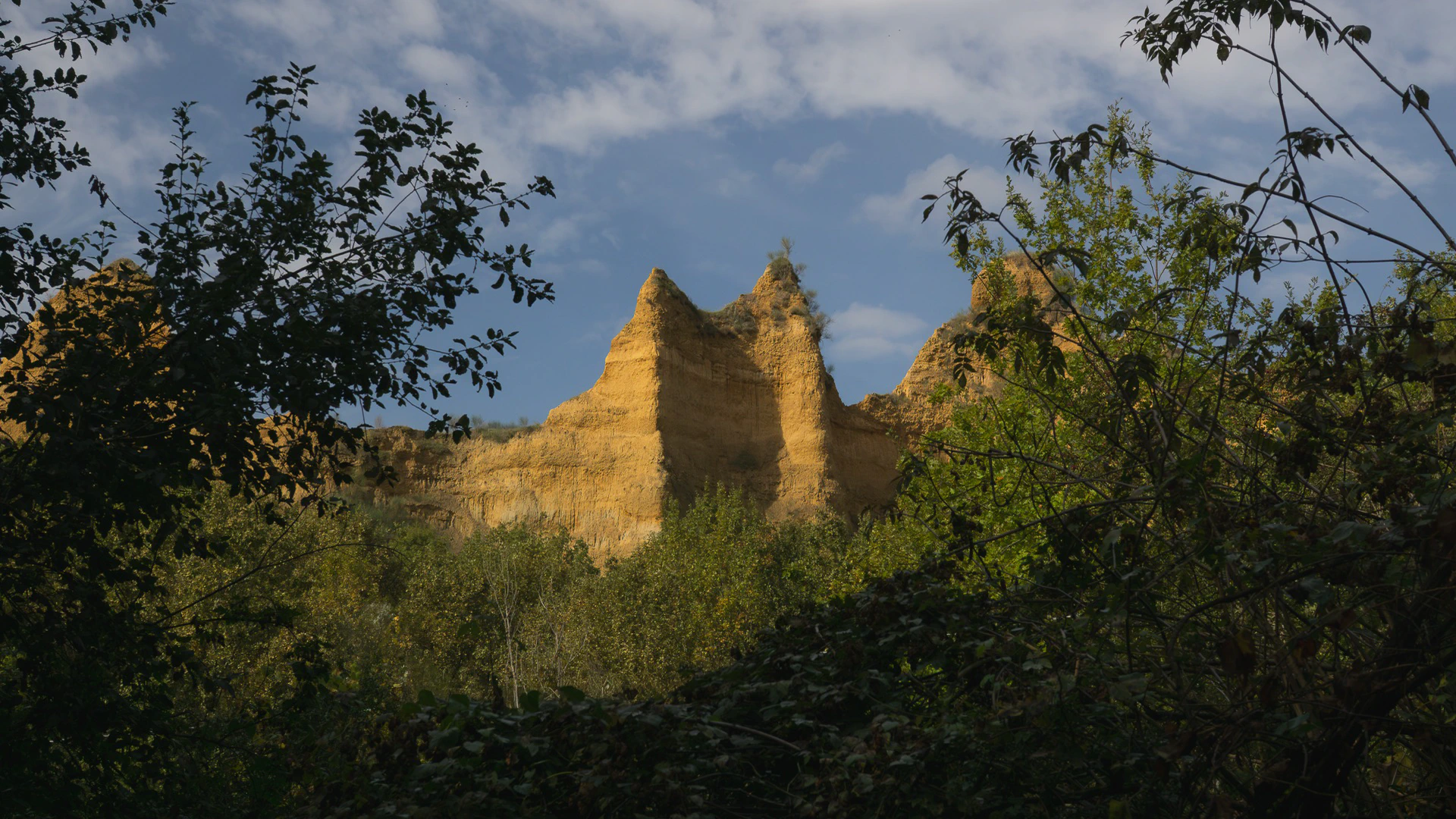

I'm Stefano, and I guide people through the Tuscany most tourists never see. Want to hike in Tuscany with me?
Behind Lisa del Giocondo’s shoulders there’s a landscape that doesn’t quite add up: a road winding away on the left, a bridge over a river on the right, water sitting at two different heights, and bare rock towers fading into blue. For five hundred years people have asked whether it’s a real place. At least five places in Italy say yes, and each one means itself. The oldest of those claims belongs to the valley where I now guide, the upper Valdarno between Florence and Arezzo, so I had a reason to go through the evidence properly. Here’s what holds up, what doesn’t, and what you can walk.
What’s Actually Behind Her
Leonardo started the portrait in Florence. We know the year because a Florentine official, Agostino Vespucci, scribbled a note in the margin of a book in October 1503 saying that Leonardo was working on a portrait of Lisa del Giocondo. He kept the panel for the rest of his life, took it to France in 1516, and it has hung in the Louvre since the end of the eighteenth century. So if your question is where it was painted, the answer is Florence, with years of reworking in Milan, in Rome and finally in France.
The landscape is the part that keeps the arguments going. On the left a track climbs between rocks towards a lake. On the right a river runs under a bridge, three or four arches depending on who counts, and on past it into haze. The two halves don’t quite join up: the water on the right seems to sit higher than the lake on the left, and no two experts read that the same way. Nothing is named. Leonardo’s notebooks, thousands of pages of them, never say what the view is.
The Valdarno Theory
In the early 1990s Carlo Starnazzi, a scholar from Arezzo, gave weight to a local lawyer’s hunch that the bridge is Ponte Buriano, a seven-arched stone bridge of 1277 over the Arno at the edge of Arezzo. The pale towers joined the story later: the municipality of Castelfranco Piandiscò now runs a project called “Leonardo da Vinci, Castelfranco e le Balze”, Silvano Vinceti argued at its launch that the balze, the eroded cliffs of the upper Valdarno, are the rocks behind her, and Arezzo’s tourist board has built an itinerary on the whole idea.
What the theory has going for it is real. Leonardo was here. In 1502 and 1503 he worked as an engineer for Cesare Borgia and mapped the Valdichiana, and for Florence’s scheme to divert the Arno he drew the valley itself; the sheets survive in Windsor and Madrid. In the Codex Leicester, written around 1504 to 1508, he describes the upper Valdarno as a freshwater lake, held back by the rock of the Gonfolina and stretching from the foot of the Pratomagno down to the Girone, and he notes that no sea shells turn up in its old bed. That fits the fight he picks elsewhere in the same notebook, where the shells in other Tuscan hills become proof of a sea that stood there for ages, and not of Noah’s flood. Vinceti also points to drawings of what Leonardo called pyramids of earth.
What it has against it is just as real. Ponte Buriano has seven arches and the painted bridge has three or four. The Balze stand more than 20 km from the bridge, so the two would have been pushed together on the panel. And the valley Leonardo describes in the Codex is a geology lesson, not a view he says he painted.
The Rivals
The Valdarno is the oldest claim, and it has company.
- Montefeltro. Since 2008 Rosetta Borchia and Olivia Nesci have placed the view in the Valmarecchia, between Romagna and the Marche, and theirs is the one reading that has reached a peer-reviewed journal, in 2025.
- Bobbio. In 2011 Carla Glori argued for the hump-backed Ponte Gobbo over the Trebbia at Bobbio, in Emilia-Romagna.
- Laterina. In May 2023 Silvano Vinceti, the same man who champions the Balze, moved the bridge downstream to the Ponte Romito at Laterina, on the strength of its four arches and of Medici papers showing it in use around 1501 to 1503. One arch of it still stands.
- Lecco. In May 2024 Ann Pizzorusso, a geologist and art historian, took the whole scene north to Lombardy: the Azzone Visconti bridge at Lecco, Lake Garlate below it, and limestone of the right grey-white colour. Her point was that everyone argues about the bridge and nobody looks at the rock.
Then there are the art historians who think the exercise misses what Leonardo was doing. Martin Kemp at Oxford calls the geological hunt fanciful and reads the landscape as an invented world, and Francesca Fiorani at the University of Virginia sees his backgrounds the same way. I’d put it like this: Leonardo saw the Valdarno, wrote about it and drew it. Whether he painted it behind Lisa is a question the panel won’t answer, and I’d be wary of anyone who tells you it has.
The Other Paintings People Mention
A local guide first told me this story standing under the Balze, and named three paintings, so here are the other two.
The Virgin of the Rocks exists in two versions, in Paris and in London, both set in a grotto of fractured stone. Vinceti says Balze-like forms appear in both. The scholarly discussion of those rocks runs the other way: Pizzorusso has argued since the 1990s that the Louvre version’s geology is right down to the weathering and the London version’s isn’t, and neither side of that argument puts the grotto in the Valdarno.
The Virgin and Child with Saint Anne, the one with the lamb, has a background of misty mountains and water that could be a dozen places. Starnazzi put it in the upper Valdarno as well, together with the Madonna of the Yarnwinder, and Arezzo’s small Leonardo museum shows the three identifications side by side. Nobody outside that circle has taken it up, as far as I can find, so I tell it as the local reading it is.
Where Leonardo Was Born: Vinci and Anchiano
Leonardo was born on 15 April 1452 in Vinci, a hill town on the Montalbano ridge about 15 km from where I live. The house traditionally given as his birthplace stands at Anchiano, 3 km above the town among the olives, and the Museo Leonardiano in the old castle holds the models of his machines that most visitors come for. A signed path climbs from the town to the house.
I don’t guide Vinci yet. It’s the obvious walk for me to build, along the olive terraces of the Montalbano with the Arno plain below, and whether I build it depends on how many of you ask.
Two more pieces of his ground lie close by. West of the ridge is the Padule di Fucecchio, the marsh he drew on his maps of the lower Arno; I’ve written about walking the Padule on its embankments. To the south-east, where the Arno squeezes between hills at the Gonfolina, is the rock he argued the river had cut through to drain the plain of Florence, in the same Codex that describes the Valdarno lake. And in Florence itself the Uffizi holds his early work, the Annunciation, the unfinished Adoration of the Magi and the Baptism of Christ he painted with Verrocchio, all three in one room since 2018.
What You Can Walk
Of all of this, the piece you can walk with me is the Valdarno. The Balze stand above Castelfranco di Sopra, 41 km from Arezzo and 42 from Florence, and the day there is the one I’ve put online while I finish measuring it. I tell this whole story on the ground, rival bridges included, and the pinnacles do the rest. Ponte Buriano still carries traffic over the Arno outside Arezzo, and if your base is Arezzo you can drive across it on the way back.
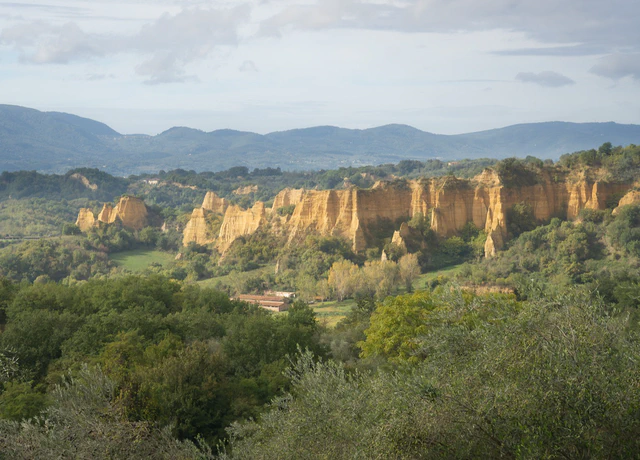
The Balze del Valdarno
Towers and walls of pale sand and clay, left behind by the lake that filled this valley before the Arno cut through it. Late in the afternoon they turn gold. An easy walk, 41 km from Arezzo and 42 from Florence.
Easy
View this hikeThe practical side of the day, distances and all, is in my Balze del Valdarno post.
Frequently asked questions
Walk Leonardo's Valley with Me
The Balze walk isn’t priced yet, but the request form already works. Send me your dates and how many of you are coming, and I’ll reply with the route, the hours and what it costs as soon as they’re fixed. Nobody is committed to anything until you’ve seen them.