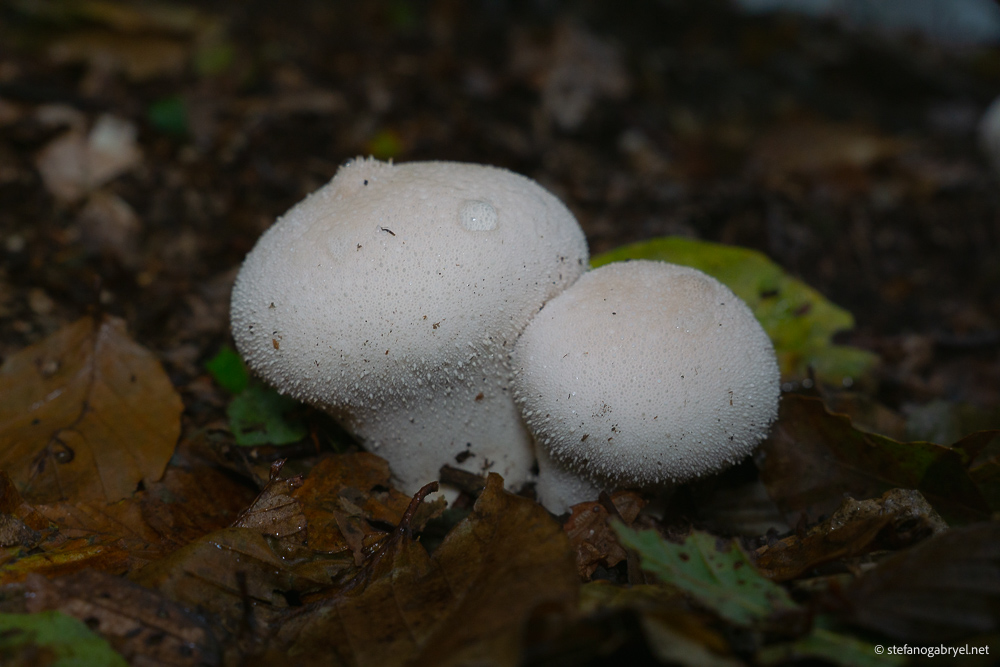
Walk through almost any Tuscan forest in autumn and you’ll see them: small, white, pear-shaped mushrooms scattered across the forest floor like abandoned golf balls.
Most foragers ignore them completely, eyes scanning for the prized porcini or the distinctive caps of parasols.
But those overlooked white spheres—Lycoperdon perlatum, known in Tuscany as “vescia”—deserve more attention than they receive.
Not because they’re spectacularly rare or economically valuable, but because they represent something increasingly uncommon: a truly beginner-friendly edible mushroom with a surprisingly delicate flavor.
When properly prepared, young vescia have a taste that reminds many people of crab or delicate seafood.
And the identification, when done correctly, is genuinely foolproof.
What Vescia Actually Are
Lycoperdon perlatum belongs to the puffball family—mushrooms that produce spores internally rather than on external gills.
The Italian name “vescia” relates to “vescica” (bladder), referring to the way mature specimens release clouds of spores when compressed.
In Tuscany, you’ll hear various local names:
- Vescia (most common)
- Loffa
- Puzzola (though this sometimes refers to other puffball species)
The “perlatum” in the scientific name means “adorned with pearls,” describing the small, warty spines that cover young specimens.
These spines wear off as the mushroom matures, leaving a smooth, net-like pattern on the surface.
The fruiting body is roughly pear-shaped, usually 3-6 centimeters tall, with a rounded head tapering to a stem-like base.
Young specimens are pure white throughout.
As they age, the interior transforms from firm white flesh to yellowish, then olive-brown, finally becoming a mass of brown spore powder.
You want them when they’re completely white inside—that’s the edible stage.
Where to Find Them: Sandy Soil Secrets
Unlike mycorrhizal mushrooms that require specific tree partnerships, Lycoperdon perlatum is a saprotroph—it feeds on decaying organic matter.
This gives it flexibility in where it can grow, but it does have preferences.
In my experience guiding across Tuscan forests, I find vescia most abundantly in areas with sandy or well-drained soil.
Typical habitats include:
- Pine forests where sandy soil and acidic conditions prevail
- Mixed woods with sandy underlayers
- Forest edges where soil drainage is good
- Disturbed areas with sandy soil enriched by organic matter
The connection to sandy soil isn’t absolute—I’ve found them in other soil types—but if you’re specifically hunting vescia, sandy pine woods are your best bet.
They often fruit in groups or small clusters rather than as isolated individuals.
Seasonality runs from late summer through autumn (August-November), with peak abundance in September and October following good rainfall.
Unlike some mushrooms that appear suddenly after rain and disappear within days, puffballs have reasonable longevity.
A good fruiting patch might produce specimens over several weeks as new individuals emerge.
The Safe Identification Protocol
Here’s what makes vescia genuinely beginner-friendly: the identification method is simple, visual, and eliminates all dangerous look-alikes.
Step 1: External appearance
Look for small, white, pear-shaped mushrooms with a warty or pearly surface when young.
No gills visible underneath (puffballs don’t have gills).
Grows from the ground, not from wood.
Step 2: The critical cut test
This is non-negotiable: always cut every puffball in half vertically before harvesting.
What you should see in an edible vescia:
- Completely uniform white interior, like fresh mozzarella
- Firm texture, not spongy or hollow
- No internal structures visible (no gills, no developing cap, no dark areas)
If the interior is pure white and uniform, you have an edible puffball.
If you see anything else—any structure, any darkness, any non-white areas—do not eat it.
Understanding the Lookalikes
The cut test exists because young puffballs can superficially resemble two things: other fungi that aren’t puffballs, and puffballs past their edible stage.
Earthballs (Scleroderma species)
Earthballs are toxic puffball relatives that can look similar externally.
Key differences:
- Earthballs have much thicker, tougher skin
- The exterior is often yellowish-brown rather than pure white
- Most critically: when cut open, the interior is dark—purplish-black or dark gray, never pure white
The cut test immediately eliminates any risk of confusion.
If you cut open what looks like a puffball and see dark interior flesh, you’ve found an earthball.
Discard it.
Young Amanita “Eggs”
This is the more serious safety concern.
Deadly Amanita species (including Amanita phalloides, the Death Cap) begin their development as egg-like buttons emerging from the ground.
At this stage, they can superficially resemble small puffballs.
However, the cut test reveals the difference immediately:
When you slice a young Amanita egg in half vertically, you’ll see the developing mushroom inside—the outline of the cap, the gills, the stem, all compressed but visible in cross-section.
It looks like a tiny mushroom folded up inside an egg.
A true puffball shows none of this internal structure.
Just uniform white flesh, like cutting into a ball of mozzarella.
This is why the cut test is mandatory, not optional.
It’s the difference between eating a harmless puffball and consuming a potentially lethal Amanita.
Old Puffballs
Even genuine Lycoperdon perlatum becomes inedible with age.
As the mushroom matures:
- The white interior flesh begins turning yellowish
- Eventually it becomes olive-brown
- Finally it transforms into brown spore powder
Only the pure white stage is edible.
If you cut one open and see any yellowing, any brown color, any transformation toward spore production, leave it.
It won’t kill you, but it will taste terrible and could cause digestive upset.
The Unexpected Flavor: Why “Crab Mushroom” Makes Sense
Here’s what surprises people about vescia: the flavor is delicate, almost sweet, with umami notes that remind many people of seafood.
The comparison to crab isn’t universal, but it’s common enough that some foragers call these “crab mushrooms.”
The texture when properly cooked is tender but with slight resistance—again, somewhat reminiscent of seafood.
This is completely different from the robust, earthy flavor of porcini or the nutty taste of parasols.
Why They’re Overlooked
The paradox of Lycoperdon perlatum is that it’s common, safe, and tasty—yet largely ignored by foragers.
Several reasons explain this:
Cultural perception:
In Italy, and especially Tuscany, mushroom foraging is dominated by the porcini obsession.
Everything else is somewhat secondary.
Puffballs don’t have the prestige, don’t command market prices, and aren’t part of traditional high-status cuisine.
The name “vescia” itself carries slightly dismissive connotations—it’s the mushroom you settle for when you can’t find anything better.
Appearance:
Vescia aren’t dramatic. They don’t have the stature of parasols, the distinctive orange of Lactarius deliciosus, or the robust caps of porcini.
They’re small, white, easily missed.
Many foragers literally walk past them without registering their presence.
Short edible window:
Unlike porcini which have some leeway in harvest timing, vescia must be caught at exactly the right stage.
Wait too long and they’re inedible.
This requires more attention and frequent checking.
Lack of knowledge:
Many casual foragers simply don’t know vescia are edible, or don’t know how to prepare them properly.
Without that knowledge, there’s no motivation to harvest them.
What Vescia Teach Us
From my perspective as both a guide and someone who values the complete fungal ecosystem, Lycoperdon perlatum represents something important.
These mushrooms demonstrate that:
Abundant doesn’t mean worthless.
Just because something is common and easy to find doesn’t make it less valuable culinarily or ecologically.
The rarity obsession in mushroom hunting sometimes causes us to overlook genuine quality.
Safe identification is possible.
The cut test for puffballs is foolproof if you actually do it.
This makes vescia one of the best teaching species for beginners—success builds confidence.
Flavor is subjective.
Some people try vescia and find them bland. Others genuinely appreciate the delicate, almost seafood-like flavor.
Neither response is wrong—it’s about palate and preparation.
Ecosystem diversity matters.
A forest producing abundant vescia is telling you something about soil health, organic matter decomposition, and fungal diversity.
These aren’t just “food items”—they’re indicators of ecosystem function.
My Recommendation
If you’re beginning mushroom foraging, start with vescia.
Not because they’re the most exciting find, but because the identification is genuinely safe when done correctly, and success builds the confidence and skills you’ll need for more challenging species.
The protocol:
- Find small, white, pear-shaped puffballs in sandy soil areas
- Cut every single one in half vertically
- Verify pure white interior with no internal structures
- Harvest only those that pass this test
- Prepare them simply to appreciate the delicate flavor
If you’re an experienced forager who’s been ignoring them:
Maybe reconsider.
On days when porcini are scarce and other choice species aren’t fruiting, a basket of fresh vescia properly prepared makes a genuinely good meal.
The crab-like flavor is real if you cook them right.
And there’s something satisfying about appreciating a common mushroom that most people overlook.
It suggests you’re looking at the forest as it actually is, not just as a source of prestigious species.
Are you a beginner?
If you’re just beginning to explore mushroom foraging, Geoff Dann’s Edible Mushrooms is the field guide I recommend to all my clients. It’s an excellent starting point for learning safe identification. Read my full review here.
Want to learn in the field? Join me for a hands-on mushroom hunting experience ⬇️ ⬇️ ⬇️ ⬇️
Ready to move from photos to field identification?
Experience these fascinating fungi firsthand on a guided autumn hike through Tuscan woodlands. Learn professional identification techniques, understand ecosystem roles, and capture your own stunning mushroom photography.
Attention!
While the content of this blog post is aimed at providing you with information as accurate as possible, it should be treated as what it is: simply a blog post on the internet.
Mushroom identification should only be performed by experts, as a mistake can lead to dire consequences. Attempting to identify a mushroom on your own, without prior experience, based solely on the content of this blog post is strongly discouraged.
Explore Hidden Tuscany
Guided hiking experiences combining expert trail knowledge, professional photography, and wilderness mindfulness.
Latest posts
 4 March 2026
Galium Aparine: Cleavers in Tuscan Hedgerows
4 March 2026
Galium Aparine: Cleavers in Tuscan Hedgerows 3 March 2026
Umbilicus Rupestris: Wall Pennywort in Tuscany
3 March 2026
Umbilicus Rupestris: Wall Pennywort in Tuscany 3 March 2026
Laurus Nobilis: Bay Laurel in Tuscan Landscapes
3 March 2026
Laurus Nobilis: Bay Laurel in Tuscan Landscapes 2 March 2026
Guided Tours for Exploring Marble Quarries in Apuan Alps
2 March 2026
Guided Tours for Exploring Marble Quarries in Apuan Alps 26 February 2026
Photographing Nottolini Aqueduct: Light & Geometry
26 February 2026
Photographing Nottolini Aqueduct: Light & Geometry