
I'm Stefano, and I guide people through the Tuscany most tourists never see. Want to hike in Tuscany with me?
Last updated 26 September 2026
As a base, Siena wins when your days are hill towns, Chianti and the Val d’Orcia by car. If you’re coming to walk, and above all if you won’t have a car, stay in Lucca. Lucca or Siena for one day out of Florence is a separate question, and for that one I’d send you to Siena.
I’m based about half an hour from Lucca and a little over an hour from Siena. I guide walks around Lucca, so you know which way my bias runs before you read any further. The Lucca or Siena threads on the Rick Steves forum mostly settle on Siena, usually because it’s more central. For a driver heading into Chianti, that’s the right call. Walking hardly comes up in those threads, and it’s the one part of the question I can answer from my own work.
Lucca or Siena as a Base, by Kind of Trip
- You want to walk most days, and you’d rather not drive. Lucca. The station sits just outside the walls, with regional trains to Pisa and to the coast at Viareggio. Monte Pisano rises at the edge of town, and the one walk I guide straight from the station, along the Nottolini aqueduct, starts about ten minutes away on foot.
- Mountain days, with a car. Lucca again, with the Apuan Alps to the north and the Pistoiese Apennines to the east. All three mountain walks further down start in one or the other.
- Hill towns and wine country. Siena. Castellina in Chianti is about 25 minutes from it by car, while from Lucca the drive to Siena alone takes about an hour and three quarters.
Lucca sits on a plain, so after six hours out at Lago Scaffaiolo the stroll to dinner is flat. Siena’s three hills are harder on tired legs. Its station also sits below the old town, and from there you ride 283 metres of escalators up toward Porta Camollia before the walk into the centre even begins. I’d rather step off a train and be at the walls in five minutes.
| Lucca | Siena | |
|---|---|---|
| The old town | Flat, inside 4.2 km of walls | Built on three hills around Piazza del Campo |
| Station to centre | About five minutes on foot to the walls | Escalators up from below the hill, then a walk in |
| Trains | Pisa about 30 min, Viareggio about 25, Florence about 1 hr 30 | Regional lines only, no direct train to Lucca |
| By car | The three mountain walks below, 61 to 67 km | Pienza, in the Val d’Orcia, about 56 km |
| I’d base there for | Walking days, with or without a car | Hill towns, Chianti and the Val d’Orcia |
Some forum answers suggest Florence instead, as the rail hub. That’s a fair answer for museums. For walking, Florence puts about an hour and a half of regional train between you and Lucca station before the aqueduct walk has started, and the same again to get home, which is a lot of sitting on either side of a three-hour walk.
I’ve written up the car question separately, in do you need a car in Tuscany. Pisa works as a walking base in much the same way, half an hour down the line and with the airport inside the city, and it has its own page, Pisa as a base for nature. How many days Lucca itself deserves I’ve answered in is Lucca worth visiting.
Walking From a Lucca Base, Nearest First
Every walk below is one I guide, and the distances are by road from Lucca.
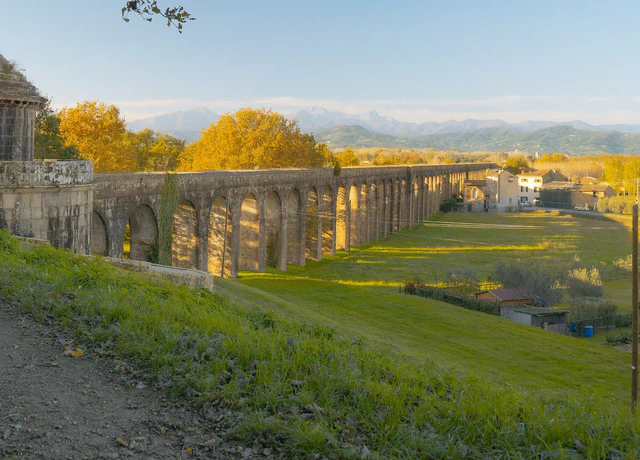
The nearest one starts in town. The Nottolini aqueduct begins at the Tempietto di San Concordio and runs its arches out across the plain toward the foothills of Monte Pisano. There’s no gate, no ticket and no opening hours, so you could walk it alone. With me, the day carries on past the last arch to the source that feeds it, and comes back the same way.
Nottolini Aqueduct
The aqueduct doubles as a sundial. Once a day the light runs straight down its corridor of arches, at a time that shifts through the year.
- About 3 hours
- €165 per group
- Reachable by train
- Longer route to a view over Lucca, on request
Easy · 9.1 km (5.7 mi) · 50 m (164 ft) ascent
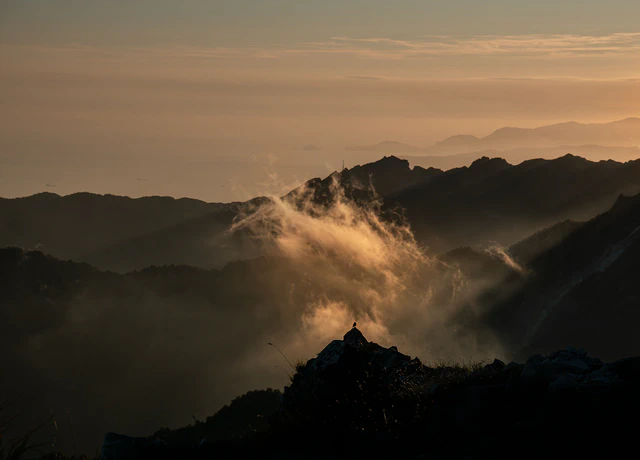
View this hikeThe Marmifera del Corchia runs on Saturdays and Sundays only. On weekdays the road belongs to the marble trucks, which makes this the one walk here you plan the week around. It starts at Passo Croce, 1,150 metres up in the Apuan Alps and 61 km from Lucca, and of the three mountain days it’s the shortest.
Marmifera del Corchia
The road climbs past active quarries with Viareggio and Forte dei Marmi below you. On clear days you can pick out Corsica.
- About 3.5 hours
- €210 per group
- Saturdays and Sundays only
Medium-Easy · 7 km (4.3 mi) · 420 m (1,378 ft) ascent
View this hikeLago Nero lies 63 km from Lucca, in the Apennines above Abetone. You start at about 1,300 metres in beech and fir, and once the trees run out you reach the lake at 1,730, in a glacial cirque.

Lago Nero
Nero means black. From most angles the water looks it, and on a still day the surface mirrors the peaks around the basin.
- About 5 hours
- €240 per group
- Longer day on request
Medium · 8 km (5 mi) · 450 m (1,476 ft) ascent
View this hikeScaffaiolo is the furthest and the longest day, 67 km out and about six hours on foot. The lake sits at 1,775 metres on the ridge between Tuscany and Emilia-Romagna. The Rifugio Duca degli Abruzzi beside it opens in summer only. You bring your own food and water either way, and outside the summer months there’s no open refuge to fall back on.

Lago Scaffaiolo
- About 6 hours
- €240 per group
- Shorter or longer day on request
Medium · 9.5 km (5.9 mi) · 370 m (1,214 ft) ascent
View this hikeI’ve written up both of the high lakes, with the months they’re actually walkable, in the lakes near Lucca. All three mountain days need a car. The trailheads sit about an hour to an hour and a half from Lucca by road. If you don’t have a car, tell me when you write and I’ll help you find a solution.
Choosing a base usually means several nights, and some of these days sit well together. I’d pair the aqueduct on a weekday with the Marmifera on the Saturday, or run the two lakes on consecutive days. Each day carries its own rate, so send me both dates in one message and I’ll check them together.
Those extra nights help with the weather too. I can’t tell you a week ahead what the crest at Scaffaiolo will be doing, so I make the call the evening before, and you’ll hear from me by 20:00 only if something has to change. Rain alone never cancels a walk. When a named danger rules the day out, such as a storm you can’t plan around or strong wind on the crest, I reschedule first, and a longer stay leaves more days to move to. In July and August the lakes are also where I’d head to get out of the heat, because everything below 1,000 metres bakes.
Everything I run from the city is on my hiking near Lucca page. The coast and Pisa, which you can reach by train and see perfectly well without me, are in the day trips from Lucca.
What Siena Does Better
Siena’s centre is built around Piazza del Campo, the shell-shaped square where the Palio is run on 2 July and 16 August, with trial races on the days before each one. If your dates touch the Palio, settle whether you want a bed in Siena for it before anything else. Chianti begins just north of the city, and the Val d’Orcia lies to the south. Those are the two landscapes most people picture when they think of Tuscany. UNESCO has listed both the Val d’Orcia (2004) and Siena’s centre (1995). For a trip built on a different hill town every day by car, I’d sleep there.
I don’t guide anywhere around Siena, so I can’t tell you which paths down there deserve a day of your trip. The two towns do meet on foot, though. The Via Francigena runs from Lucca through San Gimignano to Siena, a walk of several days done in stages, and I’ve written about the Tuscan stretch of the Via Francigena for anyone tempted to link them that way.
Lucca or Siena for a Day Trip
From Florence, both take about an hour and a half on a regional train. Lucca’s station is about five minutes from the walls and Siena’s leaves you at the foot of those escalators, but for one day of sightseeing I’d still pick Siena, for the Campo and the Gothic centre around it. Check the Lucca timetable before you set off, since the line has had weekend closures for track works.
Between the two towns there’s no direct train, so a day trip from Lucca to Siena means two and a half to three hours each way with at least one change. The drive is about 140 km, roughly an hour and three quarters. By train I wouldn’t bother. Pick one as your base, and if you want nights in both, split the stay.
Frequently asked questions
Plan Your Walking Days From Lucca
Send me your dates and how many of you are coming, and I’ll say which of the aqueduct, the Marmifera, Lago Nero and Scaffaiolo fit around your stay. From May to October my free days go early, so the sooner you write the better, though if one is genuinely open I can still take a booking at 24 hours’ notice. Not on WhatsApp? The contact form works just as well, and you can list all your dates in one message.