In the forests of Northern Europe—Scandinavia, the Baltic states, Russia—Leccinum scabrum is so common that foragers almost take it for granted.
In Tuscany, finding one is a minor event.
Not because the mushroom is inherently rare or particularly valuable, but because its obligate partner—the birch tree—is scarce in our region.
Leccinum scabrum, the birch bolete or “porcinello” as it’s sometimes called in Italian, cannot exist without birch.
The mycorrhizal relationship is absolute, exclusive, and inflexible.
No birch trees means no birch boletes, regardless of how perfect the other habitat conditions might be.
So when I do encounter Leccinum scabrum during hikes in Tuscany—typically at higher elevations in the Apennines where scattered birches grow among the more dominant beeches—it’s worth noting.
This is a mushroom that tells you something specific about the trees around you, even before you consciously register the presence of birch.
What You’re Looking At
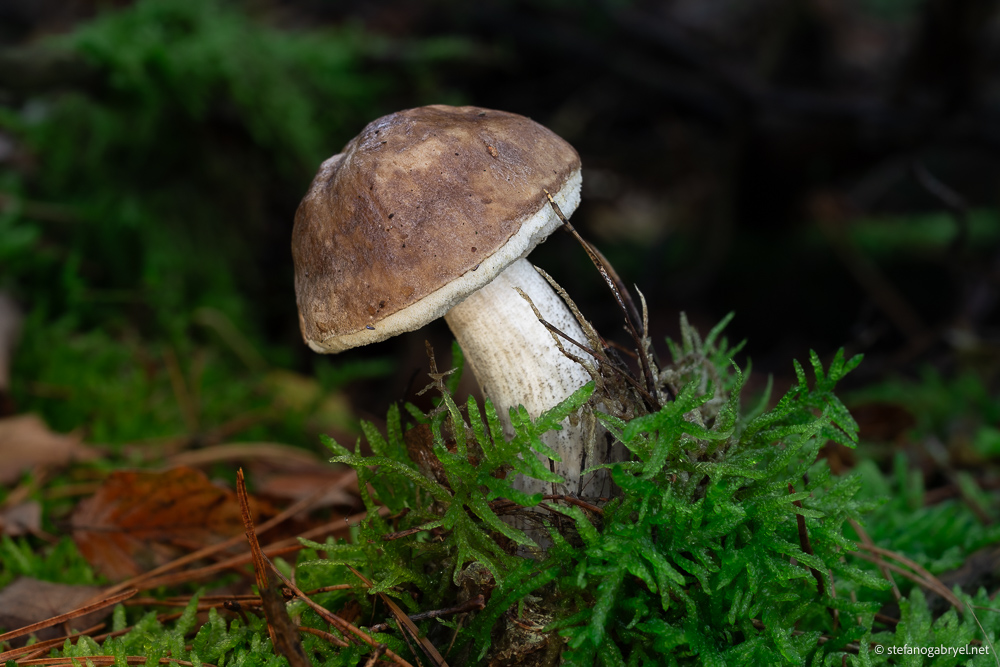
Leccinum scabrum follows the typical bolete form: a cap and stem, with pores rather than gills on the underside of the cap.
The cap ranges from 5-15 cm across, sometimes larger, starting hemispheric and expanding to convex or nearly flat with age.
The color varies considerably—from pale grey-brown to darker brown, sometimes with olive or reddish tones, occasionally almost tan.
The surface is smooth or slightly sticky when wet, dry in drier conditions.
The pores underneath are initially white, becoming dirty cream or grey-brown with age.
They’re small, closely packed, and when bruised or cut, the flesh typically turns pinkish or wine-red, then eventually darkens to grey or black.
This color change is distinctive and helps with identification.
But the defining feature is the stem—specifically, the surface texture.
The stem is 8-15 cm tall, relatively slender compared to robust porcini, typically widening slightly toward the base.
The color is pale—whitish to grey—but what matters is the covering of small, dark scales or “scabers” that roughen the surface.
These raised scales give the mushroom both its species name “scabrum” (rough, scurfy) and its common name in several languages.
In English: “rough-stemmed bolete.”
In German: “Birkenrotkappe” (birch red-cap, though the cap isn’t always red).
In Italian: various names including “porcinello,” “volpino,” or “bruschitt” in some northern dialects.
These stem scales are the tactile signature of Leccinum species generally.
Run your finger down the stem and you feel the roughness—quite different from the smooth stems of porcini or the reticulated (net-like) pattern of some other boletes.
The Birch Partnership: An Exclusive Relationship
Understanding Leccinum scabrum means understanding its absolute dependence on birch trees.
This is mycorrhizal symbiosis in its most specialized form.
The fungal mycelium colonizes the fine roots of birch trees (Betula species).
The fungus provides the tree with enhanced nutrient and water absorption, particularly phosphorus.
The tree provides the fungus with carbohydrates from photosynthesis.
But unlike some mycorrhizal fungi that can partner with multiple tree genera, Leccinum scabrum is a birch specialist.
You will never find it under oaks, never under pines, never under beeches.
Only birch.
In Northern Europe where birch forests are extensive, this specialization isn’t limiting—L. scabrum grows prolifically wherever birches thrive.
In Tuscany, where birch is a minor component of the forest flora, this exclusivity means the mushroom is correspondingly uncommon.
Where you might find birches in Tuscany:
- Higher elevations in the Apennines and Apuan Alps (1,000+ meters)
- Mixed mountain forests where birch grows among dominant beech
- Occasionally as pioneer species in disturbed or recovering forest areas
- Wetland edges or stream valleys where conditions suit birch
The birches in Tuscany are typically Betula pendula (silver birch), recognizable by the white bark with black fissures, and the graceful, drooping branch tips.
If you’re not familiar with identifying birch trees, Leccinum scabrum won’t help you find them—you need to identify the trees first to know where to look for the mushrooms.
Seasonality and Fruiting Patterns
In the limited birch habitat available in Tuscany, Leccinum scabrum fruits from summer through autumn (June-November), with peak abundance in late summer and early fall.
The fruiting is less prolific than you’d see in birch-dominated northern forests, simply because there are fewer trees supporting fewer fungal colonies.
Individual specimens grow relatively quickly—a young button can reach full size in a week under good conditions.
They don’t persist long at peak quality:
Within days of reaching maturity, the flesh begins to soften, insects move in, and the mushroom deteriorates.
This is not a species you can afford to “check back on later”—if you find young, firm specimens, that’s the time to harvest if you’re planning to eat them.
Edibility: Good But Not Great
Leccinum scabrum occupies a middle tier in the hierarchy of edible boletes.
It’s genuinely edible and safe, with no toxic lookalikes in our region that share the scaly stem characteristic.
But it’s not porcini.
Culinary characteristics:
Flavor: Mild, pleasant, mushroomy but not intense. Some describe it as slightly nutty or earthy.
Texture: The cap flesh is relatively soft, especially in older specimens. When cooked, it can become somewhat spongy or mushy if overcooked.
According to most books the stem is typically too fibrous to bother with—discard it or save for stock, I have consumed it myself, and I find it ok.
Color change: The pinkish-wine-red bruising and eventual blackening when cut is harmless but not particularly appetizing visually. The cooked mushroom will be darker than fresh porcini.
Water content: Higher than porcini, which means they release more liquid during cooking. Expect them to shrink considerably and produce moisture in the pan.
What to avoid:
- Eating raw (all Leccinum species should be cooked)
- Very old specimens (they become mushy and unpleasant)
- Overcooking (they turn to mush)
Honest assessment:
If you find Leccinum scabrum in Tuscany’s limited birch habitat, it’s worth taking home if you want to eat it.
The flavor is good, the mushroom is safe, and there’s satisfaction in finding something relatively uncommon in our region.
But if you’re specifically hunting mushrooms for cuisine, you’d rather find porcini.
The superior texture, flavor, and culinary versatility of Boletus edulis group mushrooms makes them more desirable.
Leccinum scabrum is “good enough” rather than “excellent.”
Identification and Potential Confusion
Key identifying features:
- Habitat: Exclusively under or near birch trees
- Cap: 5-15 cm, grey-brown to brown, smooth or slightly sticky
- Pores: White becoming cream-grey, bruising pinkish then darkening
- Stem: 8-15 cm, pale with dark rough scales (scabers)
- Flesh: White, turning pinkish-wine when cut, eventually grey-black
- Spore print: Olive-brown
The scabrous stem is diagnostic for Leccinum species generally.
No other bolete genus in Tuscany has this roughened, scaly stem texture.
Potential confusion within the Leccinum genus:
Several Leccinum species exist, each associated with different trees:
- Leccinum aurantiacum (red-capped bolete) - with aspen/poplar, orange-red cap
- Leccinum versipelle (orange birch bolete) - with birch, orange-red cap, darkens dramatically when cut
- Leccinum carpini - with hornbeam
- Leccinum quercinum - with oak
In Tuscany, the oak-associated species are more common than the birch species simply due to tree distribution.
The orange-capped birch boletes (L. aurantiacum, L. versipelle) are even rarer than L. scabrum due to the scarcity of their host trees.
All Leccinum species are edible when cooked, though quality varies.
So even if you confuse one Leccinum for another, you’re not at risk of poisoning.
The main identification task is distinguishing Leccinum from other bolete genera:
- Porcini (Boletus edulis group): Smooth or reticulated stem, never scaly. Superior eating quality.
- Bay bolete (Imleria badia, formerly Boletus badius): Smooth stem, bay-brown cap that bruises blue-green.
- Bitter bolete (Tylopilus felleus): Similar form but intensely bitter taste (a tiny nibble reveals this).
The scaly stem eliminates confusion with all of these.
If the stem has those rough, dark scales, you’re looking at Leccinum, and all Leccinum species are edible when cooked.
What Finding It Tells You
When I encounter Leccinum scabrum during hikes in the Tuscan Apennines, it serves as an ecological indicator.
This mushroom’s presence confirms:
Birch trees are nearby, even if you haven’t consciously noticed them.
Leccinum scabrum doesn’t fruit far from its host—if you find the mushroom, the birch is within a few meters at most.
The mycorrhizal network is healthy.
Robust fruiting indicates the fungus has established a successful partnership with birch roots, which suggests both tree and fungus are thriving.
The forest is ecologically diverse.
In Tuscany where beech and chestnut often dominate at elevation, the presence of birch (and its associated fungi) indicates habitat heterogeneity rather than monoculture.
Why It Matters Despite Being Uncommon
Leccinum scabrum will never be abundant in Tuscany.
The limited birch habitat guarantees this.
But that’s exactly why it’s worth knowing.
In mycology, understanding the relationship between fungi and their ecological requirements teaches you to read the forest.
The presence or absence of specific mushrooms tells you about soil chemistry, tree species, moisture regimes, and forest history.
Leccinum scabrum is a birch indicator—find the mushroom and you’ve found the tree, or vice versa.
This is the kind of knowledge that separates casual mushroom hunting from true forest literacy.
Anyone can walk through the woods looking for porcini.
Understanding that a scaly-stemmed bolete means birch presence, that birch presence means specific soil and moisture conditions, that these conditions support particular plant communities and other fungi—this is reading the landscape as an integrated system.
And from a guiding perspective, Leccinum scabrum provides teaching moments.
When we find one during a hike, I can explain:
- Mycorrhizal specificity and how it differs from generalist fungi
- Why tree species distribution affects mushroom distribution
- How to identify birch trees (many people don’t know birch from other trees)
- The role of pioneer species like birch in forest succession
- Comparative edibility among bolete species
A single mushroom becomes a portal to understanding forest ecology.
The Practical Reality
If you’re visiting Tuscany hoping to forage Leccinum scabrum, manage your expectations.
Unless you’re specifically hiking in high-elevation Apennine forests, or Apuan Alps, with confirmed birch presence, you’re unlikely to encounter it.
And even in appropriate habitat, it won’t be abundant.
This isn’t the mushroom to plan a trip around.
But if you’re already hiking in the right areas for other reasons—exploring the Apennines, photographing mountain landscapes, looking for porcini or other species—and you happen upon Leccinum scabrum, it’s a pleasant discovery.
Worth photographing, worth harvesting if you want to eat it, worth appreciating as an indicator of the birch-fungus partnership.
Just don’t expect the culinary revelation that finding a basket of prime porcini delivers.
This is a good, edible mushroom with interesting ecology and distinctive identification features.
That’s enough.
Are you a beginner?
If you’re just beginning to explore mushroom foraging, Geoff Dann’s Edible Mushrooms is the field guide I recommend to all my clients. It’s an excellent starting point for learning safe identification. Read my full review here.
Want to learn in the field? Join me for a hands-on mushroom hunting experience ⬇️ ⬇️ ⬇️ ⬇️
Ready to move from photos to field identification?
Experience these fascinating fungi firsthand on a guided autumn hike through Tuscan woodlands. Learn professional identification techniques, understand ecosystem roles, and capture your own stunning mushroom photography.
Attention!
While the content of this blog post is aimed at providing you with information as accurate as possible, it should be treated as what it is: simply a blog post on the internet.
Mushroom identification should only be performed by experts, as a mistake can lead to dire consequences. Attempting to identify a mushroom on your own, without prior experience, based solely on the content of this blog post is strongly discouraged.
Explore Hidden Tuscany
Guided hiking experiences combining expert trail knowledge, professional photography, and wilderness mindfulness.
Latest posts
 4 March 2026
Galium Aparine: Cleavers in Tuscan Hedgerows
4 March 2026
Galium Aparine: Cleavers in Tuscan Hedgerows 3 March 2026
Umbilicus Rupestris: Wall Pennywort in Tuscany
3 March 2026
Umbilicus Rupestris: Wall Pennywort in Tuscany 3 March 2026
Laurus Nobilis: Bay Laurel in Tuscan Landscapes
3 March 2026
Laurus Nobilis: Bay Laurel in Tuscan Landscapes 2 March 2026
Guided Tours for Exploring Marble Quarries in Apuan Alps
2 March 2026
Guided Tours for Exploring Marble Quarries in Apuan Alps 26 February 2026
Photographing Nottolini Aqueduct: Light & Geometry
26 February 2026
Photographing Nottolini Aqueduct: Light & Geometry