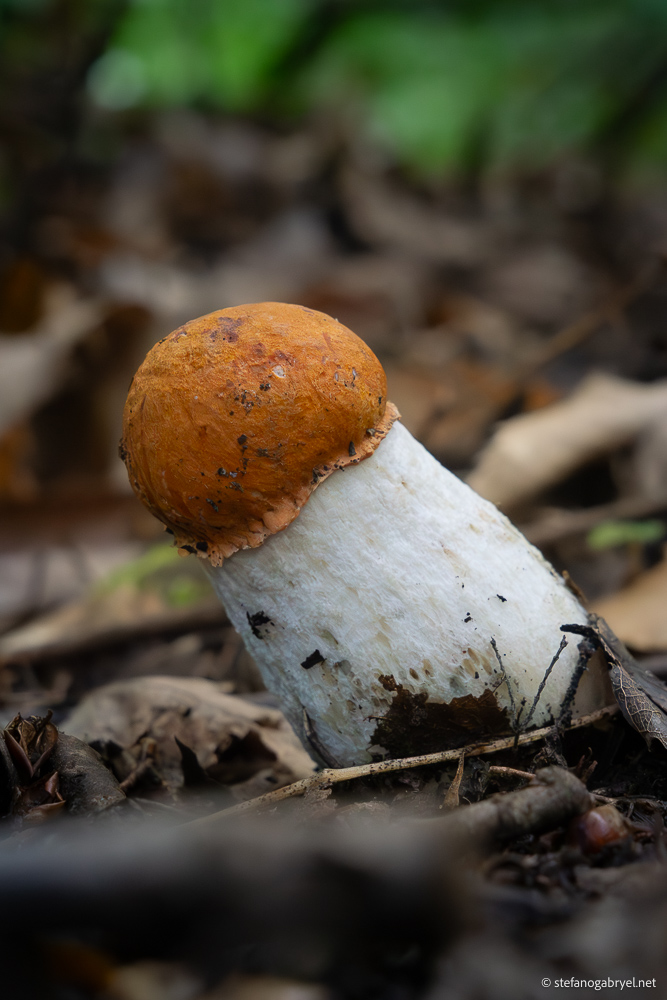
You find it at the base of an aspen—orange-red cap against pale leaf litter.
You cut it open. The flesh is white and firm.
You set it down and move a few steps away to continue searching.
You look back two minutes later.
The flesh has turned dark grey. Almost black.
No other mushroom in Tuscany’s forests does this quite so dramatically.
This is Leccinum aurantiacum, the red aspen bolete—known in Italy as the porcinello rosso.
What You’re Looking At
Leccinum aurantiacum is a bolete.
Like the porcini, it carries pores rather than gills on the cap underside.
But where porcini have smooth stems with a fine net-like pattern, Leccinum has something entirely different.
The stem is covered in rough, raised tufts called scabers.
On aurantiacum, these are orange-brown to reddish—giving the whole genus its English common name: the scaber stalks.
Run your finger down the stem and you feel them immediately.
The cap ranges from 6 to 20 cm across. It starts round and firm, expanding to broadly convex with age.
The color is warm orange to brick red—variable between specimens, always in that orange-red spectrum.
The surface is dry to slightly velvety when young, smoothing with age.
The pores underneath are off-white to pale grey, small and closely packed.
The stem reaches 10-20 cm, pale whitish, entirely covered in those distinctive orange-brown scabers.
Saprophytic, Decomposer, or Mycorrhizal?
Not all mushrooms feed the same way.
Saprophytic fungi break down dead organic matter in the soil—leaf litter, humus, decomposing plant material.
They are the forest floor’s recycling system. Many common woodland species feed this way.
Decomposer fungi go further, breaking down the toughest structural material: lignin and cellulose in dead wood.
Think of bracket fungi on fallen logs—specialist engineers of decay.
Mycorrhizal fungi are something else entirely.
They form a living partnership with the roots of living trees.
The fungus colonizes the fine root tips, extending the tree’s ability to absorb water and minerals—particularly phosphorus.
In exchange, the tree supplies the fungus with sugars produced through photosynthesis.
Neither partner thrives as well without the other.
For the forager, this has one essential practical implication: a mycorrhizal mushroom is always found near its host tree.
No tree, no mushroom. Ever.
Leccinum aurantiacum is strictly mycorrhizal.
And its host tree is very specific.
The Key Indicator: Populus tremula
Leccinum aurantiacum grows almost exclusively with Populus tremula—the trembling aspen, known in Italian as pioppo tremulo.
Not with oak. Not with beech. Not with chestnut.
Aspen.
This means learning to find this mushroom begins with learning to find its tree.
Populus tremula is one of the easier trees to identify in the field.
The leaves are roughly circular, 3-8 cm across, with a slightly wavy edge.
What makes them extraordinary is the petiole—the leaf stalk.
It is flattened at a right angle to the blade.
This means even the slightest breeze sets the leaves in constant, shimmering motion.
Stand near an aspen and you hear it before you see it. A constant, soft rustling—even on nearly still days.
The bark on young trees is pale grey-green, smooth and almost chalky.
On older trunks it develops darker fissures lower down, while the upper branches stay pale.
Aspen is a pioneer species. It colonizes disturbed ground and open areas.
It is often the first tree to establish after clear-cuts, fires, or landslides.
In Tuscany’s Apennines and Apuan Alps, look for it in clearings, along forest margins, and on recently disturbed slopes at mid-to-high elevation.
Where aspen grows, the possibility of Leccinum aurantiacum exists.
Seasonality in Tuscany
Leccinum aurantiacum fruits from late spring through autumn—roughly June to October.
The earliest finds come in summer, from lower elevations where aspen grows in warmer conditions.
At higher elevations in the Apennines and Apuan Alps, fruiting peaks in August and September.
The mushroom needs moisture to fruit.
A dry summer suppresses fruiting even in good aspen habitat.
The most productive conditions are warm temperatures combined with generous rainfall.
Summer thunderstorms followed by warm, humid days create ideal conditions.
Unlike chanterelles or black trumpets which persist for weeks, Leccinum aurantiacum moves quickly from button to past-prime.
Check candidate areas regularly during the season. Young, firm specimens are the target.
The Black Secret
Here is the fact that stays with you after your first encounter.
Cut the flesh and watch it.
It begins white and firm.
Within minutes it turns pinkish-lilac.
Then grey.
Then, over the course of an hour or less, it darkens to an almost complete black.
This transformation is caused by oxidative reactions in the flesh.
It is harmless.
But it is dramatic—and it continues in the pan.
A pot of Leccinum aurantiacum will turn its cooking liquid dark grey.
The finished mushroom is markedly darker than fresh porcini.
David Arora in Mushrooms Demystified addresses this phenomenon directly. He notes that the dramatic color change in Leccinum species frequently alarms first-time cooks.
The color is cosmetic, not a warning.
The mushroom is still edible. The darkness is chemistry—not spoilage, not toxicity.
What you should pay attention to is a separate matter entirely.
Edibility: Capable but Careful
Leccinum aurantiacum is edible—but with conditions.
All Leccinum species must be cooked.
Raw consumption can cause gastrointestinal distress. This is consistent across the genus.
Mycological literature also notes occasional reports of mild GI issues even from cooked specimens.
Harvest young, firm caps and cook them thoroughly. This eliminates most risk.
The cap flesh is the prize. The stem is edible but fibrous—better reserved for stock.
The flavor is mild and pleasant. Mushroomy, slightly earthy.
It lacks the depth and intensity of porcini, but it’s a capable mushroom in the kitchen.
High water content means it shrinks considerably in the pan and releases liquid.
Cook on high heat to evaporate moisture and avoid a waterlogged result.
Potential Confusion: Know Your Leccinum
The scabrous stem is diagnostic for the entire Leccinum genus.
No other bolete in Tuscany has this roughened, tufted texture on the stem.
If you see the scabers, you are in Leccinum. The tree then tells you which species.
The main species to distinguish in Tuscany:
Leccinum scabrum — grey-brown cap, associates exclusively with birch. Much less dramatic flesh-darkening than aurantiacum.
Leccinum versipelle — also orange to orange-red cap, but its mycorrhizal partner is birch (Betula), not aspen. The flesh darkens just as dramatically. Considered edible under the same cooked-only conditions.
Leccinum quercinum — orange-red cap with an oak association. Given oak’s wide distribution in Tuscany, this species may be more commonly encountered than aurantiacum in many areas.
The tree within 15-20 meters is always your first diagnostic tool.
Aspen (Populus tremula) → almost certainly aurantiacum.
Birch (Betula pendula) → consider versipelle or scabrum.
Oak (Quercus spp.) → likely quercinum.
Stefan Buczacki in Collins Fungi Guide emphasizes that Leccinum species remain closely associated with their host trees throughout their entire lifecycle. The mycelium persists in the soil for years, ready to fruit when rainfall and temperature align.
This is why productive spots tend to be consistent year after year—as long as the host tree stands.
Where to Look in Tuscany
Leccinum aurantiacum is not common here—its range follows its host tree.
Aspen is a mountain species in Tuscany, scattered rather than dominant.
Focus your search on clearings and forest margins in the Apennines above 600 meters, disturbed or recovering woodland where aspen has colonized open ground, and the Apuan Alps at mid elevations in mixed forest edges.
When you find a productive aspen stand, return to it each season.
The mushroom tells you more about the forest than a trail map ever will.
Svizzera Pesciatina
The hills of the Svizzera Pesciatina hold the kind of mixed forest habitat where aspen establishes itself quietly alongside other species.
I have found Leccinum aurantiacum here, in the clearings and forest margins that characterize this area.
It is one of those locations that rewards slow, attentive walking more than distance covered.
I will be writing more extensively about the Svizzera Pesciatina in a dedicated article—it deserves it.
Acquedotto del Nottolini
The Acquedotto del Nottolini is better known for its 460 neoclassical brick arches and its bay laurel-lined path than for mushroom hunting.
But aspen grows in the surrounding countryside, and I have found Leccinum aurantiacum along this route.
It is a reminder that productive mushroom habitat is rarely where you expect it.
The combination of an architecturally extraordinary trail and the possibility of finding this striking bolete makes for an unusual and rewarding day out.
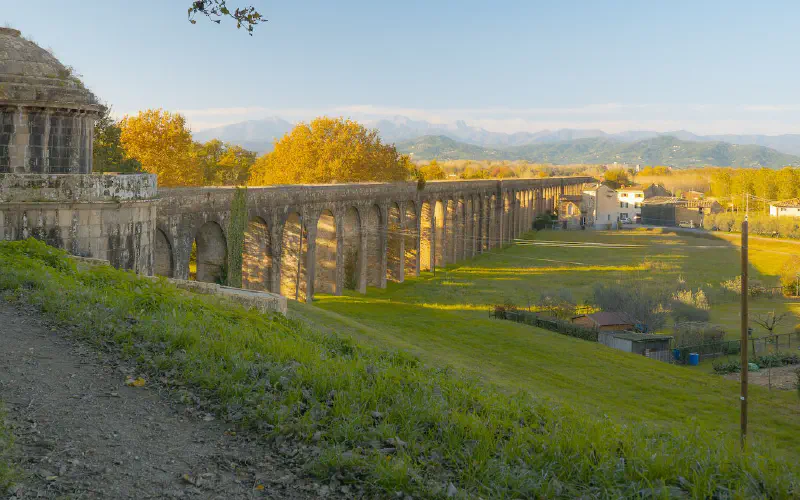
No car required: Walk the 400 arches of Nottolini Aqueduct from Lucca. Guided tour accessible by train. Discover 'Parole d'Oro'. Book now!
Are you a beginner?
If you’re just beginning to explore mushroom foraging, Geoff Dann’s Edible Mushrooms is the field guide I recommend to all my clients. It’s an excellent starting point for learning safe identification. Read my full review here.
Want to learn in the field? Join me for a hands-on mushroom hunting experience ⬇️ ⬇️ ⬇️ ⬇️
Ready to move from photos to field identification?
Experience these fascinating fungi firsthand on a guided autumn hike through Tuscan woodlands. Learn professional identification techniques, understand ecosystem roles, and capture your own stunning mushroom photography.
Attention!
While the content of this blog post is aimed at providing you with information as accurate as possible, it should be treated as what it is: simply a blog post on the internet.
Mushroom identification should only be performed by experts, as a mistake can lead to dire consequences. Attempting to identify a mushroom on your own, without prior experience, based solely on the content of this blog post is strongly discouraged.
Explore Hidden Tuscany
Guided hiking experiences combining expert trail knowledge, professional photography, and wilderness mindfulness.