Walk the slopes of Monte Pisano near Ripafratta and you’ll encounter something unexpected. Entire hillsides covered in bay laurel. Not the neat kitchen-garden plants in ceramic pots. Wild trees reaching 10-15 meters tall. Their glossy leaves releasing that unmistakable aroma when brushed.
Most people know Laurus nobilis only as dried leaves in the spice cabinet. The fresh plant in its native habitat tells a different story. This is a Mediterranean native that has shaped human culture for millennia. From victory crowns in ancient Greece to the word “laureate” itself.
In Tuscany, bay laurel grows wild throughout hills and valleys. It colonizes old walls like the Acquedotto del Nottolini. But most impressively, it forms dense stands on certain hillsides. The Monte Pisano forests near Ripafratta offer some of the most spectacular examples.
Recognition: More Than Kitchen Herb
Laurus nobilis is an evergreen shrub or tree. In cultivation, it remains small and manageable. In the wild, it can reach 7-18 meters tall. Occasionally even taller in protected locations.
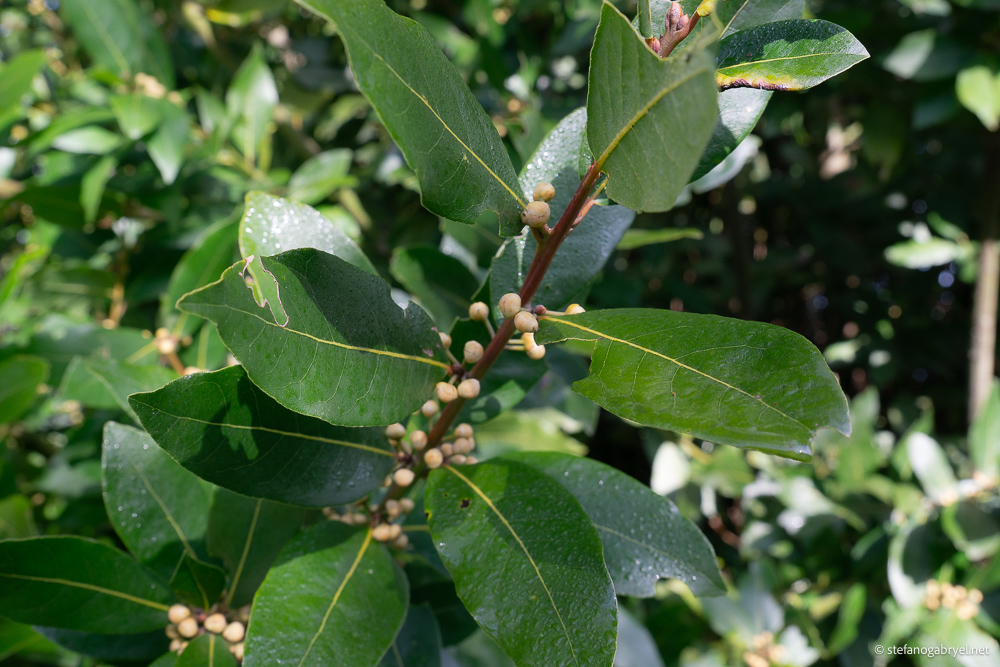
The leaves are the plant’s most distinctive feature. They measure 6-12 cm long and 2-4 cm wide. The shape is lance-like (lanceolate). The margin is entire—no teeth or serrations. Some leaves have slightly wavy edges. The surface is smooth (glabrous) and glossy. The color is dark green, leathery in texture.
Crush a leaf and the aroma is immediate. That’s how you confirm identification in the field. The scent is distinctive, aromatic, slightly peppery. Unmistakably bay.
The flowers appear in early to mid-spring (March-May in Tuscany). They’re small, pale yellow-green, about 1 cm in diameter. They appear in clusters (umbels) at the leaf axils. The plant is dioecious. This means individual trees are either male or female. Only female trees produce fruit.
The fruit develops through summer. By autumn, female trees bear small, shiny black drupes. Each fruit is roughly 1-1.5 cm long, oval in shape. They contain a single seed. Birds eat the fruits and disperse the seeds.
Habitat: Mediterranean Native
Laurus nobilis belongs to the Lauraceae family. This ancient plant family also includes avocado, cinnamon, and sassafras. The genus name Laurus and species epithet nobilis (noble or renowned) reference the plant’s cultural significance.
Bay laurel is native throughout the Mediterranean Basin. This includes southern Europe, North Africa, and western Asia. It’s found wild in Greece, Italy, Turkey, Spain, France (including Corsica), and the Maghreb countries.
The plant represents something important ecologically. It’s a relict species. A survivor from the ancient laurel forests that once covered much of the Mediterranean. When the climate dried during the Pliocene, these forests retreated. They were replaced by the drought-adapted scrubland (macchia) we see today. Most laurel forests disappeared roughly 10,000 years ago. But Laurus nobilis adapted and persisted.
In its native habitat, bay laurel prefers:
- Partial shade to full sun
- Well-drained soils (tolerates various types)
- Moderate to low moisture once established
- Protection from extreme cold and drying winds
- Coastal or temperate climates
The plant is drought-tolerant once established. This comes from its Mediterranean origins. But it performs best with some moisture. It thrives particularly well in valleys and north-facing slopes. Places where humidity lingers.
In Tuscany, you’ll find wild bay laurel:
- Along river valleys and gorges (especially the Serchio)
- On shaded hillsides and ravines
- Mixed into macchia Mediterranean scrubland
- Colonizing old stone walls and abandoned structures
- Forming pure stands on certain hillsides (particularly Monte Pisano)
The Monte Pisano Bay Forests
The slopes of Monte Pisano between Pisa and Lucca support something remarkable. Dense stands of wild bay laurel covering entire hillsides. These aren’t scattered individuals. These are nearly pure bay forests. Hundreds of trees growing together in ecological communities.
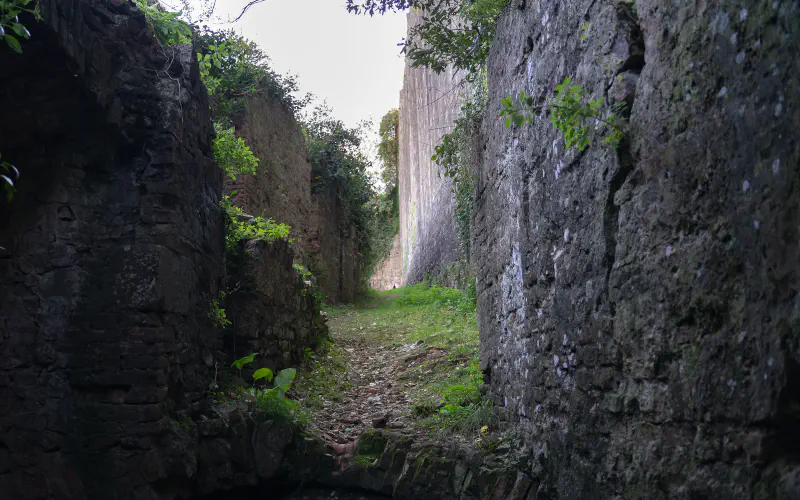
The Rocca di San Paolino hike at Ripafratta passes directly through these bay-dominated areas. The trail climbs from the Serchio gorge. It ascends through Mediterranean vegetation toward the medieval fortress. Along the way, bay laurel becomes the dominant woody species.
Walking through these stands, the sensory experience is overwhelming. The aromatic compounds in the leaves volatilize in warm weather. The air itself carries the scent. It’s particularly intense on hot days. Or after rain when moisture releases the oils.
The trees here reach impressive sizes. Many exceed 10 meters tall. Their trunks develop rough, dark gray bark. The canopy creates deep shade beneath. Few other plants grow in that shade. The fallen bay leaves decompose slowly. They release aromatic compounds that may inhibit other species. This is allelopathy—chemical warfare between plants.
The Monte Pisano conditions favor bay laurel for specific reasons:
- North-facing slopes provide shade and retain moisture
- Rocky, well-drained limestone soils prevent waterlogging
- Proximity to the Serchio River creates humid microclimates
- Historical land use (grazing, selective cutting) may have favored bay over competitors
- The gorge topography protects from harsh winds
These bay forests represent significant ecological communities. They’re not simply collections of individual plants. They create specific habitats. Certain insects, birds, and fungi associate specifically with bay. The forests provide shelter, food, and nesting sites for wildlife.
From a naturalist’s perspective, these stands offer exceptional observation opportunities. You can see bay laurel’s full growth form. Its natural stature and branching pattern. The way it competes with and excludes other species. How it reproduces and spreads in wild conditions. This is bay as an ecological entity, not a garden ornamental.
The Ripafratta hike allows you to walk directly through these communities. The trail is well-marked, moderate difficulty, accessible to most hikers. You pass beneath bay canopies. You brush against leaves releasing their fragrance. You see the fruits developing on female trees. You observe the full life cycle and ecological role of this culturally significant plant.
Book a private guided hike to Ripafratta Castle. Easy historical trekking from Pisa & Lucca. Discover 13th-century secrets. Reserve your tour now!
Along the Nottolini: Wall-Dwelling Bay
Bay laurel appears in different contexts depending on habitat. While Monte Pisano supports forest communities, other locations show different growth patterns.
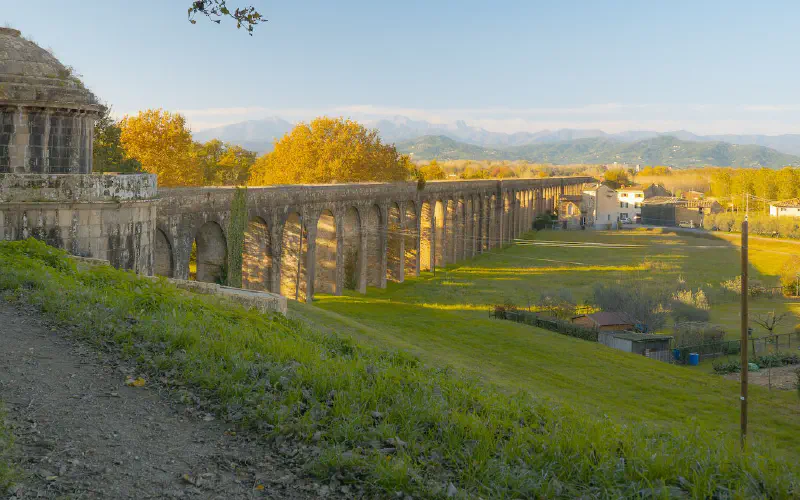
The Acquedotto del Nottolini hosts scattered bay laurel plants. They grow in crevices along the aqueduct’s brick arches. Or in adjacent hedgerows and field margins. These aren’t the dense stands of Monte Pisano. But they demonstrate bay’s versatility as a colonizer.
The aqueduct plants remain smaller. They grow as large shrubs rather than trees. But they produce the same aromatic leaves. The same spring flowers. The same autumn fruits. They show how bay adapts its growth form to available space and resources.
No car required: Walk the 400 arches of Nottolini Aqueduct from Lucca. Guided tour accessible by train. Discover 'Parole d'Oro'. Book now!
Culinary Uses: From Field to Kitchen
Laurus nobilis is the bay leaf of culinary tradition. The same species used in Mediterranean cooking for millennia. But there’s a significant difference between commercial dried leaves and fresh wild leaves.
Fresh leaves are more aromatic. They contain higher concentrations of essential oils. The flavor is stronger, more complex. More peppery and slightly bitter than dried leaves.
For culinary use, leaves can be harvested year-round. But summer harvesting is traditional. The oils are most concentrated then. Select mature, unblemished leaves from healthy plants. Avoid leaves showing pest damage or discoloration.
Fresh leaves work best in long-cooked dishes. Soups, stews, stocks, braises. The leaves aren’t eaten—they’re removed before serving. The edges are sharp and the texture remains tough even after hours of cooking. They’re flavor agents, not vegetables.
To dry leaves: Harvest in summer, spread in a single layer in shade. Good air circulation prevents mold. They dry completely in 1-2 weeks. Store in airtight containers away from light. Properly dried and stored, bay leaves maintain flavor for roughly one year.
The berries are also aromatic. They’re sometimes pressed for oil. This oil has been used in traditional Aleppo soap. The berries and wood can be burned for aromatic smoke. But the leaves remain the primary culinary application.
A foraging note: When harvesting wild bay, choose clean locations away from roads. Avoid plants that may have absorbed pollutants. Leaves growing on old walls in urban areas may have accumulated contaminants. Select plants from rural, unpolluted environments.
Cultural Significance: Crowns and Language
Laurus nobilis figures prominently in classical Greco-Roman culture. Its cultural influence persists in modern language and tradition.
In ancient Greece, bay laurel was sacred to Apollo. The laurel crown—woven from bay branches—represented the highest honor. Victory in athletic games, military conquest, poetic achievement. These earned the laurel crown.
The word “laureate” derives directly from laurus. Poet laureate, Nobel laureate, baccalaureate. All reference the bay laurel crown. The plant’s scientific name nobilis (noble) reflects this association with honor and excellence.
In ancient Rome, victorious generals wore laurel crowns during triumphal processions. Roman emperors were often depicted crowned with laurel. The association between bay and victory, power, and divine favor was deeply embedded in classical culture.
The plant appears throughout classical mythology. Most famously in the story of Apollo and Daphne. Pursued by Apollo, Daphne transformed into a laurel tree. Apollo then adopted the laurel as his sacred plant. He wore its branches as a crown.
These aren’t merely historical curiosities. They demonstrate how deeply certain plants intertwine with human culture. Bay laurel isn’t just a culinary herb. It’s a symbol that has persisted for over two millennia.
Identification and Similar Species
In Tuscany, Laurus nobilis is distinctive enough that confusion with other species is unlikely. But some awareness helps.
Cherry laurel (Prunus laurocerasus) is sometimes confused with true bay. But cherry laurel has serrated leaf margins. True bay has smooth margins. Cherry laurel leaves are broader and less glossy. The smell when crushed is different—slightly almond-like from cyanogenic compounds.
Other Mediterranean shrubs with aromatic leaves (myrtle, pittosporum) have different leaf shapes and aromas. Once you’ve identified true bay a few times, the recognition becomes automatic. The glossy, lance-shaped leaves with entire margins and that specific aroma become unmistakable.
Growth, Reproduction, and Ecology
As a dioecious species, bay laurel populations require both male and female trees for seed production. This affects colonization patterns. Areas with only male or only female trees won’t produce the next generation from seed.
Vegetative reproduction also occurs. Bay can sprout from the base after cutting or fire. This allows persistence even when seed production fails. It also explains how bay maintains populations in areas where both sexes may not be present.
Growth is slow. In wild conditions, bay adds roughly 20-40 cm per year under good conditions. This slow growth makes large, old trees valuable. Those 10-15 meter trees on Monte Pisano may be 50-100 years old or more.
The plant tolerates pruning and shaping exceptionally well. This explains its popularity in formal gardens, topiaries, and hedges. You can shear bay into almost any form. It responds by producing dense new growth. This tolerance likely evolved as adaptation to browsing by wild herbivores.
Wildlife interactions: Birds consume the fruits, dispersing seeds across the landscape. Certain insects specialize on bay, including the jumping plant louse (Trioza alacris). This pest causes characteristic leaf galls—thickened, curled leaf margins. Scale insects also affect bay. But established trees tolerate these pests without serious damage.
Why This Matters
You might reasonably ask: why write extensively about a plant everyone already knows as a spice?
Because knowing bay only as dried leaves is like knowing oak only as lumber. You’re aware of one use while missing the organism itself. Its ecology. Its history. Its role in landscapes and cultures.
Walking through a Monte Pisano bay forest changes your relationship with this plant. You smell the aromatic air created by hundreds of trees. You see bay achieving its full stature—not a pruned shrub but a forest tree. You understand it as an ecological entity that creates habitat, competes with other species, and shapes entire hillsides.
This is what naturalist observation provides. You move from knowing names and uses to understanding organisms in their contexts. The spice shelf herb becomes a Mediterranean native with specific habitat preferences. A relict from ancient forests. A culturally significant plant that shaped language and tradition.
The same transformation applies to landscape reading. Once you can identify bay in the field, you start noticing it everywhere. Growing wild on hillsides. Colonizing old walls. Mixed into Mediterranean scrubland. You begin understanding how plant communities assemble. Why certain species appear in certain places.
This is valuable knowledge. Not for economic reasons or practical application. But because it changes how you see and experience landscape. It transforms hiking from exercise into observation. From covering distance to reading ecology.
Experiencing Bay Laurel in the Wild
If you want to see Laurus nobilis growing wild in its most impressive form, the Monte Pisano hillsides near Ripafratta offer the best accessible location I know in Tuscany.
The hike to Rocca di San Paolino passes directly through extensive bay stands. The trail is moderate difficulty, well-marked, manageable for anyone with reasonable fitness. The reward is walking beneath bay canopies, surrounded by that pervasive aromatic atmosphere, seeing the plant in full ecological context.
Best timing for observation:
- Spring (March-May): Flowering period, fresh new growth
- Summer (June-August): Leaves at peak aromatic concentration
- Autumn (September-October): Fruits maturing on female trees
- Any season: Bay is evergreen, always recognizable
The location is accessible by car or by train to Ripafratta station. This makes it one of the most accessible bay forest experiences in the region. Genuinely suitable for anyone interested in Mediterranean flora, regardless of advanced hiking skills.
While I primarily guide mountain expeditions and photography-focused walks, I’m always engaged with the flora we encounter. If you’re interested in a hike that includes botanical observation alongside history and landscape, that falls directly within my expertise and interests.
Walk Through Bay Forests with a Naturalist
Interested in exploring the Monte Pisano bay laurel forests with someone who can identify the plants, explain the ecology, and show you details most hikers miss? I offer guided walks that combine natural history, photography, and close observation of Tuscany’s native landscapes.

or head to the contact page
Explore Hidden Tuscany
Guided hiking experiences combining expert trail knowledge, professional photography, and wilderness mindfulness.