
I'm Stefano, and I guide people through the Tuscany most tourists never see. Want to hike in Tuscany with me?
Last updated 19 October 2026
Ask about lakes in Tuscany, or near Lucca, and almost every answer points at flat water. Massaciuccoli behind the Versilia coast. The reservoirs out in the Garfagnana, with a bar and a car park at one end. Somewhere to swim in August.
All of that is real. None of it is a walk.
The two lakes in this corner of Tuscany that you reach on foot sit about ninety minutes’ drive from Lucca and a little over 1,700 metres up, on the ridge where Tuscany meets Emilia-Romagna. Lago Nero lies in a glacial cirque, left behind when the ice pulled back off the Apennines. Scaffaiolo sits in a hollow right on the crest. Both take a full day. Neither shows up on the usual lists, because those lists are written for people who want to get in the water rather than climb to it.
This is a guide to both, plus an honest account of the ones you drive to. If you meant the big lakes elsewhere in Tuscany, Bilancino in the Mugello north of Florence or Chiusi and Montepulciano in the Valdichiana, they’re a long way from these mountains and not on this page.
Lago Nero, 1,730 metres
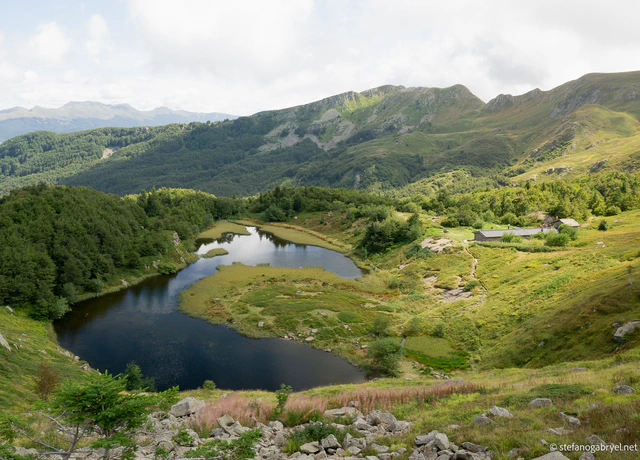
Lago Nero sits in a glacial cirque between Alpe delle Tre Potenze and Monte Gomito, in the mountains above Abetone. The name is literal. The water reads black from most angles.
The approach is what makes the day. You start in beech and fir, and for the first couple of hours the walk is a forest walk: deep shade, soft ground, and in autumn the whole floor of it turning. This is good ground for fungi, and if you are walking with me in September or October we will be stopping a lot. Then the trees end, fairly abruptly, and you come out into the open glacial basin, with the ridge above you.
CAI Pistoia’s Bivacco Lago Nero, a small hut at the water’s edge, is staffed only on summer weekends. Do not count on anyone being up there. Carry your own water and food.
The trailhead is at about 1,300 metres and the lake at 1,730. Between them, eight kilometres, 450 metres of climb, about five hours with stops. That is a guided day, so it includes an unhurried pace and time spent looking at things. Marked path, no scrambling, but the ascent is steady work throughout. It is an out-and-back, which sounds like the lesser option and is not: the light changes completely between morning and afternoon, and the return leg through the beech woods in late sun is the part most people remember.
Lago Nero
- About 5 hours
- €240 per group
- Longer day on request
Medium · 8 km (5 mi) · 450 m (1,476 ft) ascent
View this hikeLago Scaffaiolo, 1,775 metres
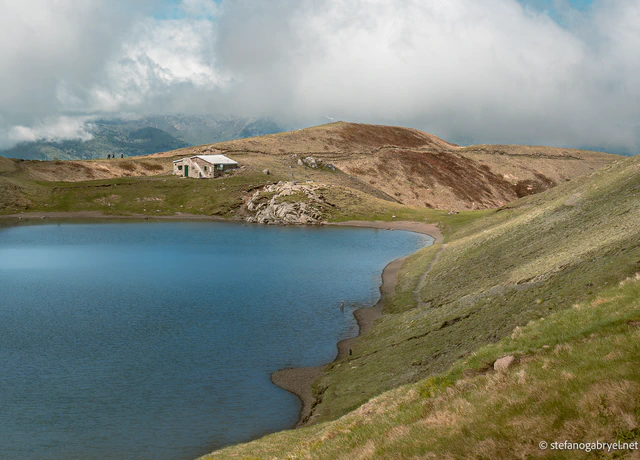
Scaffaiolo is the higher of the two and by far the more open. It sits almost exactly on the regional border, one of the highest natural basins in the Apennines, in a saddle on the crest with the land dropping away on both sides. Tuscany to the south, Emilia-Romagna to the north.
Once you reach the ridge, the route runs along the crest, and on a clear day you can see a very long way in every direction. On a bad day you can see about forty metres and the wind does not stop. There is no shelter up on the crest until you reach the lake, which is why you put on two more layers at the top than you wanted at the car.
Rifugio Duca degli Abruzzi stands beside the lake. It opens every day from mid-June to mid-September and at weekends for the rest of the year, except in November. It does not offer much in the way of comfort, which is fine, because the point of it is coffee and shelter rather than a meal out.
The trailhead is already at about 1,500 metres and the lake at 1,775. Between them, nine and a half kilometres, 370 metres of climb, about six hours. The first forty minutes run up a broad gravel road, and there is no scrambling anywhere on the route. The lower ascent figure against Lago Nero is only half misleading: this is the longer day and the more weather-dependent one, because most of it happens on the open crest.
Lago Scaffaiolo
- About 6 hours
- €240 per group
- Shorter or longer day on request
Medium · 9.5 km (5.9 mi) · 370 m (1,214 ft) ascent
View this hikeWhen these two are actually walkable
Broadly May to December, and how far it stretches at either end depends entirely on the year. Both lakes sit in the Appennino Pistoiese, and the Pistoia trekking guide covers what else is up there.
Snow holds on the north side of the crest and in shaded gullies long after it has gone from the valleys. In a dry year May is a real walking month. After a heavy winter it is not a month at all. From November the same thing applies in reverse: Lucca can be mild and green while the crest at 1,775 metres is already carrying ice. That does not rule the day out, it changes it, and by then the Scaffaiolo refuge has been shut since the end of September. Late in the season this stops being a casual outing and becomes a judgement about conditions, which is a large part of what you are paying a guide for.
July and August are hot everywhere below 1,000 metres and pleasant up here, which makes these two the obvious answer to a Tuscan heatwave. Late September and October give the best colour and the emptiest trails.
Getting there from Lucca and from Pisa
From Lucca, both trailheads are under an hour and a half by car. From Pisa, add roughly half an hour.
Neither is reachable by train, and this is the one honest limitation of the pair. If you don’t have a car, tell me when you write and I’ll help you find a solution. The car-free options around Lucca and Pisa cover the trips that genuinely work on the regional network, and the high lakes are not among them.
Lago di Gramolazzo, a swim under the Apuan Alps
Gramolazzo lies at the top end of the Garfagnana, about 70 kilometres from Lucca if you follow the Serchio valley up past Castelnuovo di Garfagnana, and at 604 metres it sits below Monte Pisanino, which at 1,946 metres is the highest peak in the Apuan Alps. SELT Valdarno dammed the Serchio di Gramolazzo here in the 1950s for hydroelectric power, and Enel runs the reservoir today. In 2021 a snowy photo of the lake beat Florence’s Ponte Vecchio in an online vote, with 59 percent, and went onto Nutella jars in the Ti amo Italia series.
In summer you can swim from the sandy beaches (bathing isn’t allowed from the grassy banks) and hire a canoe, a kayak, a paddleboard or a pedal boat. There are picnic tables with barbecue grills, and a cycle and foot path runs along the shore. You can fish it too, for trout and carp.
If you want the Apuan Alps on foot with me, the hike I run there is the Marmifera del Corchia, a marble quarry road further south in the same range. The quarry trucks use it on weekdays, so that one is weekends only.
Lake Massaciuccoli, the one at sea level
Massaciuccoli is the largest natural lake in Tuscany and it is close: about twenty-five minutes from Lucca, a similar run from Pisa, sitting behind the dunes between Viareggio and the pine forest of San Rossore.
It is a genuinely good place and a completely different proposition. Flat, wet, and full of birds. The LIPU oasis on the southern shore has a boardwalk out over the reed beds with hides along it, and in high summer the lotus flowers open across one section of the water, which is not a thing most people expect to find in Tuscany. Puccini wrote at Torre del Lago on its edge, and that is what the lake is famous for locally.
It takes very little planning. You park, you walk the boardwalk, you sit still for twenty minutes and see what turns up. I have written the place up properly in the LIPU oasis guide and in the piece on the lotus bloom.
The Garfagnana reservoirs, briefly
Gramolazzo has two neighbours in the Garfagnana that come up in the same searches and are worth being straight about.
Vagli is the one with the story. There is a village under it, Fabbriche di Careggine, which appears when the reservoir is drained. That has happened rarely, and a return has been announced more than once without materialising, so plan a trip around the lake rather than around the village. Isola Santa is the prettiest of the three, a restored stone village on the shore of a small reservoir on the way over to the marble country.
All three are drives, with short walks attached if you want them. None is guided ground for me, and I would rather say so than pad this article out.
Which to choose
If you have one mountain day and want the bigger view, take Scaffaiolo. If you want forest, quiet, and better odds on fungi and photography, take Lago Nero. If you have a morning rather than a day, or someone in the group who cannot climb, go to Massaciuccoli and keep the mountain day for another trip.
If you are still deciding where to base yourself, the day trips from Lucca and the hiking trails near Pisa both set out what else is within the same ninety minutes. The wider case for this range is in the Apennine guide.
Either lake works as a single private day for one to twelve people, and I will happily run two consecutive days if you want both. Both sit on my hiking near Lucca page alongside six other routes, and on the hiking near Pisa page alongside four.
Plan a Mountain Lake Day
Tell me your dates and how many of you are coming, and I’ll say which of the two suits your group, and what the crest has been doing that week. From May to October my free days go early, so the sooner you write the better, though if one is genuinely open I can still take a booking at 24 hours’ notice. The contact form reaches me just the same if you don’t use WhatsApp.