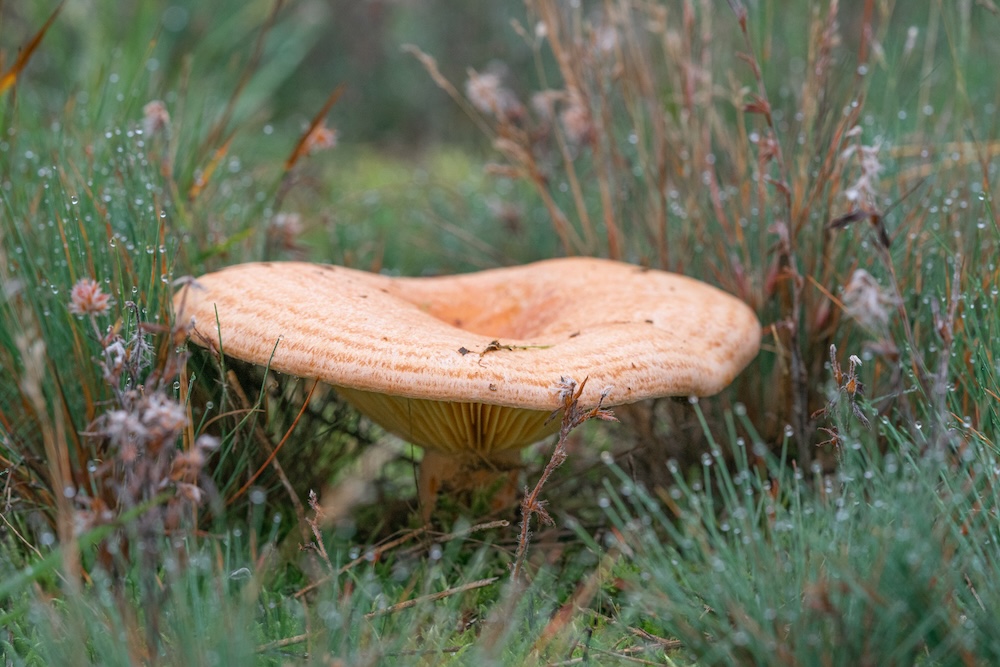
Unlike the Coprinus comatus I’ve written about, which feeds on dead matter in disturbed soil, Lactarius deliciosus is strictly mycorrhizal.
This mushroom cannot exist without pine trees.
It forms a symbiotic relationship with the roots of pines, particularly Pinus pinaster (maritime pine) and Pinus pinea (stone pine), both common in Tuscany’s lower mountain elevations and coastal areas.
The relationship is obligate and exclusive.
The mushroom provides the tree with enhanced nutrient and water absorption, while the tree supplies the fungus with carbohydrates from photosynthesis.
This means you’ll never find this mushroom in a beech forest, under oaks, or among chestnuts.
When scouting locations for my mycology hikes, I look for pine stands—the presence of the tree guarantees the potential for the mushroom.
The Appennines offer similar habitat, particularly where reforestation with pines occurred in the mid-20th century.
Seasonal Windows and Recognition
The prime season for Lactarius deliciosus in Tuscany runs from late September through November, with occasional fruiting extending into December if autumn remains mild and wet.
Unlike spring mushrooms that appear suddenly, Lactarius deliciosus need sustained rainfall and cooling temperatures.
The first significant autumn rains trigger fruiting, but patience is required—you’re typically looking at 10-14 days after good precipitation before the mushrooms emerge in appreciable numbers.
Recognition is straightforward, which partly explains this mushroom’s popularity among novice foragers.
The cap ranges from orange to salmon-pink, often with concentric zones of darker color creating a target-like pattern.
Young specimens are convex with inrolled edges, flattening and developing a central depression with age—creating that characteristic funnel shape.
Key identifying features include:
The orange latex (milk). When you cut or break the flesh, an orange-colored liquid immediately bleeds from the wound. This is the “deliciosus” of the Latin name—delicious milk. No toxic mushroom in our region produces orange latex.
Green staining. Over time, damaged areas turn green. It’s not the most appetizing transformation, but it’s diagnostic. A day-old basket of Lactarius deliciosus will show green bruises where caps touched, green fingerprints where you handled them, green cut surfaces. This is completely normal and harmless.
What I’ve Learned From Following Lactarius deliciosus
Here’s something I explain to my hiking groups: mushrooms are indicators, and reading what they indicate teaches you to see the forest differently.
When I spot Lactarius deliciosus emerging, I know several things immediately.
Environmental indicators this mushroom reveals:
Soil pH is acidic. Pines acidify the soil beneath them through needle drop, and Lactarius deliciosus thrives in this acidity. If you see healthy Lactarius deliciosus populations, you’re standing in acidic soil—valuable information for understanding what other plants and mushrooms might occur here.
The mycorrhizal network is healthy. A robust fruiting of Lactarius deliciosus indicates the underground fungal network is well-established and the pine trees are healthy partners. Poor or absent fruiting might suggest stressed trees, drought conditions, or soil problems.
Geographic and cultural notes:
The name variation across Tuscany (rosselle, pennecciole) reflects how localized mushroom knowledge traditionally was. Before modern transportation and communication, each valley, each comune, developed its own terminology.
This mushroom bridges social classes. Unlike truffles or the most prized porcini, which command premium prices, Lactarius deliciosus are the people’s mushroom—abundant enough that everyone can participate in the harvest.
The Ethics of Abundance
One final thought about Lactarius deliciosus: abundance can be deceptive.
Yes, in optimal conditions you might harvest several kilograms from a productive pine grove.
But remember that each mushroom you pick is the fruiting body of a much larger organism—the mycelium threading through the soil.
I teach my groups to harvest sustainably:
Leave the smallest and oldest specimens to continue dispersing spores.
Never harvest more than you can properly preserve or consume.
The Lactarius deliciosus will return next autumn if we respect the partnership between fungus and forest.
Are you a beginner?
If you’re just beginning to explore mushroom foraging, Geoff Dann’s Edible Mushrooms is the field guide I recommend to all my clients. It’s an excellent starting point for learning safe identification. Read my full review here.
Want to learn in the field? Join me for a hands-on mushroom hunting experience ⬇️ ⬇️ ⬇️ ⬇️
Ready to move from photos to field identification?
Experience these fascinating fungi firsthand on a guided autumn hike through Tuscan woodlands. Learn professional identification techniques, understand ecosystem roles, and capture your own stunning mushroom photography.
Attention!
While the content of this blog post is aimed at providing you with information as accurate as possible, it should be treated as what it is: simply a blog post on the internet.
Mushroom identification should only be performed by experts, as a mistake can lead to dire consequences. Attempting to identify a mushroom on your own, without prior experience, based solely on the content of this blog post is strongly discouraged.
Explore Hidden Tuscany
Guided hiking experiences combining expert trail knowledge, professional photography, and wilderness mindfulness.
Latest posts
 5 March 2026
Salamandra Salamandra: Fire Salamander in Tuscany
5 March 2026
Salamandra Salamandra: Fire Salamander in Tuscany 5 March 2026
Pisa: Base for Exploring Tuscany's Hidden Nature
5 March 2026
Pisa: Base for Exploring Tuscany's Hidden Nature 5 March 2026
Montecatini Terme: Base for Exploring Tuscany's Nature
5 March 2026
Montecatini Terme: Base for Exploring Tuscany's Nature 4 March 2026
Galium Aparine: Cleavers in Tuscan Hedgerows
4 March 2026
Galium Aparine: Cleavers in Tuscan Hedgerows 3 March 2026
Umbilicus Rupestris: Wall Pennywort in Tuscany
3 March 2026
Umbilicus Rupestris: Wall Pennywort in Tuscany