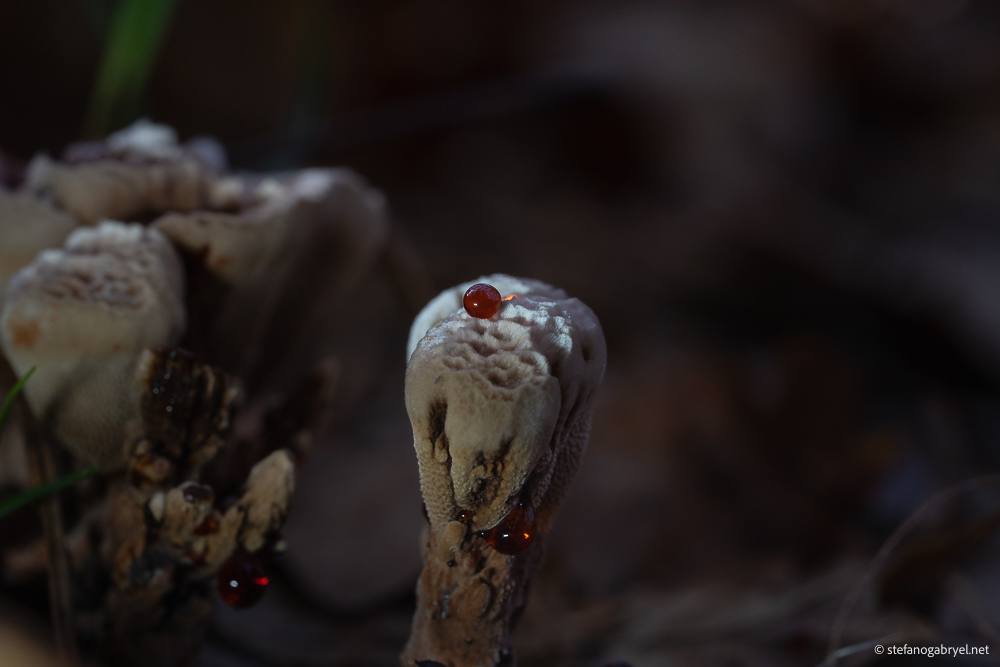
Of all the mushrooms I encounter while guiding through the pine and spruce forests of the Appennino Pistoiese, none captivates photographers quite like Hydnellum peckii—the Bleeding Tooth fungus.
The first time you see it, the sight is genuinely startling: a pale mushroom seemingly oozing droplets of bright red blood.
Even after decades of mycological observation, I still pause to photograph this remarkable species whenever I find it, knowing that each encounter is becoming increasingly rare.
Seasonality: A Cool-Weather Specialist
In Tuscany’s mountain regions, Hydnellum peckii typically appears from late September through November, though I’ve occasionally found specimens lingering into early December during mild autumns.
Unlike many mushrooms that fruit after warm rains, the Bleeding Tooth prefers the cooler temperatures of mid to late autumn.
The timing is critical: you need to search during that narrow window when temperatures have dropped but before the first hard frosts arrive.
The most dramatic “bleeding” effect occurs in young, actively growing specimens during humid conditions, usually after several days of cool, misty weather.
I’ve noticed that the mysterious red droplets appear most abundantly on foggy mornings in October, when the forest is saturated with moisture and temperatures hover around ten to fifteen degrees Celsius.
By the time the mushroom matures and the cap expands fully, the bleeding typically stops, and the droplets dry to dark reddish-brown stains on the pale surface.
The Mycorrhizal Connection: Ancient Partnerships in Conifer Forests
Hydnellum peckii is strictly mycorrhizal, forming obligate symbiotic relationships with conifer trees.
In our Tuscan mountains, I find them almost exclusively in association with pine, spruce, and occasionally fir trees at higher elevations.
This mycorrhizal relationship is non-negotiable for the fungus—it cannot grow without its tree partner, and the trees benefit significantly from the expanded nutrient absorption the fungal network provides.
What makes this particularly fascinating is the specificity: while some mycorrhizal mushrooms partner with multiple tree species across families, Hydnellum species show strong preference for conifers, particularly pines.
When you find a Bleeding Tooth, you’re looking at the fruiting body of an organism whose main mass exists as miles of microscopic threads woven throughout the forest soil, intimately connected to tree roots in an exchange that has evolved over millions of years.
The fungus provides the tree with phosphorus, nitrogen, and water from the soil, while the tree supplies the fungus with carbohydrates produced through photosynthesis.
Neither can thrive in certain environments without the other, making this one of nature’s most elegant examples of mutualistic symbiosis.
Soil Preferences: Acidity and Ancient Ground
Like many fungi associated with coniferous forests, Hydnellum peckii has a strong preference for acidic soils.
The thick carpet of pine needles in mature conifer forests creates exactly these conditions, as the needles decompose and release organic acids into the soil.
When scouting for Bleeding Tooth, look for indicator plants that signal acidic conditions: bilberry, heather, bracken fern, and various mosses that form thick mats beneath the pines.
One detail I’ve observed over years of tracking this species: Hydnellum peckii seems to prefer older, undisturbed forest areas.
You rarely find it in young pine plantations or recently logged areas.
This preference for mature forest ecosystems makes it particularly vulnerable to habitat disruption, which is one reason the species is becoming increasingly uncommon across Europe.
The fungus appears to require not just the right tree partners and soil chemistry, but also the complex ecological conditions that develop only in forests that have remained relatively unchanged for decades.
Recognition: More Than Just the Blood
The “bleeding” droplets that give this mushroom its common names are actually guttation—a process where the fungus exudes excess fluid containing pigmented compounds.
The red liquid contains atromentin, a natural anticoagulant compound that has interested pharmaceutical researchers.
When fresh and young, the mushroom’s cap is whitish to pale pink with a velvety texture, marked with those striking crimson droplets on the surface.
As the specimen ages, the cap darkens to pinkish-brown or reddish-brown, and the surface becomes rougher.
The underside is what makes identification certain: instead of gills or pores, Hydnellum peckii has teeth or spines—hence the “tooth” in its common name.
These tiny, fragile spines hang downward from the cap undersurface, typically colored pale at first and darkening with age.
The stem is solid, often irregular in shape, and similarly colored to the cap.
Edibility: Inedible but Harmless
Hydnellum peckii is not poisonous, but it is thoroughly inedible.
The flesh is extremely tough, corky, and bitter, making it completely unsuitable for the table no matter how you might attempt to prepare it.
I mention this not because anyone would be tempted after seeing its appearance, but because it’s important to understand the distinction: not all inedible mushrooms are toxic, and not all strange-looking mushrooms are dangerous.
The Bleeding Tooth represents no threat if touched or handled, which makes it perfect for photography and observation.
Conservation Concern: A Declining Species
Here’s something that weighs on me as both a naturalist and a guide: Hydnellum peckii is declining across much of Europe and is considered a species of conservation concern in several countries.
In some regions, it’s listed as near threatened or vulnerable.
The primary threats are habitat loss and forest management practices that favor younger, more economically productive forests over the old-growth conditions this species requires.
Climate change also appears to be impacting the species, as shifting temperature and precipitation patterns affect the delicate timing of fruiting and the complex soil conditions needed for mycorrhizal relationships.
This decline isn’t unique to Hydnellum peckii—many mycorrhizal forest fungi are experiencing similar pressures—but it serves as a reminder that even species that aren’t harvested for food can be vulnerable to environmental change.
The Pharmaceutical Connection: Nature’s Medicine Cabinet
Beyond its visual drama, Hydnellum peckii has attracted scientific attention for its chemical properties.
The atromentin compounds that create the red “blood” have demonstrated anticoagulant properties similar to heparin, a crucial pharmaceutical used to prevent blood clots.
Researchers have also identified antibacterial properties in extracts from the fungus.
While we’re far from seeing Bleeding Tooth-derived medications in pharmacies, this research highlights an important truth: biodiversity matters not just for ecological reasons, but for potential future applications we haven’t yet imagined.
Every species we lose is a library of unique biochemistry that took millions of years to evolve, potentially containing solutions to medical problems we haven’t solved.
Ecology Lessons: Why the Uncommon Matters
Every time I guide a group to a Bleeding Tooth location, I see the same reaction: wonder followed by questions.
Why does it bleed? Why here and not there? Why is it becoming rare?
These questions lead naturally to discussions about forest ecology, symbiosis, habitat requirements, and conservation—topics that might seem abstract in a classroom but become immediately relevant when you’re kneeling beside a living example.
Hydnellum peckii teaches us that biodiversity isn’t just about charismatic megafauna or economically valuable species—it’s also about the strange, the beautiful, and the ecologically specialized organisms that indicate healthy, functioning ecosystems.
The presence of this species in a forest tells us something important: this is a mature, relatively undisturbed habitat with the right conditions to support specialist species with narrow ecological requirements.
Its absence or decline signals that something has changed, serving as an early warning system for broader ecological shifts.
Finding Your Own: What to Look For
If you’re interested in searching for Hydnellum peckii during autumn forest walks, focus your efforts in mature coniferous forests, particularly pine-dominated areas at mid to higher elevations where human disturbance has been minimal.
Look for sections of forest where the ground is carpeted thickly with pine needles and where acidic-loving plants like bilberry and heather thrive.
The best conditions are cool, humid periods in October, especially after several days of fog or light rain.
Search carefully around the base of mature pines, paying attention to mossy areas and spots where the needle duff is thick.
Remember that even when you find the right habitat, encountering this species requires patience and often an element of luck—its rarity is part of what makes discovery so rewarding.
When you do find it, take time to observe, photograph, and appreciate this remarkable organism, knowing that you’re witnessing one of nature’s more unusual and increasingly uncommon spectacles.
Ready to move from photos to field identification?
Experience these fascinating fungi firsthand on a guided autumn hike through Tuscan woodlands. Learn professional identification techniques, understand ecosystem roles, and capture your own stunning mushroom photography.
Attention!
While the content of this blog post is aimed at providing you with information as accurate as possible, it should be treated as what it is: simply a blog post on the internet.
Mushroom identification should only be performed by experts, as a mistake can lead to dire consequences. Attempting to identify a mushroom on your own, without prior experience, based solely on the content of this blog post is strongly discouraged.
Explore Hidden Tuscany
Guided hiking experiences combining expert trail knowledge, professional photography, and wilderness mindfulness.
Latest posts
 5 March 2026
Salamandra Salamandra: Fire Salamander in Tuscany
5 March 2026
Salamandra Salamandra: Fire Salamander in Tuscany 5 March 2026
Pisa: Base for Exploring Tuscany's Hidden Nature
5 March 2026
Pisa: Base for Exploring Tuscany's Hidden Nature 5 March 2026
Montecatini Terme: Base for Exploring Tuscany's Nature
5 March 2026
Montecatini Terme: Base for Exploring Tuscany's Nature 4 March 2026
Galium Aparine: Cleavers in Tuscan Hedgerows
4 March 2026
Galium Aparine: Cleavers in Tuscan Hedgerows 3 March 2026
Umbilicus Rupestris: Wall Pennywort in Tuscany
3 March 2026
Umbilicus Rupestris: Wall Pennywort in Tuscany