After years of guiding foragers through forests, the question I hear most often is some variation of: “How can I tell if a mushroom is poisonous?”
People want a simple rule, an easy test, a blanket statement that will keep them safe.
I understand the desire, but I have to be honest: there is no such rule, and believing otherwise is the most dangerous mistake a forager can make.
The Myth of Universal Rules
“Are all red mushrooms poisonous?”
“Do poisonous mushrooms turn silver spoons black?”
“Can you eat any mushroom that animals have nibbled?”
Every one of these is false, and every one has likely contributed to poisonings over the centuries.
The uncomfortable truth is that mushroom identification requires knowledge, not shortcuts.
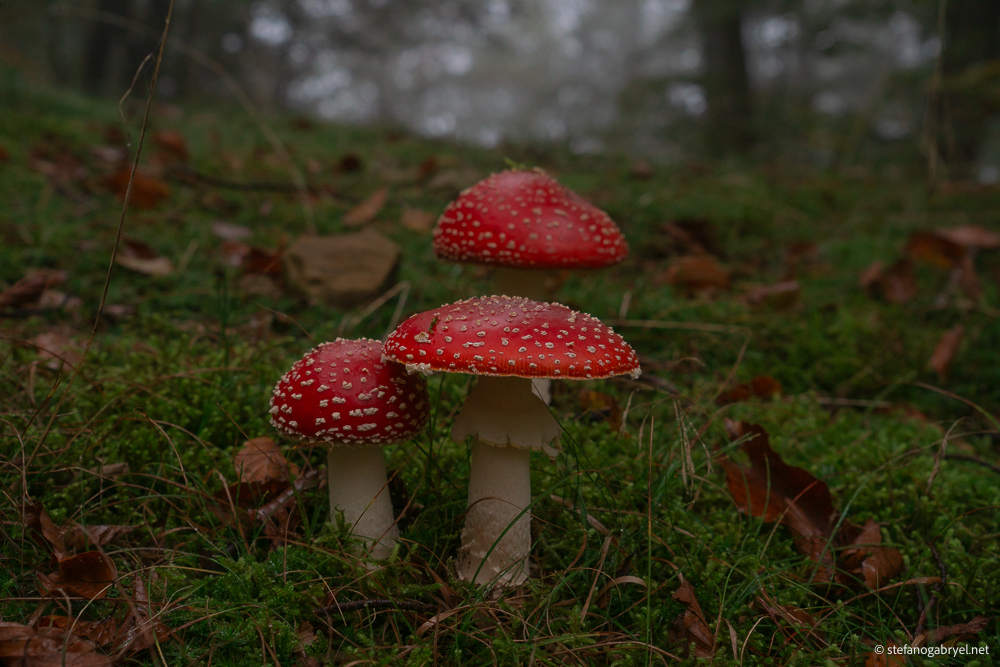
Consider the red mushroom question: yes, Amanita muscaria is toxic with its iconic red cap, but countless species of Russula—many with brilliant red caps—are perfectly edible and delicious.
In fact, some of Tuscany’s most prized edibles, like Amanita cesarea (Caesar’s Mushroom), sport vibrant orange-red caps.
Color alone tells you nothing about safety.
The Amanita Muscaria Misconception
Since we’re discussing myths, let me address one of the most persistent: Amanita muscaria, the Fly Agaric, is toxic but not typically lethal.
Contrary to popular belief and fairy tale depictions, this iconic red-capped mushroom rarely kills.
It contains neurotoxins that cause unpleasant symptoms—nausea, confusion, loss of coordination—but death from Amanita muscaria alone is extremely rare in healthy adults.
This doesn’t make it safe, but it’s important to understand the difference.
The truly deadly Amanitas are other species entirely: Amanita phalloides (Death Cap), Amanita virosa (Destroying Angel), and their relatives.
These are responsible for the vast majority of fatal mushroom poisonings worldwide, and they don’t advertise their danger with bright colors—most are white, pale green, or yellowish.
The deadliest mushrooms often look disappointingly ordinary.
The Only Rules That Matter
If you’re serious about foraging mushrooms safely, there are really only a few fundamental principles, and every single one requires discipline and honesty with yourself.
Rule One: Absolute Certainty or Nothing
Never eat a mushroom unless you can identify it with complete certainty to the species level.
Not “pretty sure,” not “looks like the ones I ate last year,” not “my friend said it’s probably okay.”
Absolute certainty.
This means knowing not just what the mushroom looks like, but understanding its key identification features, where it grows, when it fruits, and what similar species might be confused with it.
If you cannot articulate why you know what you’re looking at, you don’t know.
Rule Two: When in Doubt, Ask an Expert
Italy has an excellent system of mycological consultation: most provinces have ASL (Local Health Authority) mycologists who will examine your finds and confirm identification free of charge.
I strongly recommend that beginning foragers use this service for every collection, even when they think they’re certain.
The mycologists have seen every variation, every unusual specimen, every dangerous look-alike.
They’ve also seen the consequences of misidentification.
In Tuscany, many towns also have mycological associations with expert members who organize forays and offer identification help.
Take advantage of these resources—your health is worth the time.
Beyond official channels, finding an experienced mentor who can teach you in the field is invaluable.
Book knowledge is essential, but there’s no substitute for someone pointing out the subtle differences between a choice edible and a deadly poisonous species in their natural habitat.
Rule Three: Beware the “Little Brown Mushrooms”
Among mycologists, there’s a category we refer to as LBMs—Little Brown Mushrooms.
These are small to medium-sized mushrooms with brown caps, brown stems, and few distinctive features to the untrained eye.
They’re also among the most dangerous.
Galerina marginata, the Deadly Skullcap, is the perfect example.
This innocuous-looking little brown mushroom contains the same amatoxins as the Death Cap—toxins that destroy your liver and kidneys, often fatally.
It grows on wood, looks utterly unremarkable, and could easily be confused with several edible species by someone who doesn’t know what to look for.
I cannot stress this enough: avoid all little brown mushrooms unless you have genuine expertise.
The risk-to-reward ratio is terrible—even the edible LBMs are rarely choice species, while the poisonous ones can kill you.
When I’m guiding clients through autumn forests where Galerina marginata is present, I point them out specifically to teach recognition and avoidance.
The best approach with LBMs is simple: leave them alone entirely, no matter how certain you think you are.
Rule Four: Pored Mushrooms Are Safer, But Not Safe
Here’s a principle that has some statistical truth: mushrooms with pores instead of gills are generally safer than gilled mushrooms.
Boletes—the family that includes porcini—are pored mushrooms, and most are edible or at least non-toxic.
The same goes for polypores and many other pore-bearing species.
But “generally safer” is not the same as “safe,” and this is where people get into trouble.
Yes, there are no deadly poisonous boletes in Europe—no bolete will destroy your liver like a Death Cap.
But several boletes will make you violently ill.
Rubroboletus satanas (Satan’s Bolete) causes severe gastrointestinal distress.
Even some edible boletes become toxic when eaten raw or when older and decomposing.
The pore rule is a useful starting point for risk assessment, but it’s not a guarantee.
I teach my clients to identify porcini (Boletus edulis and relatives) specifically and thoroughly, and to be cautious with any other boletes until they’ve learned them individually.
The presence of pores gives you a slightly wider margin for error than gills do, but error can still make you sick.
What You Actually Need to Learn
If I’ve made foraging sound intimidating, good—it should be approached with respect and caution.
But that doesn’t mean you can’t forage safely.
It means you need to commit to proper education.
Start with a handful of distinctive, easily identified edible species that have no dangerous look-alikes.
In Tuscany, good beginner species include porcini (once you’ve learned to recognize them properly), chanterelles (Cantharellus cibarius), and giant puffballs (Calvatia gigantea) when young and pure white inside.
Learn each species thoroughly before adding another to your repertoire.
Study them in multiple stages of growth, in different weather conditions, in various habitats.
Learn not just what they look like, but why they look that way—the ecological and anatomical features that make them distinctive.
Understand what they could be confused with and learn those species too, so you can confidently distinguish them.
Invest in quality field guides specific to European or Italian fungi—North American guides are useless here, as many mushrooms look similar but are different species.
Join foraging walks with experts, attend mycological society meetings, and build relationships with experienced foragers who can mentor you.
This knowledge accumulates slowly, over seasons and years, but once built it serves you for life.
The Consequences of Getting It Wrong
I want to be clear about why I’m so insistent on these principles: mushroom poisoning is a uniquely horrible way to harm yourself.
With Amanita phalloides poisoning, you eat the mushroom, feel fine for eight to twelve hours, then experience severe gastrointestinal symptoms.
But by the time symptoms appear, the toxins are already destroying your liver and kidneys irreversibly.
Even with immediate medical treatment, the mortality rate is significant.
Survivors often require liver transplants.
I’ve spoken with hospital mycologists who’ve treated these cases, and the pattern is always similar: the victim was certain of their identification, had foraged successfully before, and made one fatal mistake.
The risk is real, the consequences are severe, and no meal is worth gambling with your life or your liver.
A Different Relationship With Foraging
Here’s what I tell every client on my foraging walks: mushroom hunting shouldn’t be primarily about filling your basket.
It should be about developing a relationship with the forest, learning to observe carefully, understanding ecological connections, and yes, occasionally bringing home something delicious that you’ve identified with complete confidence.
The joy is in the knowledge, the discovery, the observation—the meal is a bonus, not the primary goal.
When you approach foraging this way, the pressure to identify everything disappears.
You can observe and photograph species you don’t know without feeling compelled to eat them.
You can appreciate the deadly ones for their ecological roles and biological adaptations without resentment that they’re not edible.
And when you do find a species you know with certainty, the satisfaction is deeper because it’s earned through genuine understanding.
Combining Caution With Confidence
None of this means you should be afraid of wild mushrooms—fear is just as problematic as recklessness.
What I’m advocating is informed respect: understanding the real risks, learning systematically, consulting experts, and building competence gradually.
The mushrooms I confidently collect now are species I’ve studied for years, that I’ve seen in dozens of locations and conditions, that I can identify by touch and smell as easily as by sight.
That knowledge base took time to build, but it allows me to forage with genuine confidence rather than hopeful guessing.
You can develop the same competence if you’re willing to invest the time and maintain the discipline.
Start small, learn thoroughly, never compromise on certainty, and respect the fact that nature’s bounty comes with nature’s risks.
The forests of Tuscany offer incredible edible mushrooms for those who take the time to learn them properly—and that learning itself becomes one of the deepest pleasures of spending time in these mountains.
Are you a beginner?
If you’re just beginning to explore mushroom foraging, Geoff Dann’s Edible Mushrooms is the field guide I recommend to all my clients. It’s an excellent starting point for learning safe identification. Read my full review here.
Want to learn in the field? Join me for a hands-on mushroom hunting experience ⬇️ ⬇️ ⬇️ ⬇️
Ready to move from photos to field identification?
Experience these fascinating fungi firsthand on a guided autumn hike through Tuscan woodlands. Learn professional identification techniques, understand ecosystem roles, and capture your own stunning mushroom photography.
Attention!
While the content of this blog post is aimed at providing you with information as accurate as possible, it should be treated as what it is: simply a blog post on the internet.
Mushroom identification should only be performed by experts, as a mistake can lead to dire consequences. Attempting to identify a mushroom on your own, without prior experience, based solely on the content of this blog post is strongly discouraged.
Explore Hidden Tuscany
Guided hiking experiences combining expert trail knowledge, professional photography, and wilderness mindfulness.
Latest posts
 5 March 2026
Salamandra Salamandra: Fire Salamander in Tuscany
5 March 2026
Salamandra Salamandra: Fire Salamander in Tuscany 5 March 2026
Pisa: Base for Exploring Tuscany's Hidden Nature
5 March 2026
Pisa: Base for Exploring Tuscany's Hidden Nature 5 March 2026
Montecatini Terme: Base for Exploring Tuscany's Nature
5 March 2026
Montecatini Terme: Base for Exploring Tuscany's Nature 4 March 2026
Galium Aparine: Cleavers in Tuscan Hedgerows
4 March 2026
Galium Aparine: Cleavers in Tuscan Hedgerows 3 March 2026
Umbilicus Rupestris: Wall Pennywort in Tuscany
3 March 2026
Umbilicus Rupestris: Wall Pennywort in Tuscany