Tuscany is one of the most visited regions in Europe.
That means the guide market is one of the most saturated in Europe.
Between the platforms, the operators, the aggregators, and the thousands of listings on booking sites, finding someone who actually knows the territory is harder than it should be.
This post is not a recommendation for any particular guide.
It is a set of tools for recognizing one when you find them.
The Difference Between a Guide and an Operator
This distinction matters more than anything else on this list.
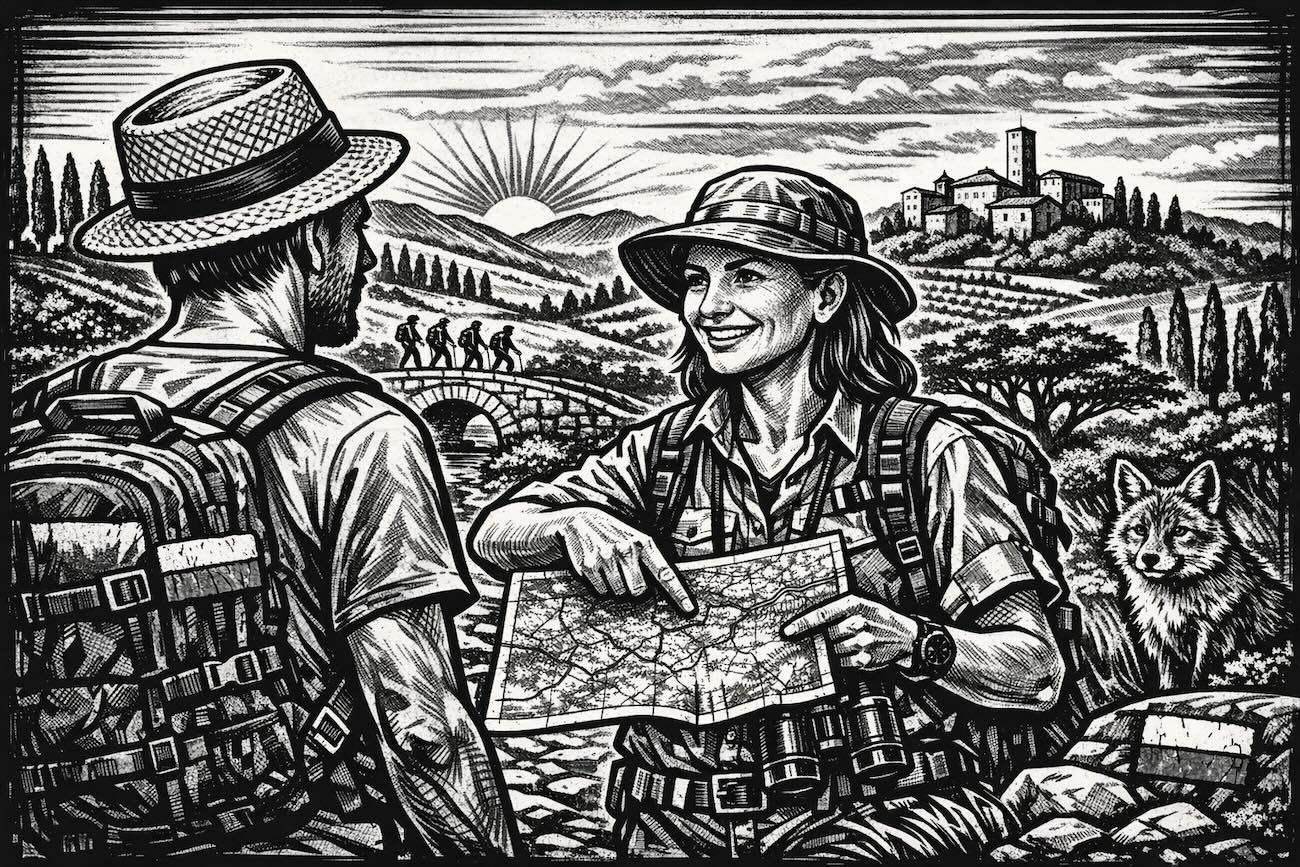
A guide has a territory. A specific set of forests, mountains, or landscapes they know deeply and return to regularly. They have watched the seasons change in those places for years. They know which trail section floods after heavy rain. They know which clearing produces mushrooms after the first September thunderstorm. They know exactly where the light falls at 7am in October.
An operator has a product. A formatted experience designed to be delivered efficiently to as many groups as possible. The itinerary is fixed. The commentary is scripted. The outcome is guaranteed—which is itself the first red flag.
Neither is dishonest by definition.
But if you want a genuine encounter with Tuscany’s landscape—rather than a performance of one—you need to find the guide, not the operator.
Seth Godin writes in Purple Cow that in a saturated market, the only thing that stands out is being genuinely remarkable. Not louder, not more visible—more specific, more honest, and more knowledgeable.
The guide worth booking often looks less impressive at first glance.
Less polished website. Fewer platform reviews. Slower to respond.
Because they spend their time in the field, not managing their digital presence.
The Truffle Hunt Problem
Truffle hunting is the clearest case study for this distinction.
Type “truffle hunting Tuscany” into any platform and you will find hundreds of options, most of them well-reviewed and attractively priced.
Many of them are theatre.
The dog finds the truffle with suspicious ease. The timing is perfect. Every group leaves satisfied.
Because the truffle was placed before you arrived.
This is not truffle hunting. It is a staged encounter designed around the constraints of operating at scale—multiple groups per day, guaranteed outcomes, consistent reviews.
I’ve written in detail about what genuine truffle hunting looks like and how to tell the difference before you book.
Read: Truffle Hunting in Tuscany: What to Know Before You Book
The same principle applies to mushroom foraging tours, photography walks, and hiking experiences.
Scale and authenticity are almost always in tension.
Red Flags to Watch For
Guaranteed outcomes.
“You will find porcini.” “You will see the truffle dog work.” “You will reach the summit.”
A real guide knows that nature doesn’t comply with booking confirmations.
The honest answer is always: it depends on the season, the weather, the conditions.
Any guide who tells you otherwise is selling a performance, not an experience.
Vagueness about territory.
Ask where, specifically, the experience takes place.
A local guide names a forest. A valley. A specific mountain.
An operator gives you a province, a region, or “the Tuscan countryside.”
Platform-only presence.
Airbnb Experiences, Viator, GetYourGuide—these platforms are not evidence of expertise.
They are distribution channels. Anyone can list on them.
Look for an independent web presence that demonstrates knowledge over time. Articles about specific species, specific trails, specific seasonal conditions. This is the evidence of someone who actually works in the territory they’re claiming.
Standardized group sizes presented as private experiences.
Read the listing carefully.
“Private” sometimes means you book the whole group. Sometimes it means you join a group of eight strangers.
Ask directly: how many people will be present? Who else might be joining?
Generic responses to specific questions.
Before booking, ask something specific.
“What mushrooms might we find in October near the Pistoiese Apennines?”
“What should I wear if we’re going above 1,400 meters in September?”
A local guide answers specifically. They might even push back—“actually, October is often past peak for that area, September is better.”
An operator gives you a formatted response from a template.
Questions Worth Asking Before You Book
These are the questions that separate genuine expertise from packaged tourism:
“What’s the best time of year for what I want, and why?”
The answer should be specific and honest, including the possibility that your travel dates are not ideal.
“What happens if conditions aren’t right on the day?”
Bad weather. No mushrooms. Trail closures. A good guide has a real answer. An operator has a refund policy.
“What won’t we find, and why?”
This is the question most people don’t think to ask.
A guide who tells you what to expect not to see is a guide who understands their territory. The absence of things is as informative as the presence.
“Can you tell me something specific about where we’re going?”
Not the region. The place. The forest. The trail. The elevation. The tree species that dominate.
If they can’t answer, they haven’t been there recently—or at all.
What Genuine Expertise Looks Like
It looks like someone who will tell you not to come.
Wrong season. Wrong fitness level. Wrong expectations for what the landscape can deliver in that window.
A guide who turns away clients is a guide whose livelihood depends on the quality of the experience, not the number of bookings.
It looks like someone who talks about failure.
The day the mushrooms weren’t there. The lake that was hidden in fog. The trail that was impassable after a storm.
These are the stories of someone who goes repeatedly, not someone who runs a route twice a season.
It looks like content.
Articles, photographs, field notes—evidence of years spent in specific places, thinking carefully about what those places contain.
Anyone can claim local knowledge. Very few people have spent the time to develop it and can demonstrate that they have.
A Note on How I Work
I operate in the mountains and forests of northern Tuscany—the Apennines, the Apuan Alps, the forests around Pistoia, Prato, Lucca, and Florence.
I guide hiking, mushroom foraging, and photography walks.
I do not run fixed departures. Every experience begins with a conversation about what you’re looking for, what time of year you’re visiting, and what the season is actually offering.
I keep groups small by design—not as a marketing claim, but because close attention to a place requires it.
I will tell you if your dates don’t align with what you want to do. And I’ll tell you what might work instead.
The content on this site is the evidence of the approach. The mushroom species posts, the habitat guides, the forest ecology—none of it was written for its own sake.
It was written because understanding these places deeply is what the work requires.
If you want to see what that looks like in practice, the trekking guides below cover the specific territories I work in—with the kind of detail that only comes from being there repeatedly.
- Trekking near Florence: Wild Trails Beyond the City
- Trekking near Pistoia: Trails for Every Level
- Trekking from Lucca: Easy Trails to Wild Peaks
- Best Day Treks from Pisa: Mountains, Aqueducts, and Ruins
- Montecatini Terme: Base for Exploring Tuscany’s Nature
- Best Hikes Near Prato: Mountains an Hour Away
If that sounds like the kind of guide you’re looking for, the next step is a conversation.
Start with a Conversation
Not sure what experience makes sense for your dates, fitness level, or interests? That’s exactly what the consultation call is for. No commitment—just an honest conversation about what’s possible.

or head to the contact page
Explore Hidden Tuscany
Guided hiking experiences combining expert trail knowledge, professional photography, and wilderness mindfulness.