Most visitors to Tuscany plan around famous cities and rolling vineyards.
What they rarely plan for—and often regret missing—is the extraordinary network of hiking trails crossing the region from coast to mountain.
Tuscany has hundreds of kilometers of marked paths. Many lead through landscapes most tourists never see.
But navigating these trails requires some understanding. Not every path is equal. Not every marker is easy to follow.
This guide explains how Tuscany’s trail system works, where the best hiking is, and why that knowledge matters before you lace up your boots.
Not All Tuscany Trails Look the Same
Before talking about mountain routes, it’s worth making one thing clear.
Hiking trails in Tuscany cover an enormous range of terrain, history, and character.
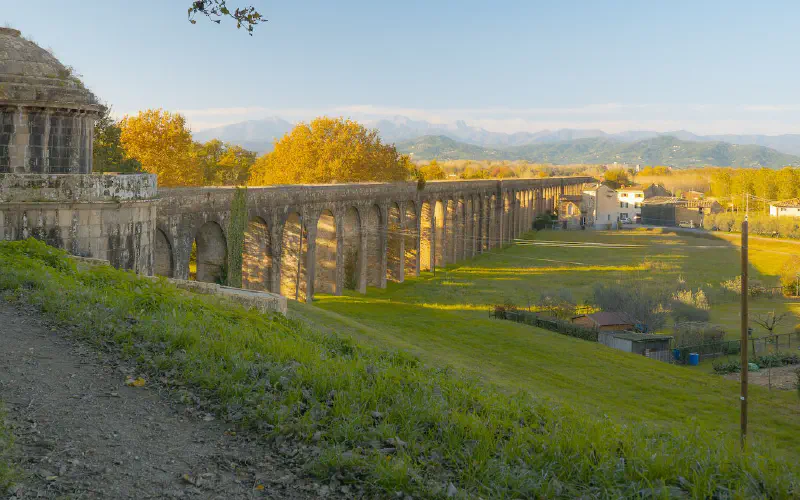
Take the Acquedotto Nottolini, near Lucca.
Built in the early 19th century to carry water from the Monte Pisano foothills into the city, the aqueduct stretches for nearly four kilometers. Its 459 arches march in a straight line across the plain in a way that stops you mid-step.
Walking alongside it is nothing like hiking in the Apennines. There is no elevation gain, no exposed ridge, no navigation challenge.
What there is instead is a quiet, unhurried path through open countryside, with one of Tuscany’s most quietly dramatic pieces of civil engineering running alongside you the whole way.
It works beautifully for families, for photographers, and for anyone who wants genuine time outdoors without committing to a mountain day.
This is part of what makes Tuscany unusual as a hiking destination. The trail variety is extreme — from flat historic walks near the coast to glacial lakes above 1,700 meters.
Understanding that range is the starting point for planning well.
No car required: Walk the 400 arches of Nottolini Aqueduct from Lucca. Guided tour accessible by train. Discover 'Parole d'Oro'. Book now!
Understanding the CAI Trail System
Italy’s mountain trails are managed by the Club Alpino Italiano (CAI), the national alpine club founded in 1863.
The CAI maintains a marked path network throughout the country. In Tuscany, you’ll find these trails across the Apennines, the Apuan Alps, and many regional parks.
How CAI Trail Markings Work

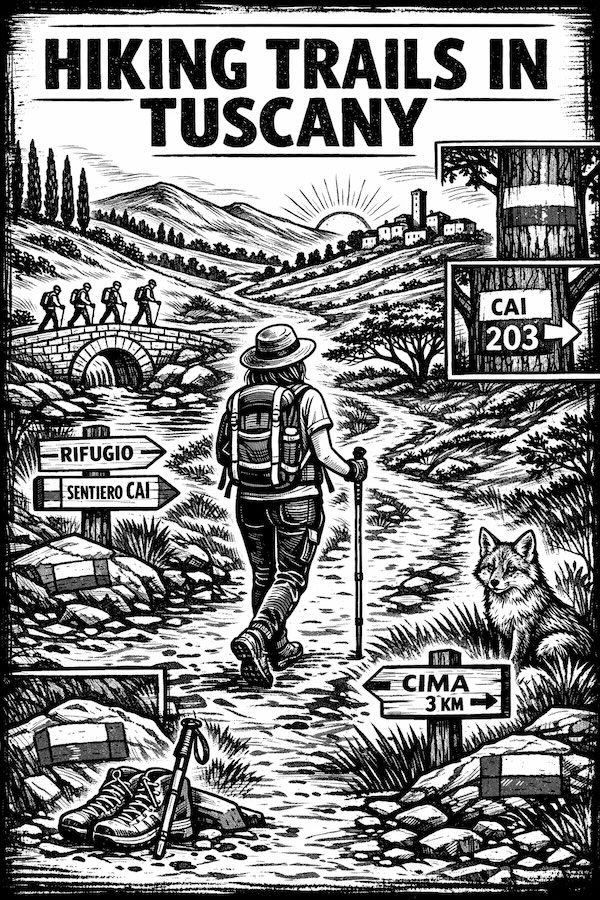
The standard CAI marker is a red-and-white painted band, applied to rocks, trees, or wooden posts.
Each trail carries a number. That number appears on:
- Trail signs at junctions
- Painted markers along the route
- Official CAI maps
Trail difficulty follows a clear classification:
- T (Turistico): Easy paths on well-maintained tracks. Suitable for most fitness levels.
- E (Escursionistico): Standard hiking trails. Some elevation gain and uneven terrain.
- EE (Escursionisti Esperti): For experienced hikers. Exposed sections, steep terrain, possible scrambling.
- EEA (Attrezzata): Equipped routes requiring via ferrata gear.
For most visitors planning a day in Tuscany’s mountains, E-grade trails are the sweet spot.
Where the System Works Well—and Where It Doesn’t
Here’s something guidebooks rarely admit: CAI markings are not equally reliable everywhere.
In popular areas—the Apuan Alps, the main Apennine ridge—markers are frequent, clear, and well-maintained.
In quieter areas, things change. Markers fade. Signs go missing after winter storms. Junctions become ambiguous.
This is not a criticism of the CAI system. Maintaining hundreds of kilometers of mountain trail is an enormous undertaking.
But it does mean that trail confidence—the ability to navigate when markers disappear—is a real skill.
This is one concrete reason to hike with a local guide.
Not because the trails are dangerous. Because knowing where you are when markings fail is the difference between a great day and a stressful one.
When to Hike in Tuscany
Tuscany’s mountains follow a clear seasonal rhythm.
Spring (April–June): The forest awakens. Wildflowers fill mountain meadows. Streams run full from snowmelt. Trail conditions improve week by week.
Summer (July–August): High elevations stay cool while valleys bake. Early starts are essential. Afternoon thunderstorms are common above 1,000 meters.
Autumn (September–November): The finest season for hiking. Mild temperatures, extraordinary colors, and—for those who know where to look—mushroom season.
Winter (December–March): High trails require snowshoes or crampons. Lower routes remain accessible, often in complete solitude.
The honest answer is that Tuscany rewards hiking in every season. You simply need to match the destination to the time of year.
Three Places Most Tourists Never Reach
Acquerino Nature Reserve
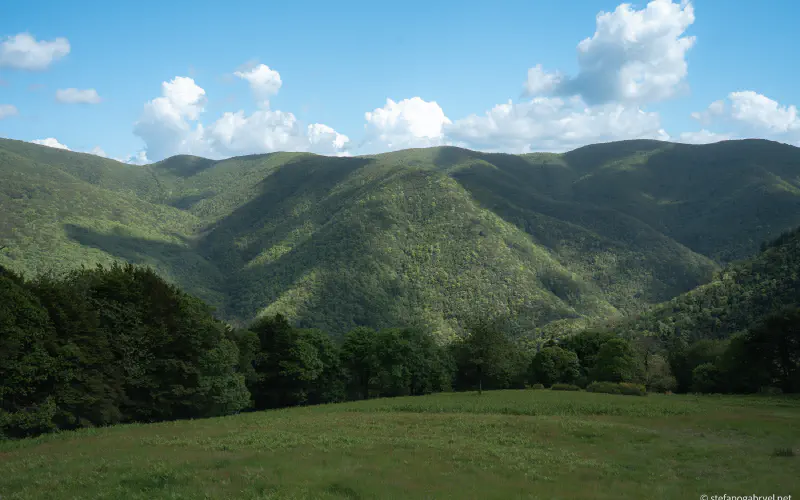
Thirty minutes from Pistoia, the Riserva Naturale di Acquerino and the Riserva Naturale Acquerino Cantagallo offer some of the finest forest hiking in the Tuscan Apennines.
These two connected reserves function as one continuous protected landscape. The administrative boundary is bureaucratic; the forest doesn’t care about municipal jurisdictions.
The trail network covers everything from easy meadow loops—ideal for families—to deeper forest routes with genuine solitude and wildlife.
The habitat here is exceptional. Mixed broadleaf forest at lower elevations gives way to high beech groves that feel almost cathedral-like in their scale and quiet.
I’ve written about this area in detail in my dedicated guide to the Acquerino reserve.
Book a private guided hike in Riserva Acquerino-Cantagallo. Expert trekking tours from Pistoia, Prato & Florence. Escape the crowds—reserve your tour!
Corno alle Scale and Lago Scaffaiolo
Further north along the Apennine ridge, Corno alle Scale reaches 1,945 meters—the highest peak in this section of the range.
But the destination that draws me back is not the summit.
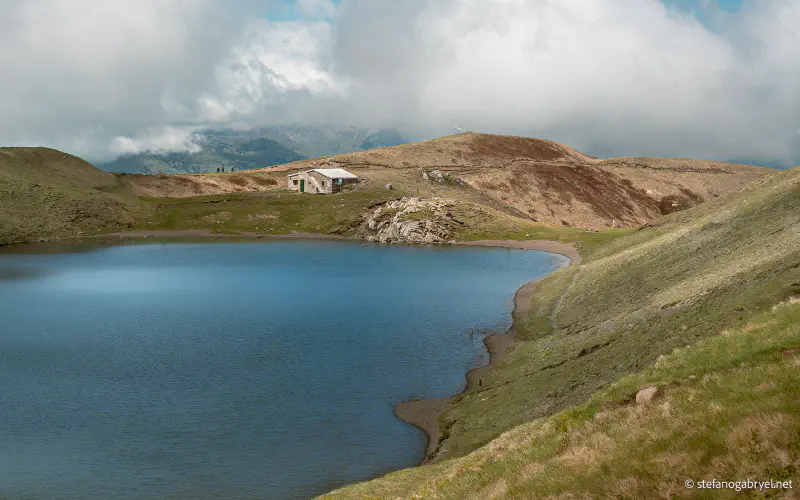
It’s Lago Scaffaiolo, a glacial lake sitting at 1,775 meters elevation.
Few high-altitude lakes exist in the Tuscan Apennines. This one feels genuinely alpine. The lake sits in a cirque below the summit ridge, surrounded by steep slopes and exposed rock.
The light here—especially early morning—is unlike anything you’ll find at lower elevations. For landscape photography, the combination of still water, mountain atmosphere, and elevation clarity is extraordinary.
Getting there requires a committed day. Plan 5–7 hours and check weather carefully. Conditions at this elevation change quickly.
Book a private guided hike to Scaffaiolo Lake. 360° Apennine views & Rifugio visit. Expert tours from Lucca, Pistoia & Pisa. Reserve your trek!
Lago Nero
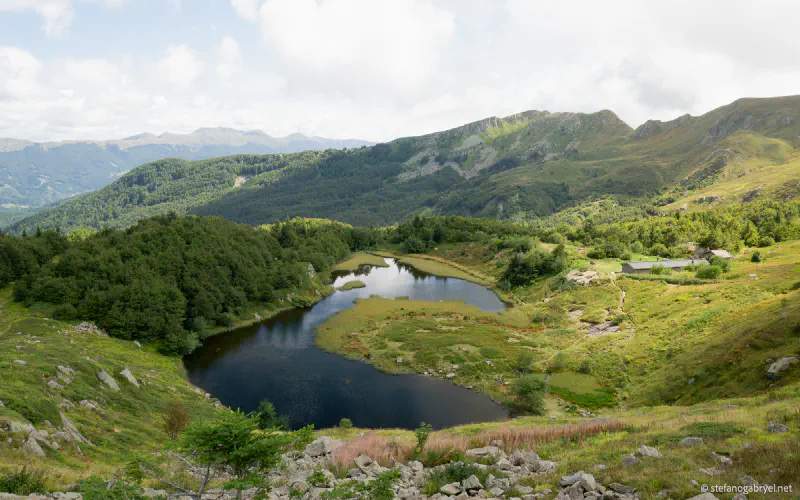
Hidden in the Pistoiese Apennines, Lago Nero is one of those places that rewards the effort required to find it.
The name means Black Lake. Dark, still water surrounded by dense forest creates an atmosphere entirely different from the open ridges above.
This is a quieter, more intimate landscape. Less dramatic than Scaffaiolo, but in its own way more surprising.
It’s also the kind of place where most tourists—even those who hike—simply never go. The path isn’t difficult. But knowing which route to take, and how to read the forest around it, matters considerably.
Book a private guided hike to Lago Nero. Professional trekking tours from Pistoia, Lucca & Florence. Discover Tuscany's glacial lakes. Reserve now!
The Practical Reality of Hiking Here
A few things worth understanding before you go.
Footwear matters more than most people expect. Trails that look gentle on a map can involve wet roots, loose stone, and uneven terrain. Proper hiking boots—not trail runners—are the right choice for most Apennine routes.
Weather in the mountains changes quickly. The classic mistake is leaving the car in sunshine and reaching the ridge in cloud. Carrying a mid-layer and a waterproof is not optional—it is standard practice.
Maps and GPS add genuine security. CAI maps cover most areas. A downloaded offline map on your phone is worth the two minutes it takes to set up.
And then there is the subtler question of what you actually see.
Marc Silber, in Advancing Your Photography, writes about the importance of truly seeing what is in front of you—not just moving through it. The same principle applies to hiking. Passing through a landscape and actually reading it are different experiences entirely.
A local guide doesn’t just prevent you from getting lost. They change what the walk means.
The Invitation
Tuscany’s hiking trails are among the finest in Italy.
They are also, in places, less forgiving than they appear on a map.
The combination of well-maintained paths, complex mountain terrain, and strong seasonal variation is exactly what makes this region so rewarding for anyone willing to go beyond the obvious.
Whether you’re planning a gentle family day at Acquerino, an ambitious summit at Corno alle Scale, a quiet afternoon at Lago Nero, or something else entirely—the mountains are here, and the planning can start now.
Plan Your Tuscany Hiking Experience
Ready to explore Tuscany’s trails with expert local guidance? Book a consultation call to discuss routes, timing, and experiences tailored to your fitness level and interests.

or head to the contact page
Explore Hidden Tuscany
Guided hiking experiences combining expert trail knowledge, professional photography, and wilderness mindfulness.