I'm Stefano, and I guide people through the Tuscany most tourists never see. Want to hike in Tuscany with me?
Last updated 4 November 2026
Search for hidden gems in Tuscany and most of the lists that come back are hill towns like Pienza or Monteriggioni. Fair enough, a town is the easiest thing in the world to put on a list.
My three are places you reach on foot, off the beaten path and still close to cities you’re probably visiting anyway: an aqueduct that leaves Lucca ten minutes from the train station and ends at a spring in the woods, a valley of sand pinnacles halfway between Florence and Arezzo, and a lake at 1,775 metres on the ridge where Tuscany meets Emilia-Romagna.
All three are easy to miss on a first trip to Tuscany. The lake is a mountain day for people who walk regularly at home. The other two are gentle walks of a few kilometres on easy ground, one starting in Lucca and the other between Florence and Arezzo, and under each I describe the ground and who it suits; the card below each one shows the length, the time and the price. You can walk all three without me, since the aqueduct needs no map and the other two have signed paths. What I’ve added under each is what a private day with me brings that a signpost can’t.
1. The Nottolini Aqueduct and the Parole d’Oro, Lucca
Lucca’s aqueduct starts at a small round temple ten minutes on foot from the station. From there about 460 brick arches run in a straight line across the plain towards Monte Pisano. Lorenzo Nottolini built it between 1823 and 1851 to bring clean spring water into a city whose wells had gone bad. He’s also the architect who turned the old Roman amphitheatre into Lucca’s oval Piazza dell’Anfiteatro. He lined the arches up with the sun, too, so the aqueduct doubles as a sundial. The alignment times are in my guide to the Lucca aqueduct.
Keep going past the last arch, as I do on my guided day. The lanes take you into the woods, to the springs that fed the whole system and to a spot called the Parole d’Oro, the golden words.
Nottolini set an inscription there in brass letters. The farmers around were sure the letters were gold and prised them off to sell. The name stuck. Later the lettering was repainted in gold. Even people born in Lucca often don’t know it’s there, in my experience. We go in under the trees, past stone channels green with moss, to an old arched bridge in the shade. On the way back I can tell you why the line of arches breaks where it does, down to the section retreating German troops blew up in 1944.
It’s the flattest walk on my list, on gravel paths and quiet asphalt lanes, with benches along the way and shade in places. It’s a half day out and back with almost no climbing, at an unhurried pace. Turn round at the last arch and the walk gets shorter, though you’ll miss the Parole d’Oro. Ask me for the longer route instead if you’d like a climb, on steeper and rougher trails up to a viewpoint over Lucca. There’s no gate and no ticket, and regional trains from Pisa and Florence stop at Lucca, so you won’t need a car.
All gallery images are original photographs taken by me.
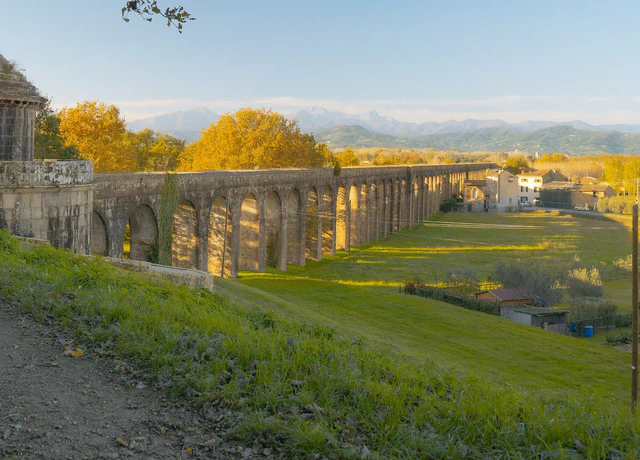
Nottolini Aqueduct
The aqueduct doubles as a sundial. Once a day the light runs straight down its corridor of arches, at a time that shifts through the year.
- About 3 hours
- €165 per group
- Reachable by train
- Longer route to a view over Lucca, on request
Easy · 9.1 km (5.7 mi) · 50 m (164 ft) ascent
View this hike2. The Balze del Valdarno, between Florence and Arezzo
Halfway between Florence and Arezzo, the olive groves of the upper Valdarno stop at a cliff edge. Below it stand towers and walls of pale sand and clay, some close to a hundred metres tall. For more than a million years this stretch of valley held a lake, and elephant and rhinoceros bones have been coming out of its old bed since at least 1596. When the lake drained, the Arno and the streams coming off the Pratomagno ridge cut down through the soft layers and left the harder ones standing, and rain is still at work on them, so the shapes you see today won’t be quite the shapes your children see.
Leonardo knew this valley. In the Codex Leicester he wrote that the upper Valdarno had once been a lake. The idea that these pinnacles are the background of the Mona Lisa has its supporters and its critics, and I’ve set out both sides in my post on the Mona Lisa background.
The walk starts from Castelfranco di Sopra, a town the Florentines laid out on a grid in 1299 on the Valdarno side of the Pratomagno. You’re on paths and farm tracks through the olives, with short ups and downs and nothing exposed. Sand and clay turn slippery after rain, so on a wet day I slow down and may shorten the route. Starting at noon in July is a terrible idea, and in July and August I start early.
Nothing I’d read had prepared me for them. The pinnacles go from bone-pale at midday to gold late in the afternoon, and in spring the fields below them turn green. On my walk I take the approach that puts that light where you want it, at a pace that leaves time for photographs. I tell the Leonardo story in front of the landscape it’s about. The guided day isn’t priced yet, but you can already ask me for a date. There’s more on getting there in my day trip guide to the Balze.
All gallery images are original photographs taken by me.
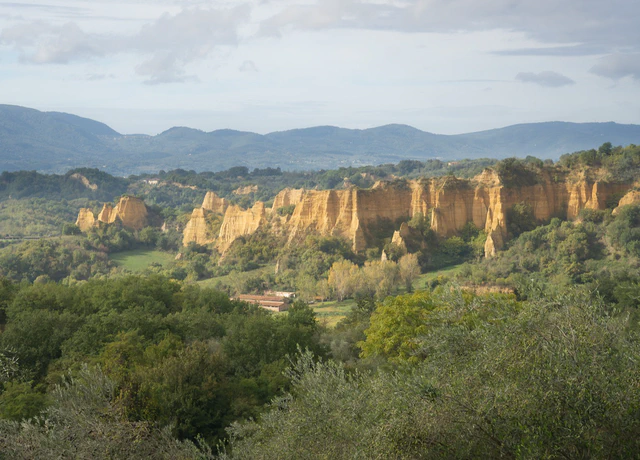
The Balze del Valdarno
Towers and walls of pale sand and clay, left behind by the lake that filled this valley before the Arno cut through it. Late in the afternoon they turn gold. An easy walk, 41 km from Arezzo and 42 from Florence.
Easy
View this hike3. Lago Scaffaiolo, on the Apennine Ridge
The third one’s for hikers. Along the northern border of Tuscany the Apennines climb past the tree line, the tallest mountains in the region and the side of it that postcards of cypresses and vineyards leave out. In a hollow on the crest, at 1,775 metres, lies Lago Scaffaiolo. There’s been a refuge at the water’s edge since 1878, and today’s Rifugio Duca degli Abruzzi is the latest of several rebuilds. Nothing flows into the lake and nothing flows out, and where its water comes from has been studied since the 1700s.
You set off from a small mountain village, and a wide gravel road takes you up towards the crest. After that the crest path takes over, with Tuscany falling away on one side and Emilia-Romagna on the other all the way to the lake. It’s a full day out and back on the same path, with one steady climb, and it suits anyone who walks regularly at home, older children included. If that sounds like a warm-up, ask me for the longer version. There’s a shorter one too.
I’ve eaten tagliatelle with porcini in that refuge with the wind pushing at the windows, and on the same day watched a clear morning ridge disappear into cloud by the time I turned downhill, so I carry layers up there even on a warm day. On the ridge I keep an eye on the sky, which leaves you free to look at the view. You can read how that day went, from trailhead to refuge, in a full day on the Apennine ridge.
The start is high in the mountains above Pistoia, and there’s no practical public transport to it.
All gallery images are original photographs taken by me.

Lago Scaffaiolo
Once you’re up, the path runs along a broad, grassy crest to the lake, with Tuscany on one side and Emilia-Romagna on the other.
- About 6 hours
- €240 per group
- Shorter or longer day on request
Medium · 9.5 km (5.9 mi) · 370 m (1,214 ft) ascent
View this hikeWhich One Fits Your Trip
- In Lucca, or without a car, take the Nottolini, in any month. You can be under the arches ten minutes after stepping off the train.
- Based in Florence or Arezzo, try the Balze. Trains on the Florence to Arezzo line stop on the valley floor below Castelfranco di Sopra.
- Fit and happy with a full day on your feet? Scaffaiolo, from late spring through autumn.
- With young children, the Nottolini again, turning round at the last arch if little legs give out. Scaffaiolo suits older children who are used to walking, and for the Balze, tell me their ages and I’ll tell you whether the day suits them.
- For photographs, late afternoon warms the brick of the arches and turns the Balze gold.
A driver booked through your hotel can take you to any of them. If you don’t have a car, tell me when you write and I’ll help you find a solution.
Prices are per group, not per person, and each card shows the current one. It covers one to three walkers, and each walker from the fourth adds €5, so a family of four pays the card price plus €5. It’s your group only, up to 12 people with me alone. On the way I’ll tell you about the land and what grows on it, fungi included, and help with your photos if you want it.
Frequently asked questions
Walk One of Them with Me
Each of these is a private day, just your group and me. Write to me through the contact form or on WhatsApp with your dates, where you’re staying and how many of you there are, plus anything I should know about knees or young children, and I’ll tell you which one fits.