Walk any trail in Tuscany during spring and you’ll encounter it. You might not notice until you stop to rest. Then you discover your pants, sleeves, and pack covered in small green burrs. Tiny hooked hairs grip fabric with surprising tenacity.
Most people know Galium aparine only as an annoyance. Those sticky seeds that cling to clothing and dog fur. But this common plant deserves closer attention. Not because it’s rare or beautiful. Because it’s remarkably successful at what it does.
The plant thrives along the Acquedotto del Nottolini near Lucca. It grows in hedgerows throughout the Tuscan countryside. It colonizes trail edges, field margins, and disturbed ground. Anywhere humans create edges between cultivation and wild, cleavers appears.
Recognition: The Velcro Plant
Galium aparine goes by many common names in English. Cleavers, goosegrass, catchweed, sticky willy, bedstraw, robin-run-the-hedge. The multiplicity reflects how widely known and noticed this plant is. Despite being dismissed as a weed.
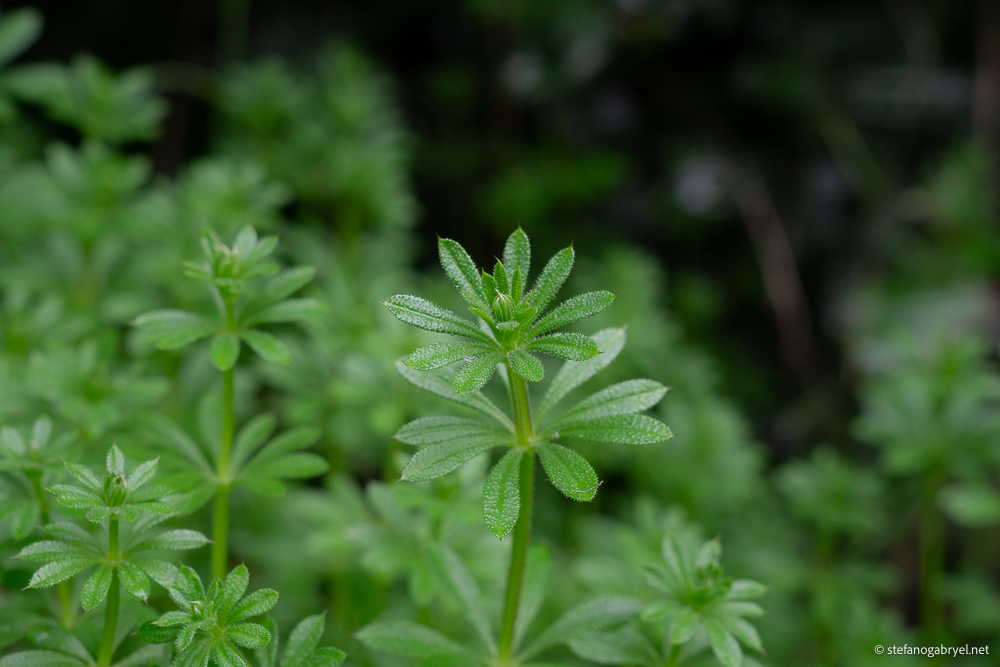
The most distinctive feature is tactile rather than visual. Everything about the plant is covered in tiny hooked hairs. Stems, leaves, fruits. These hooks point backward along the stem. They catch on anything they touch. This is what inspired Velcro, allegedly. The plant demonstrates the principle perfectly.
The stems are weak and square in cross-section. They can reach 1-2 meters long. But they cannot stand upright. Instead, they sprawl across the ground. Or they climb over other vegetation. The hooked hairs act as climbing aids. They anchor the weak stems as they grow upward through supporting plants.
The leaves are narrow, lance-shaped, arranged in distinctive whorls. Each whorl contains 6-8 leaves radiating from a single point on the stem. The leaves measure 1-5 cm long. They taper to a point. Both surfaces bear hooked hairs along the midrib and edges.
The flowers appear in spring and early summer (April to June in Tuscany). They’re tiny—only 2-3 mm across. White or greenish-white, with four petals. They grow in small clusters of 2-5 flowers. They emerge from the leaf axils. The flowers are so small they’re easily overlooked. Most people only notice cleavers when the fruits appear.
The fruits are the plant’s calling card. Two small, round burrs develop from each fertilized flower. Each burr is roughly 3-5 mm in diameter. Covered completely in hooked hairs. These are what stick so tenaciously to fabric and fur. They’re designed for animal dispersal. Any passing creature becomes an unwitting seed distributor.
Etymology: Milk and Clinging
The scientific name reveals something about how humans have interacted with this plant.
Galium derives from the Greek word γάλα (gala), meaning milk. A related species, Galium verum (lady’s bedstraw), was used to curdle milk in cheese-making. The enzyme in the plant acted as a rennet substitute. This association gave the entire genus its name.
Aparine comes from the Greek verb ἀπαίρω (apairo), meaning “to seize” or “to cling.” Theophrastus, the ancient Greek philosopher and botanist, used this name. It’s perfectly descriptive. The plant literally seizes anything it touches.
The English common name “cleavers” has the same root. To cleave means to stick or adhere. “Goosegrass” reflects that geese (and other fowl) eagerly consume the plant. “Bedstraw” indicates historical use—dried plants were stuffed into mattresses. The hooked hairs helped the bedding stay cohesive.
Habitat: Edge Specialist
Galium aparine belongs to the Rubiaceae family. This includes coffee, gardenia, and various bedstraws. The family is largely tropical. But cleavers is cosmopolitan. It grows throughout Europe, North Africa, Asia, North America, and parts of South America.
In Italy, it’s common from sea level to moderate mountain elevations. It prefers temperate conditions with adequate moisture. But it tolerates a wide range of conditions.
The plant specializes in disturbed edges:
- Hedgerows and field margins
- Woodland edges and clearings
- Trail sides and path edges
- Along streams and ditches
- Abandoned agricultural land
- Garden borders and waste ground
It’s an annual plant. Seeds germinate in autumn or early spring. The plants grow rapidly through spring. They flower and set seed by early summer. Then they die back completely. The cycle repeats.
What makes cleavers successful is niche exploitation. It doesn’t compete well in undisturbed plant communities. Mature forests exclude it. Dense grasslands outcompete it. But in disturbed edges where other plants struggle? Cleavers thrives.
Human activity creates ideal habitat. Agricultural field edges. Trail maintenance that prevents succession. Livestock grazing that opens dense vegetation. These disturbances favor cleavers. Which is why it’s more common now than before intensive agriculture.
Along the Nottolini: Springtime Abundance
The Acquedotto del Nottolini provides excellent habitat for Galium aparine. The trail edges, the base of the aqueduct arches, the hedgerows alongside—all support cleavers in spring.
Walking the Nottolini in April and May, you can observe the plant at every growth stage. Young rosettes just emerging. Climbing stems reaching through hedgerow vegetation. Plants in full flower. Early fruit development. All visible along a single three-kilometer walk.
The accessibility makes it valuable for learning plant identification. You can examine the square stems up close. Feel the backward-pointing hooks. Observe the leaf whorls. Watch how the plant uses other vegetation as support. All without scrambling through dense undergrowth or trespassing.
The aqueduct itself—with its combination of brick structure, adjacent hedgerows, and human-maintained paths—creates exactly the disturbed-edge habitat cleavers exploits. It’s a textbook example of how certain plants thrive specifically because of human landscape modification.

No car required: Walk the 400 arches of Nottolini Aqueduct from Lucca. Guided tour accessible by train. Discover 'Parole d'Oro'. Book now!
Edibility and Traditional Uses
Galium aparine is edible, though not commonly eaten today. The young shoot tips and leaves can be consumed raw or cooked. Best harvested in early spring before the plant flowers and the stems become tough.
The taste is mild, slightly bitter. Some describe it as grassy or green-bean-like. Nothing offensive, but not particularly appealing. The hooked hairs create textural issues when eating raw. They can irritate the mouth and throat. Cooking (boiling 10-15 minutes) softens the hairs and makes the plant more palatable.
The practical challenge is cleaning. Those same hooked hairs that attach to clothing attach to debris. Every bit of dead leaf, grass blade, or soil particle sticks. Cleaning enough cleavers for a meal requires patience. This likely explains why it never became a major food source. Too much effort for modest nutritional return.
The seeds, when roasted, can substitute for coffee. Cleavers belongs to the same family as coffee (Rubiaceae). The roasted seeds produce a dark beverage with coffee-like flavor. Though caffeine content is much lower. Gathering enough seeds for even one cup requires significant effort. It’s more curiosity than practical coffee substitute.
Traditional medicinal applications are extensive:
- Diuretic (increases urine production)
- Lymphatic system support (reduces swelling)
- Skin conditions (eczema, psoriasis, seborrhea)
- General detoxifying agent
- Febrifuge (reduces fever)
During World War II in Britain, children were paid to harvest cleavers. Pharmaceutical companies used it to manufacture medicine for treating infections. This industrial-scale use demonstrates that folk medicine applications had recognized efficacy.
Modern herbalism still employs cleavers primarily for lymphatic support. The plant is made into teas, tinctures, or fresh juice. Harvested in spring when tender. Used specifically for conditions involving fluid retention or lymphatic congestion.
Other traditional uses:
- Red dye from the roots (intense enough to color bones red if consumed)
- Tinder for fire-starting (dried plant material)
- Sieve or strainer (layered stems create effective filter)
- Removing pitch/tar from hands (the plant somehow dissolves sticky residues)
The Hooks: Engineering Worth Examining
The hooked hairs deserve closer observation. They’re not random structures. They’re precisely engineered for specific functions.
Each hook is a modified hair (trichome). The tip curves backward sharply. The angle is perfect for catching but difficult to dislodge. Run your hand up a stem—smooth. Run it down—rough, catching. This directional grip allows the plant to climb. It can ascend through vegetation by hooking onto supporting plants. But it doesn’t slide back down.
The same hooks serve seed dispersal. Animals brushing past plants collect dozens of burrs. The seeds travel considerable distances before eventually detaching. This zoochory (animal-mediated dispersal) is remarkably effective. One sheep passing through a cleavers patch might carry seeds hundreds of meters. Or to entirely different locations.
The hooks also deter some herbivores. The texture is unpleasant for many mammals. Though geese, chickens, and other fowl eat cleavers readily. The plant’s common name “goosegrass” reflects this. Different animals respond differently to the hooked texture.
This is elegant botanical engineering. A single structural modification—curved hair tips—serves multiple functions simultaneously. Support, dispersal, and defense. This efficiency explains part of the plant’s ecological success.
Ecology and Life Strategy
Galium aparine employs what ecologists call a ruderal strategy. Named after ruderal habitats (waste ground, disturbed areas). These plants specialize in colonizing disturbed ground rapidly. They grow quickly, reproduce prolifically, and don’t persist long-term.
The strategy works through specific characteristics:
- Annual life cycle (no investment in perennial structures)
- Rapid growth (exploiting temporary opportunities)
- Abundant seed production (hundreds per plant)
- Effective seed dispersal (zoochory via hooks)
- Germination timing (autumn or spring, depending on conditions)
- Tolerance of disturbance (thrives where others struggle)
This strategy makes cleavers a successful weed. It appears quickly in gardens, agricultural fields, and disturbed ground. It grows rapidly. It sets seed before being removed. Next year’s plants emerge from that seed bank.
But this same strategy limits cleavers to disturbed habitats. It cannot compete in stable plant communities. Old-growth forests exclude it. Mature meadows suppress it. It’s permanently restricted to edges and disturbances.
From a naturalist perspective, this makes cleavers an indicator. Where you find abundant cleavers, you know the habitat is disturbed regularly. Human activity, animal disturbance, or environmental processes prevent succession. The plant reveals landscape history through its presence.
Why This Common Plant Matters
You might reasonably ask: why write about such a common, even annoying plant?
Because common plants teach us how landscapes actually function. Not how we imagine them. Not the charismatic species featured in nature documentaries. But the ordinary organisms that dominate actual ground.
Galium aparine is one of the most successful plants in human-modified landscapes. It thrives because of our activities. Our agriculture, trails, disturbances—these create its habitat. Understanding why it succeeds helps us understand how our actions reshape plant communities.
The plant also demonstrates beautiful adaptations. Those hooked hairs serving multiple functions. The climbing strategy using other plants as structure. The seed dispersal via animal transport. These aren’t accidents. They’re solutions to specific challenges. Observing them in the field teaches functional plant ecology better than textbooks.
Finally, cleavers reminds us that “weeds” are successful organisms. We call them weeds because they thrive where we don’t want them. But from the plant’s perspective, it’s simply exploiting available resources. It’s no more or less evolved than rare orchids. Just differently adapted.
Experiencing Cleavers in the Field
If you want to observe Galium aparine properly—beyond merely removing it from your clothing—spring is the season. April and May in Tuscany.
The Acquedotto del Nottolini provides accessible observation along a flat, easy trail. No special access required. Just walk the path and observe the hedgerows and trail edges.
What to look for:
- The distinctive leaf whorls (6-8 leaves per whorl)
- Square stems with backward-pointing hooks
- Climbing behavior (stems ascending through other plants)
- Tiny white flowers in small clusters
- The developing burr-like fruits (late spring)
Feel the stems. Observe how the directional grip works. Watch how the plant uses other vegetation for support. See which animals are eating it (birds particularly).
This kind of observation—focused attention on common plants—trains naturalist skills. You learn to see details. To understand adaptations. To read what plants reveal about habitat and history.
While I primarily guide mountain hikes and photography expeditions, botanical observation remains central to my engagement with landscape. If you’re interested in walking the Nottolini with attention to the plants we encounter, that’s absolutely within my expertise and interests.
Walk Tuscan Trails with a Naturalist's Eye
Interested in exploring Tuscany’s trails with someone who can identify the plants, explain their ecology, and show you the details most hikers miss? I offer guided walks that combine natural history, photography, and close observation—transforming ordinary hikes into opportunities for genuine discovery.

or head to the contact page
Explore Hidden Tuscany
Guided hiking experiences combining expert trail knowledge, professional photography, and wilderness mindfulness.