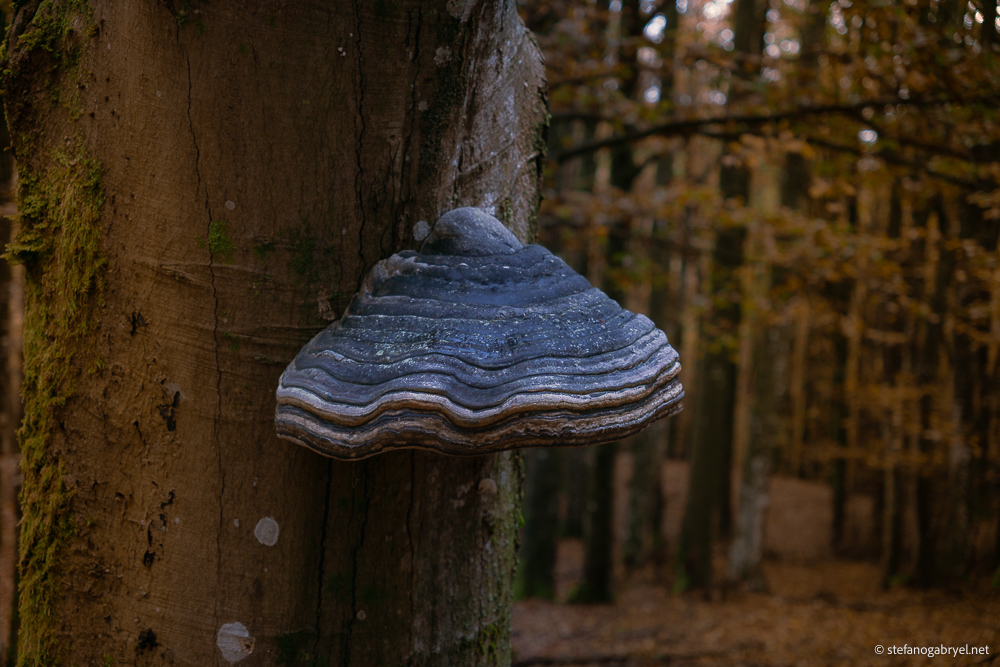
Not every mushroom I encounter during my hikes through Tuscan forests ends up in a basket destined for the kitchen.
Some mushrooms tell stories that matter more than their edibility.
Fomes fomentarius—the tinder fungus, hoof fungus, or as it’s sometimes called in Italy, “esca” or “fungo dell’esca”—is one of these.
When you spot one of these grey-brown, hoof-shaped brackets jutting from a dead beech tree, you’re looking at a fungus that humans have valued for over 5,000 years.
We know this with certainty because when Ötzi the Iceman was discovered in 1991, frozen in the Ötztal Alps, he was carrying pieces of Fomes fomentarius in his equipment.
This wasn’t a random mushroom he’d picked up on his final journey—this was a deliberate tool, carefully prepared and packed, essential enough to his survival that it traveled with him across the mountains.
What does a 5,300-year-old technology teach us about mushrooms today?
Quite a bit, actually.
The Iceman’s Mushroom: What Ötzi Carried
Among the numerous items found with Ötzi—weapons, clothing, food, medicinal plants—were fungal objects.
Specifically, researchers identified processed Fomes fomentarius in his girdle bag, prepared as tinder material.
This wasn’t just any mushroom specimen—it was amadou, a felt-like material created through a labor-intensive process of soaking, beating, and treating the fungus’s inner layers.
The discovery tells us several important things:
Prehistoric knowledge was sophisticated.
Creating amadou from Fomes fomentarius isn’t obvious or simple.
It requires understanding which part of the fungus to use, how to process it, and how to prepare it for specific purposes.
This fungus was valuable enough to carry.
When you’re traveling through alpine terrain 5,300 years ago, every item you carry represents a choice about weight, utility, and survival.
Ötzi chose to bring Fomes fomentarius.
Fire-starting technology relied on fungi.
Before matches, before lighters, before easy ignition, people needed reliable tinder—material that catches sparks and smolders long enough to start a fire.
Properly prepared amadou from Fomes fomentarius was one of the best options available.
This use continued for millennia.
The practice didn’t die with Ötzi—Europeans used amadou for tinder well into the 19th and early 20th centuries, and some traditional survivalists still use it today.
What Fomes Fomentarius Actually Is
Fomes fomentarius is a perennial polypore fungus—a wood-decay specialist that produces distinctive bracket-shaped fruiting bodies.
The common name “hoof fungus” describes its appearance perfectly:
The fruiting body resembles a horse’s hoof attached to the tree, often 10-40 centimeters across, hard and woody, with a grey to grey-brown upper surface marked with concentric zones.
It’s not annual—these fruiting bodies persist for years, adding new layers annually.
The oldest specimens can be decades old, growing larger and more substantial with each passing season.
The fungus itself is a parasite that becomes a decomposer.
It initially infects living hardwood trees—particularly beech, birch, and occasionally other species—through wounds in the bark.
The mycelium spreads through the tree, causing white rot that weakens the wood.
Eventually the tree dies, but Fomes fomentarius continues living on the dead wood, functioning now as a saprotroph that hastens decomposition.
In Tuscan forests, I encounter it most frequently on dead or dying beech trees, particularly at mid to higher elevations where beech forests dominate.
The Apennines (like Acquerino) provide ideal habitat—mature beech stands with enough dead wood to support robust fungal populations.
Identification: Reading the Hoof
Fomes fomentarius has a distinctive appearance that becomes unmistakable once you know what to look for.
External characteristics:
- Shape: Hoof-like or semicircular bracket, hard and woody
- Size: Typically 10-40 cm across, though exceptional specimens can be larger
- Upper surface: Grey, grey-brown, or sometimes nearly black (slightly blue sometimes), with concentric zones
- Texture: Hard, smooth to slightly rough, like touching a horse’s hoof
- Attachment: Broadly attached to the tree, no visible stem
Cut in cross-section, the interior reveals:
- Brown, corky tissue with distinct layers
- A harder outer crust
- Softer, fibrous inner layers (this is the material processed into amadou)
- Tube layers visible as fine pores on the underside
The underside (pore surface) is:
- Off-white to grey-brown
- Consists of tiny pores (4-5 per millimeter)
- Often bruises brown when touched
- Fresh growth at the margin appears lighter
Spore print: White
Potential Lookalikes
While Fomes fomentarius is fairly distinctive, a few other polypores might cause confusion:
Ganoderma species (Artist’s Conk, Reishi relatives):
- Often similar in size and growth habit
- Key difference: Ganoderma has a varnished, shiny surface; Fomes is matte
- Ganoderma produces brown spores; Fomes produces white spores
Phellinus species:
- Also hard, perennial polypores on hardwoods
- Generally darker, more irregular in shape
- Less distinctly hoof-shaped
In practice, once you’ve seen Fomes fomentarius a few times, it becomes unmistakable.
The specific combination of hoof shape, grey-brown coloring, and rock-hard texture on beech or birch is diagnostic.
Traditional Uses: Beyond Tinder
While fire-starting is the most famous use—and presumably Ötzi’s primary purpose—Fomes fomentarius served multiple roles across cultures.
Amadou production:
The inner, corky layers can be processed into a felt-like material through repeated soaking, beating, and sometimes treatment with nitre or other compounds.
This amadou catches sparks readily and smolders for extended periods—perfect for transporting fire or starting new fires with flint and steel.
Medical applications:
Traditional European medicine used Fomes fomentarius as:
- A styptic (to stop bleeding)—the material is highly absorbent
- An antiseptic wound dressing
- Treatment for various internal ailments (though efficacy is questionable)
Modern research has identified compounds in Fomes fomentarius with potential anti-inflammatory and anti-tumor properties, though this doesn’t validate all traditional medicinal claims.
Textile and craftwork:
In parts of Romania and Eastern Europe, amadou was crafted into:
- Hats and caps (the mycologist Paul Stamets is famous for wearing one)
- Clothing items
- Decorative objects
The material, when properly prepared, resembles leather or felt—sometimes called “mushroom leather.”
Fly fishing:
Modern fly fishermen still use amadou for drying artificial flies between casts.
The absorbent properties that made it useful for wound dressing also make it ideal for quickly drying feathers.
Why It’s Not Edible (And Why That’s Fine)
Let me be clear: do not attempt to eat Fomes fomentarius.
It is not toxic in the sense of causing poisoning, but it is inedible for practical purposes:
- The texture is woody and impossibly tough
- No amount of cooking will make it palatable
- It would be like trying to eat a piece of cork
- There’s no culinary tradition of consuming it because there’s no way to make it work as food
This doesn’t diminish its value—it simply means the value lies elsewhere.
Not every mushroom needs to be edible to be important.
Fomes fomentarius represents ecological function (wood decomposition), historical significance (5,000+ years of human use), and practical application (tinder, crafts, potential medicine).
That’s more interesting than most edible mushrooms can claim.
What I Tell People When We Find It
During my mycology hikes in the Apennines, when we encounter Fomes fomentarius on a dead beech, I always stop.
This is a teaching moment that goes beyond mushroom identification.
I explain the Ötzi connection—how this exact species traveled with a person who died before the Egyptian pyramids were built.
I demonstrate the hardness of the fruiting body, the concentric zones showing years of growth.
We discuss the dual life of the fungus: parasite first, decomposer later.
And I emphasize the broader point: not all valuable mushrooms end up in the pan.
The forest is full of fungi that matter for reasons having nothing to do with cuisine.
Fomes fomentarius breaks down dead wood, returning nutrients to the soil.
It provides habitat for insects and other organisms.
It tells us something about the health and age of the forest—abundant Fomes fruiting bodies indicate mature woodland with substantial dead wood, which is ecologically important.
Understanding this mushroom means understanding forest ecology, human history, and the diverse roles fungi play beyond simply being potential food.
The Practical Question: Should You Harvest It?
Occasionally, someone asks if they should take a Fomes fomentarius specimen—either for trying to make amadou or simply as a curiosity.
My answer: probably not.
Here’s why:
Growth rate is slow.
These fruiting bodies take years to reach substantial size.
Removing one eliminates decades of fungal growth.
Ecological function matters.
That bracket is actively decomposing wood, providing habitat, and contributing to nutrient cycling.
Taking it removes those functions from the ecosystem.
Processing amadou is labor-intensive and requires specific knowledge.
Unless you’re genuinely planning to learn traditional fire-starting techniques or craftwork, it’s likely to sit unused.
Observation is often more valuable than possession.
Photographing it, understanding its role, recognizing it as part of the forest’s living system—these don’t require removal.
Exceptions exist:
If you’re seriously interested in traditional bushcraft and fire-starting, learning to process amadou is a legitimate skill.
In that case, take only from dead, fallen wood where the fungus is already detached from living trees, and take minimally.
But for most hikers and nature enthusiasts, simply knowing what Fomes fomentarius is and why it matters is enough.
The Connection to Deeper Time
What strikes me most about Fomes fomentarius is the continuity it represents.
The mushroom growing on that beech tree is essentially identical to the one Ötzi carried 5,300 years ago.
Same species, same properties, same uses.
The knowledge of how to process and use it was passed down through countless generations, across cultures, surviving upheavals and changes in human society.
And now we’re rediscovering some of that knowledge—not out of necessity, but out of curiosity about how our ancestors lived.
This mushroom connects us to the Neolithic, to medieval fire-starters, to 19th-century rural communities, to modern mycologists and bushcraft practitioners.
It’s a living link to deep human history, growing on trees in Tuscan mountains.
That’s worth more than a meal, in my opinion.
Are you a beginner?
If you’re just beginning to explore mushroom foraging, Geoff Dann’s Edible Mushrooms is the field guide I recommend to all my clients. It’s an excellent starting point for learning safe identification. Read my full review here.
Want to learn in the field? Join me for a hands-on mushroom hunting experience ⬇️ ⬇️ ⬇️ ⬇️
Ready to move from photos to field identification?
Experience these fascinating fungi firsthand on a guided autumn hike through Tuscan woodlands. Learn professional identification techniques, understand ecosystem roles, and capture your own stunning mushroom photography.
Attention!
While the content of this blog post is aimed at providing you with information as accurate as possible, it should be treated as what it is: simply a blog post on the internet.
Mushroom identification should only be performed by experts, as a mistake can lead to dire consequences. Attempting to identify a mushroom on your own, without prior experience, based solely on the content of this blog post is strongly discouraged.
Explore Hidden Tuscany
Guided hiking experiences combining expert trail knowledge, professional photography, and wilderness mindfulness.
Latest posts
 4 March 2026
Galium Aparine: Cleavers in Tuscan Hedgerows
4 March 2026
Galium Aparine: Cleavers in Tuscan Hedgerows 3 March 2026
Umbilicus Rupestris: Wall Pennywort in Tuscany
3 March 2026
Umbilicus Rupestris: Wall Pennywort in Tuscany 3 March 2026
Laurus Nobilis: Bay Laurel in Tuscan Landscapes
3 March 2026
Laurus Nobilis: Bay Laurel in Tuscan Landscapes 2 March 2026
Guided Tours for Exploring Marble Quarries in Apuan Alps
2 March 2026
Guided Tours for Exploring Marble Quarries in Apuan Alps 26 February 2026
Photographing Nottolini Aqueduct: Light & Geometry
26 February 2026
Photographing Nottolini Aqueduct: Light & Geometry