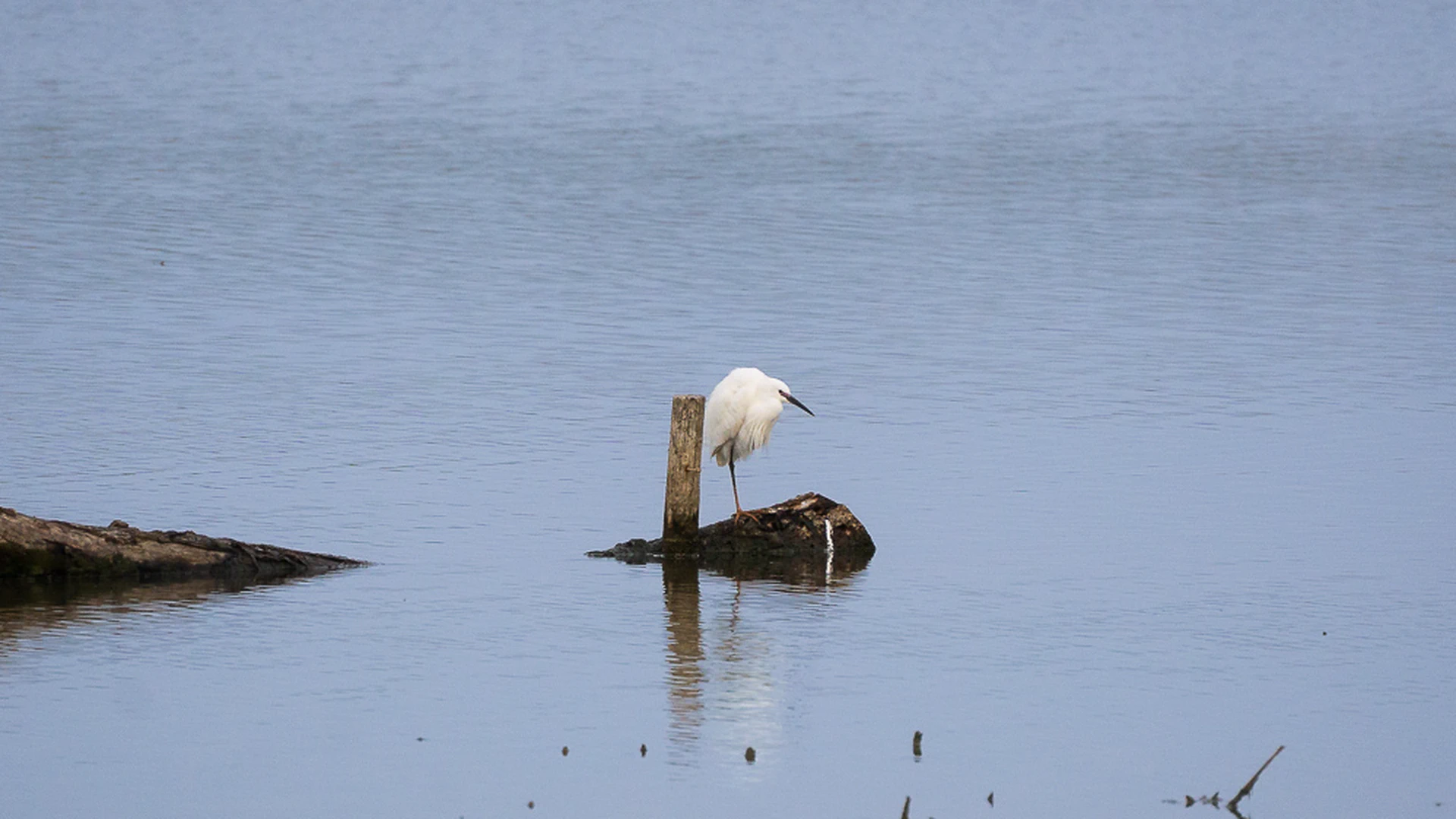
There is a moment when a little egret steps out from behind a reed bed—white against green, moving with impossible precision through shallow water—and you stop whatever you were doing.
It is that kind of bird.
The little egret (Egretta garzetta) is not rare. It is not especially elusive. But it has a quality of presence that makes it one of the most reliably photogenic and immediately arresting birds in Tuscany’s wetlands.
If you spend any time near Tuscan water—lakes, marshes, river edges—you will encounter it.
Knowing what you are looking at changes the encounter entirely.
Identification
The little egret is unmistakable once you have seen one.
The entire plumage is white. No markings, no variation, no ambiguity. In the right light—particularly the low morning light over open water—it appears to generate its own illumination.
The bill is long, black, and sharply pointed. The legs are black. The feet are a brilliant, surprising yellow—a field mark visible at considerable distance when the bird wades through clear water.
Those yellow feet matter. They distinguish the little egret instantly from the cattle egret (Bubulcus ibis) and from the great white egret (Ardea alba), which is substantially larger with dark feet and a yellow bill.
In breeding condition, the little egret develops two long, curved plumes at the back of the head and extraordinary loose plumes—aigrettes—on the breast and back. These ornamental feathers have a history that is worth knowing.
The Aigrette Trade
Here is the fact about this bird that most visitors don’t know—and that makes its current abundance all the more remarkable.
In the late 19th and early 20th centuries, the ornamental breeding plumes of egrets were among the most fashionable materials in European and American millinery. The aigrettes—long, ethereal, displayed at their finest during the breeding season—were sewn onto women’s hats and sold at extraordinary prices per ounce, sometimes exceeding the price of gold.
The problem was the timing.
Egrets grow these plumes precisely when they are nesting. Hunters killed them at the colony—when the birds were most concentrated and least able to leave their young. The chicks starved in the nests. Entire colonial breeding populations were dismantled within a few seasons.
By the early 1900s, little egret populations across western Europe had collapsed.
The campaign against the plume trade was one of the founding moments of the modern bird protection movement. In Britain, it was a direct catalyst for the formation of what became the RSPB. The trade was eventually outlawed. The colonies were left to recover.
They did. Slowly at first, then rapidly.
Today, the little egret has not merely recovered—it has expanded northward, colonizing Britain and Ireland as a breeding species within living memory. The recovery is one of the more hopeful stories in European conservation.
Knowing this, watching an egret hunt in a Tuscan marsh, changes how the encounter feels.
How It Hunts
The little egret is an active hunter—quite different in technique from the patient, motionless style of the grey heron.
It moves.
It wades quickly through shallow water, sometimes running short distances, often vibrating one foot against the bottom to disturb invertebrates and small fish. When prey flushes, it strikes with the speed and precision of the grey heron—but it gets there faster, because it was already in motion.
In the right conditions, it will also spread its wings slightly while hunting—using the shadow to reduce surface glare and improve its view into the water below. This wing-spreading behaviour, when you see it, is one of the stranger and more beautiful things a wading bird can do.
Its diet is opportunistic: fish, frogs, crustaceans, insects, earthworms in flooded fields. It will hunt in agricultural land after rain, standing out against brown soil like a lit candle.
Looking for private hiking in Tuscany?
Browse my full collection of small-group, fully private hikes across the region.
In Tuscany: When and Where
The little egret is present in Tuscany year-round.
Numbers are highest in the warmer months—from March through October—when birds from northern populations supplement the resident Italian breeding population. In winter, numbers fall, but the species does not disappear. Even in January, individuals hunt along quiet river stretches or in the shallows of lowland lakes.
Breeding occurs in colonial heronries, usually in willow or alder trees over or near water, often shared with grey herons and night herons. The presence of a mixed heronry—multiple species nesting in close proximity—is one of the more striking natural sights in Tuscan wetland ornithology.
Padule di Fucecchio
The Padule di Fucecchio is one of the most reliable locations in Tuscany for close views of little egrets.
Italy’s largest inland wetland, in the Valdinievole plain south of Pistoia, hosts a significant breeding population. The mixed heronry here—grey herons, little egrets, and night herons nesting together above the water—is visible and audible from the levee paths during the breeding season.
Outside the breeding season, egrets hunt along the channels and in the shallower sections of the wetland throughout the year. The flat terrain and the quality of morning light over open water make this one of the best photographic environments for the species in the region.
Oasi LIPU Massaciuccoli
Near Torre del Lago Puccini, the Oasi LIPU at Lake Massaciuccoli is a managed wetland reserve where little egrets are consistently present.
The boardwalks and hides at Massaciuccoli bring you close to the water’s edge—sometimes within a few meters of actively hunting birds. The combination of proximity, flat terrain, and consistently good light makes this one of the easier places in Tuscany to photograph the species well.
The reserve sits between Pisa and Lucca, accessible from both, and rewards repeat visits across the seasons in its own right.
Photographing the Little Egret
White birds present specific technical challenges.
The problem is exposure. Correct for the bird, and the background goes dark. Correct for the background, and the white plumage blows out. The aigrette feathers in breeding season carry fine structural detail—and that detail disappears entirely the moment you overexpose.
Michael Langford in Langford’s Basic Photography is direct on the challenge of high-contrast subjects: the key is deciding which tonal range matters most, and exposing for that rather than for the scene average.
In practice:
- Use spot metering on the bird, not the scene
- In bright conditions, reduce exposure by 1/3 to 2/3 of a stop below the meter’s reading
- Shoot in RAW if possible—the recovery latitude for white feathers is far greater than JPEG allows
- Early morning light is softer and reduces contrast between white bird and dark water
A longer focal length helps—300mm is a working minimum for portraits, 400mm or more gives you room to compose properly. But some of the best images of this species are at wider focal lengths, where the bird occupies a deliberate position within a larger composition of water, reeds, and sky.
Patience matters more than focal length. The egret that walks toward you because you stayed still will always be a better photograph than the one you chased.
Why This Bird Rewards Attention
The little egret is not exotic. It is not rare. You will not need to travel far to see one in Tuscany.
But the birds that are always present are often the ones most poorly observed.
Understanding what you are seeing—the hunting technique, the conservation history, the adaptation of that yellow-footed form moving through shallow water—transforms the encounter from background detail into something worth stopping for.
It is also, photographically, one of the most forgiving and rewarding subjects Tuscany’s wetlands offer. It hunts in accessible locations, behaves predictably, and tolerates a patient observer at reasonable distance.
For anyone beginning to develop an interest in wetland photography or wildlife observation, it is an excellent starting point.
Frequently asked questions
See the Little Egret in Tuscany
Interested in a guided walk at the Padule di Fucecchio or Oasi Massaciuccoli? Get in touch to discuss a guided visit tailored to nature photography and wildlife observation.