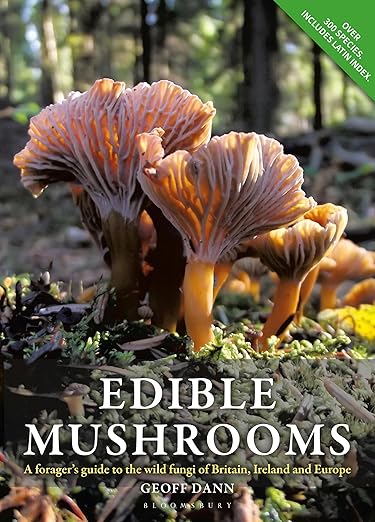
When friends and customers hear about my passion for mycology, they inevitably ask the same question: “Where did you start? Which book should I get?”
After years of foraging across Europe’s forests and guiding others through their first mushroom identifications, I always point everyone to the same book: Edible Mushrooms by Geoff Dann.
Not because it’s the most comprehensive field guide available—it isn’t.
Not because it covers every species you might encounter in Italy/Europe—it doesn’t.
But because it does something more valuable than exhaustive coverage: it honestly tells you how difficult each mushroom is to identify safely.

The Critical Information Most Field Guides Skip
Open most mushroom identification guides and you’ll find detailed descriptions, habitat information, season, edibility status, and perhaps some photos or illustrations.
What you won’t find is a clear statement of: “This mushroom is dangerous for beginners because it has deadly look-alikes that require expert knowledge to distinguish.”
Geoff Dann’s book includes exactly that—a difficulty rating system that marks each species as beginner-friendly, intermediate, or advanced based on the risk of misidentification.
This single feature makes it invaluable, even now that I’m experienced enough to tackle more complex identifications.
Here’s why: it acknowledges the reality that not all edible mushrooms are equally safe to forage.
Some species, like puffballs when properly identified (young, completely white inside, no internal structure), have virtually nothing dangerous they can be confused with.
Dann rates these as beginner-appropriate—and he’s right.
If you’re just starting out, harvesting giant puffballs or parasol mushrooms (Macrolepiota procera) with their distinctive snakeskin stems gives you confidence and success without significant risk.
Other species might be choice edibles but have look-alikes that could kill you.
Dann marks these clearly as advanced, essentially saying: “Yes, this is edible and delicious, but attempting to identify it without substantial experience is genuinely dangerous.”
Why This Matters More Than You Think
I’ve encountered too many enthusiastic beginners who approach mushroom foraging with the same confidence they bring to berry picking.
The assumption is: if I can identify it correctly using a book, I can safely eat it.
This is technically true but dangerously incomplete.
The real question is: Can you reliably identify it correctly given your current level of experience?
Some mushrooms have subtle differences from toxic species that only become obvious after you’ve seen both in person multiple times.
Photographing a mushroom and comparing it to book photos might suggest a match, but critical distinguishing features might not be visible in your photo angle, or might require spore prints, or might depend on characteristics that only appear at specific growth stages.
Dann’s difficulty ratings acknowledge this gap between “theoretically identifiable” and “safely identifiable by someone at your skill level.”
When I’m guiding mycology hikes and someone asks about a particular mushroom, I consider their experience level before explaining identification features.
For beginners, I point out the obvious species with clear distinguishing features and minimal risk.
For more experienced participants, we can discuss subtle differences between similar species, the importance of context clues, how to interpret ambiguous characteristics.
The book essentially does the same thing in print—it meets you where you are rather than assuming everyone has the same expertise.
What Makes It Useful Even For Experienced Foragers
You might assume that once you’ve gained experience, a beginner-oriented guide becomes obsolete.
I still reference Dann’s book regularly, and here’s why:
The difficulty ratings serve as a safety check on my own confidence.
If I’m considering harvesting a species I’ve identified, knowing it’s marked as “advanced” reminds me to be especially careful, to verify multiple characteristics, to be certain rather than merely confident.
Overconfidence kills mushroom foragers.
There is a timeless adage in the mycological community: ‘There are old mushroom hunters, and there are bold mushroom hunters, but there are no old, bold mushroom hunters.’ In the field, humility is your most important piece of equipment. Mycology doesn’t reward bravado; it rewards the patient, the meticulous, and those who respect the fine line between a choice edible and a lethal look-alike.
Having a system that explicitly says “this one requires expertise” helps counter the creeping assumption that I know enough to be casual about identification.
Additionally, when teaching others—whether clients on guided hikes or friends asking for advice—the difficulty system gives me a framework for explaining why I’ll enthusiastically teach them to identify parasol mushrooms but actively discourage them from attempting certain Agaricus species.
It’s not gatekeeping; it’s appropriate risk assessment.
The European Coverage Issue (And Why That’s Fine)
Since Dann’s book covers edible mushrooms across Europe, it necessarily includes species that don’t occur in Tuscany and might miss some regional specialties.
This is actually less of a problem than you might think.
Many excellent edible species have wide European distributions—porcini (Boletus edulis group), parasols (Macrolepiota procera), chanterelles, wood blewits, and dozens of others appear both in Britain (where Dann is based) and throughout Italy.
The fundamental identification principles and the difficulty assessment apply regardless of exactly where in Europe you’re foraging.
However, I always recommend supplementing Dann’s guide with something region-specific.
For Tuscany and Italy more broadly, having a guide that covers local names, regional species, and specific Italian mushroom traditions adds essential context.
The ideal approach uses both:
- Dann’s book for the difficulty ratings and solid identification methodology
- A regional Italian guide for comprehensive local coverage and cultural context
Think of Dann as teaching you how to think about mushroom identification safely, while regional guides tell you what specifically grows where you’re actually foraging.
The Species It Handles Particularly Well
Where Dann’s book truly excels is with the approachable, high-value species that make excellent introduction points for beginners.
The coverage of puffballs, parasols, hedgehog mushrooms, and similar “safe bets” is excellent.
These are mushrooms where the identification features are obvious, the risk of dangerous confusion is minimal, and the eating quality is good enough to make the effort worthwhile.
For more complex species—particularly the Agaricus genus, certain Russula species, and other groups requiring careful attention to subtle features—the book acknowledges this complexity rather than pretending identification is straightforward.
This honesty is refreshing and potentially life-saving.
I’d rather a book tell me “this is difficult and risky” than present every mushroom as equally accessible to anyone with a field guide.
What About Apps and Online Resources?
These days, people often ask whether mushroom identification apps have made field guides obsolete.
My answer: absolutely not, and in fact apps can be dangerous precisely because they lack the difficulty rating context.
An app might use image recognition to suggest an identification with high confidence, but it has no way of knowing whether you have the experience to distinguish that species from similar look-alikes.
It can tell you what the mushroom might be; it can’t tell you whether you’re qualified to make that determination safely.
Dann’s book, by explicitly rating difficulty, essentially says: “I can describe this mushroom to you, but that doesn’t mean you should attempt to identify it without more experience.”
That’s the kind of honesty that keeps foragers safe.
My Recommendation Strategy
Here’s what I tell people asking about getting started with mushroom foraging:
Essential foundation:
- Get Dann’s Edible Mushrooms for the difficulty ratings and solid methodology
- Add a regional Italian/Tuscan mushroom guide for local species and context
- Never rely solely on books—find someone experienced to verify your identifications initially
Practical approach:
- Start with species rated as beginner-friendly: parasols, puffballs, chanterelles
- Learn about amanita species like Amanita muscaria, Amanita cesarea
- Learn to identify poisonous mushrooms
- Spend at least one full season identifying without harvesting, just learning to recognize species
- Join guided forays or hire a guide (yes, like me) to see species in context and learn from someone with experience
- Gradually expand to intermediate species only after you’re consistently accurate with beginners
The golden rule:
When in doubt, don’t eat it. No mushroom meal is worth the risk of misidentification.
The difficulty ratings in Dann’s book help you understand where doubt should exist—which species are genuinely straightforward and which ones only seem simple until you encounter their look-alikes.
The Honest Assessment
Is Edible Mushrooms by Geoff Dann the perfect mushroom guide?
No—perfection would require comprehensive coverage of all regional species, which is impossible in a single European-wide volume.
But is it the best book for someone starting mushroom foraging?
Absolutely, because it prioritizes safety and self-awareness over completeness.
It teaches you not just what mushrooms look like, but how to assess whether you’re competent to identify them.
That meta-skill—knowing what you don’t know—is more valuable than memorizing a thousand species descriptions.
After years of foraging in forests, after finding porcini and parasols and rosselle and dozens of other species, after teaching countless people to identify their first edible mushrooms, I still keep Dann’s book on my shelf.
Not because I need it for basic identifications anymore, but because its approach to teaching safe foraging remains the best I’ve encountered.
If you’re serious about learning mushroom identification, start here.
Then add regional guides, seek experienced mentors, spend time in the forest observing without harvesting.
Build your knowledge gradually, respect the difficulty ratings, and never let confidence outpace competence.
That’s the path to becoming a safe, skilled forager—and it starts with a book honest enough to tell you when something is too dangerous for your current level.
Ready to move from photos to field identification?
Experience these fascinating fungi firsthand on a guided autumn hike through Tuscan woodlands. Learn professional identification techniques, understand ecosystem roles, and capture your own stunning mushroom photography.
Attention!
While the content of this blog post is aimed at providing you with information as accurate as possible, it should be treated as what it is: simply a blog post on the internet.
Mushroom identification should only be performed by experts, as a mistake can lead to dire consequences. Attempting to identify a mushroom on your own, without prior experience, based solely on the content of this blog post is strongly discouraged.
Explore Hidden Tuscany
Guided hiking experiences combining expert trail knowledge, professional photography, and wilderness mindfulness.
Latest posts
 4 March 2026
Galium Aparine: Cleavers in Tuscan Hedgerows
4 March 2026
Galium Aparine: Cleavers in Tuscan Hedgerows 3 March 2026
Umbilicus Rupestris: Wall Pennywort in Tuscany
3 March 2026
Umbilicus Rupestris: Wall Pennywort in Tuscany 3 March 2026
Laurus Nobilis: Bay Laurel in Tuscan Landscapes
3 March 2026
Laurus Nobilis: Bay Laurel in Tuscan Landscapes 2 March 2026
Guided Tours for Exploring Marble Quarries in Apuan Alps
2 March 2026
Guided Tours for Exploring Marble Quarries in Apuan Alps 26 February 2026
Photographing Nottolini Aqueduct: Light & Geometry
26 February 2026
Photographing Nottolini Aqueduct: Light & Geometry