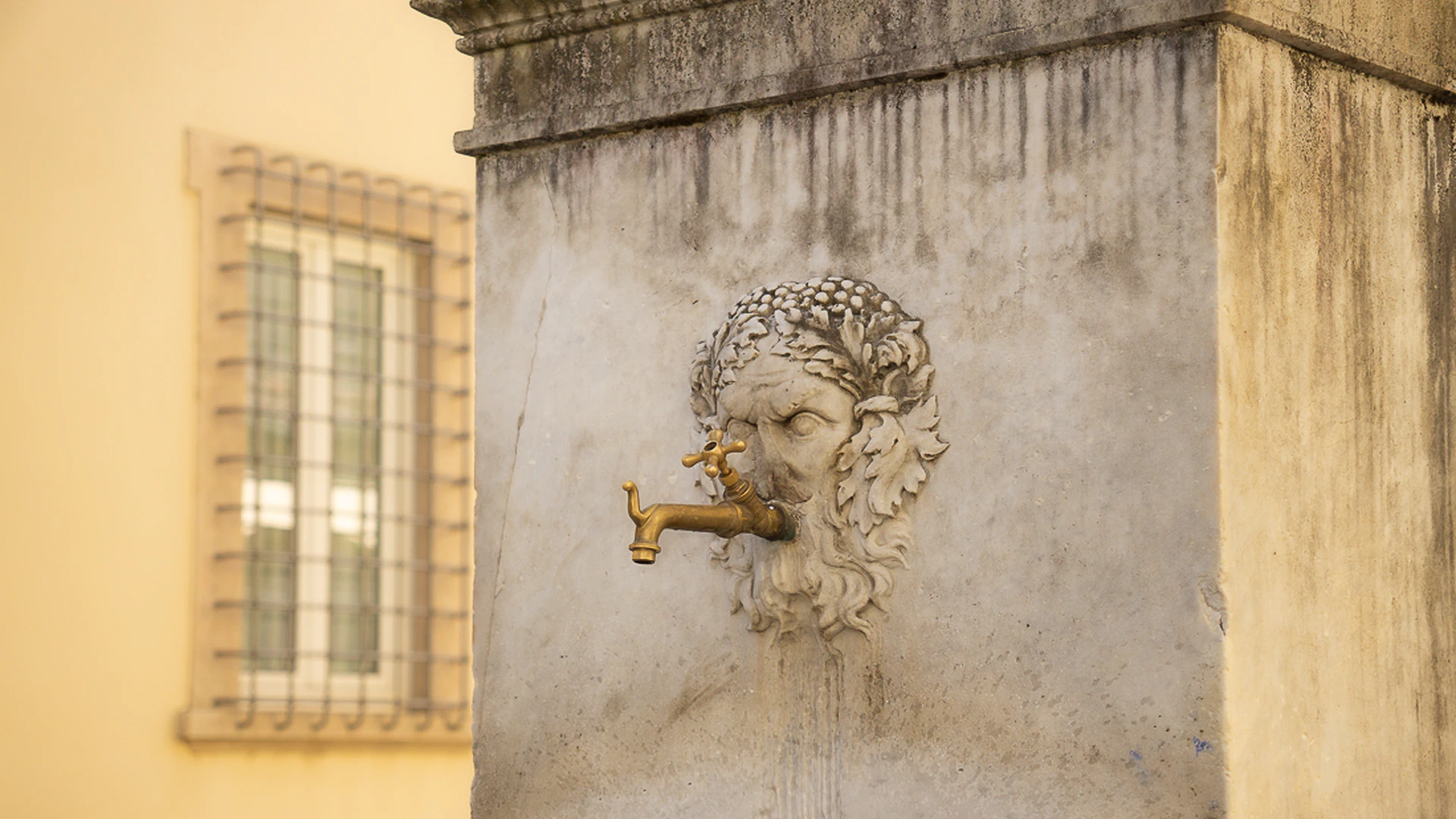
Many visitors arrive in Tuscany quietly convinced they must buy bottled water. They picture rustic villages and assume the tap is a risk. That instinct is understandable, and it is mostly wrong.
Can you drink the water in Tuscany? In almost every case, yes. Tap water and most public fountains are safe, and Tuscany makes it easy to know when they are not.
The reason is not luck. It is a system built on clear signage. And near Lucca, it rests on centuries of respect for clean spring water. Let me give you the rule I teach every guest.
Sorting the practical side of your Tuscan trip? A local’s Expert Brief answers the small questions and the big ones.
The one rule worth remembering
Drinking water in Tuscany runs on a simple principle. Water that is tested and controlled carries no warning. Water that is not tested carries a sign. Read the sign, and you are almost always fine.
You will see these Italian phrases on or near public fountains:
- “Acqua potabile” means drinkable and tested.
- “Acqua non potabile” means not drinkable. Skip it.
- “Acqua non controllata” means the water is not monitored.
- “Acqua non testata” means it is not tested. Treat it the same way.
The safe habit is short. On a municipal fountain with no warning, the water is generally fine. If any warning is present, skip it and move on.
I can’t vouch for a fountain I have never seen. Conditions change, and I am a guide, not a lab. So learn the rule, and let it travel with you.
Fontanelle and the culture of public water
Italy has a long love of public drinking fountains. These are the small fontanelle you find in piazzas and along streets. Many towns are proud of them. A few even run modern kiosks with chilled still or sparkling water for a few cents.
For a walker, this culture is a gift. You do not need a wall of plastic bottles. Carry one refillable bottle and top it up as you go. It is cheaper, lighter, and kinder to the landscape you came to enjoy.
Tuscan tap water, in restaurants and hotels, is the same safe supply. Ordering bottled water here is a preference, not a precaution.
The water that built a monument
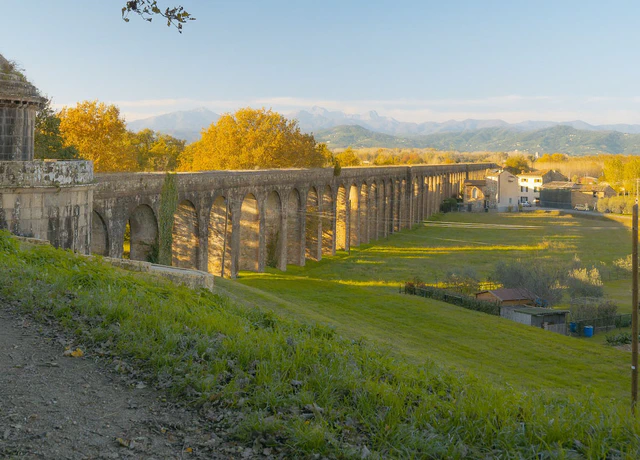
For a sense of how much Tuscany values clean water, look to the Nottolini Aqueduct near Lucca. I have written a full photography guide to its 460 arches.
In 1822, Maria Luisa di Borbone, Duchess of Lucca, faced a public-health crisis. The city’s wells were contaminated and stagnant. People were falling ill. Her answer was extraordinary.
She commissioned the architect Lorenzo Nottolini to bring clean spring water into the city. He channeled it from the springs of Monte di Vorno, in the Monte Pisano foothills. Gravity did all the work. The water ran along roughly 460 arches, over about three kilometres, to the Tempietto di San Concordio in Lucca.
Near the source lies the Parole d’Oro, the “Golden Words” meadow. It is a serene spot dotted with springs. The name comes from a brass inscription that farmers once mistook for gold and stole.
I want to be precise about the history. Those springs were prized because their water was clean and abundant. A duchess built a monument to carry it.
And this is not only history. Along the route you pass fountains you can actually drink from. The water is genuinely excellent: cold, soft, and clean. Most travellers I guide here stop to taste it, and they love it. Some fill their bottles and talk about it for the rest of the day. It is one of the quiet pleasures of the walk.
The walk itself is easy and rewarding. It starts a few minutes from Lucca train station. It stays flat, and it needs no car.
Nottolini Aqueduct Private Tour: Neoclassical Engineering & Sacred Springs
No car required: Walk the 400 arches of Nottolini Aqueduct from Lucca. Guided tour accessible by train. Discover ‘Parole d’Oro’. …
View this hikeMountain springs on the trail
Higher up, on the trails I guide across the Apuan Alps and the Apennines, you meet sorgenti. These are natural mountain springs. Their water is often superb, cold and clear straight from the rock.
It is also, almost always, untested. No agency checks a remote spring on a ridge. So my approach is a naturalist’s caution, not fear.
I know the specific springs on the routes I run, and how the ground above them behaves. That local knowledge is exactly what a printed map cannot give you. When in doubt, I carry enough water. I treat an unknown source as a photograph, not a drink.
The bigger picture
Worrying about water is a small tax on a good trip. In Tuscany, you can set that worry down almost entirely.
Trust the tap. Read the fountain. Carry one bottle and refill it. Save your attention for the arches, the meadows, and the long light on the hills. That is what you actually came for.
Walk Tuscany With Someone Who Knows the Ground
If you want a signature day that goes beyond the guidebook, a short consultation call shapes it around you.