Walk through certain sections of Riserva Acquerino and you might notice something unexpected among the native beeches and chestnuts.
Tall, straight conifers with distinctive reddish-brown bark and soft, flat needles—trees that look somewhat like firs but aren’t quite right.
These are Pseudotsuga menziesii—Douglas fir—and they’re thriving here despite being about 8,000 kilometers from home.
Home, in this case, is the Pacific Northwest of North America, where Douglas fir grows as one of the continent’s most massive trees, reaching heights over 100 meters in old-growth forests of Oregon and Washington.
At Acquerino, they’re more modest—perhaps 20-35 meters tall in the established stands—but they’re undeniably successful.
This is an introduced species, brought to Italy in 1830, that has found the conditions at Acquerino remarkably suitable.
And whether you view this as a forestry success story or an ecological complication depends partly on your perspective and partly on how carefully you look at what’s actually happening in the forest.
The Tree That Isn’t What Its Name Suggests
Pseudotsuga menziesii carries multiple misleading common names.
“Douglas fir” suggests it’s a true fir (genus Abies)—it’s not.
“Oregon pine” suggests it’s a pine (genus Pinus)—also false.
“Douglas spruce” suggests spruce (genus Picea)—still wrong.
The genus name Pseudotsuga literally means “false hemlock,” acknowledging that this tree doesn’t quite fit into any of the established conifer genera despite superficial similarities to all of them.
It’s a distinct lineage within the pine family (Pinaceae), unique enough to warrant its own genus.
The species name menziesii honors Archibald Menzies, a Scottish physician and naturalist who first documented the tree on Vancouver Island in 1791.
The common name “Douglas” honors David Douglas, the Scottish botanist who later extensively studied and promoted the species, recognizing its extraordinary timber potential.
His 1820s-1830s explorations in the Pacific Northwest brought Douglas fir to European attention, ultimately leading to its introduction as a forestry species.
What makes it distinctive at Acquerino:
Bark: Thick, deeply furrowed, reddish-brown to grey-brown. Young bark is smooth and grey with resin blisters.
Needles: Flat, soft, 2-3 cm long, dark green above with two white stomatal bands below. Arranged spirally around the twig but appearing somewhat two-ranked. When crushed, they smell sweet and resinous.
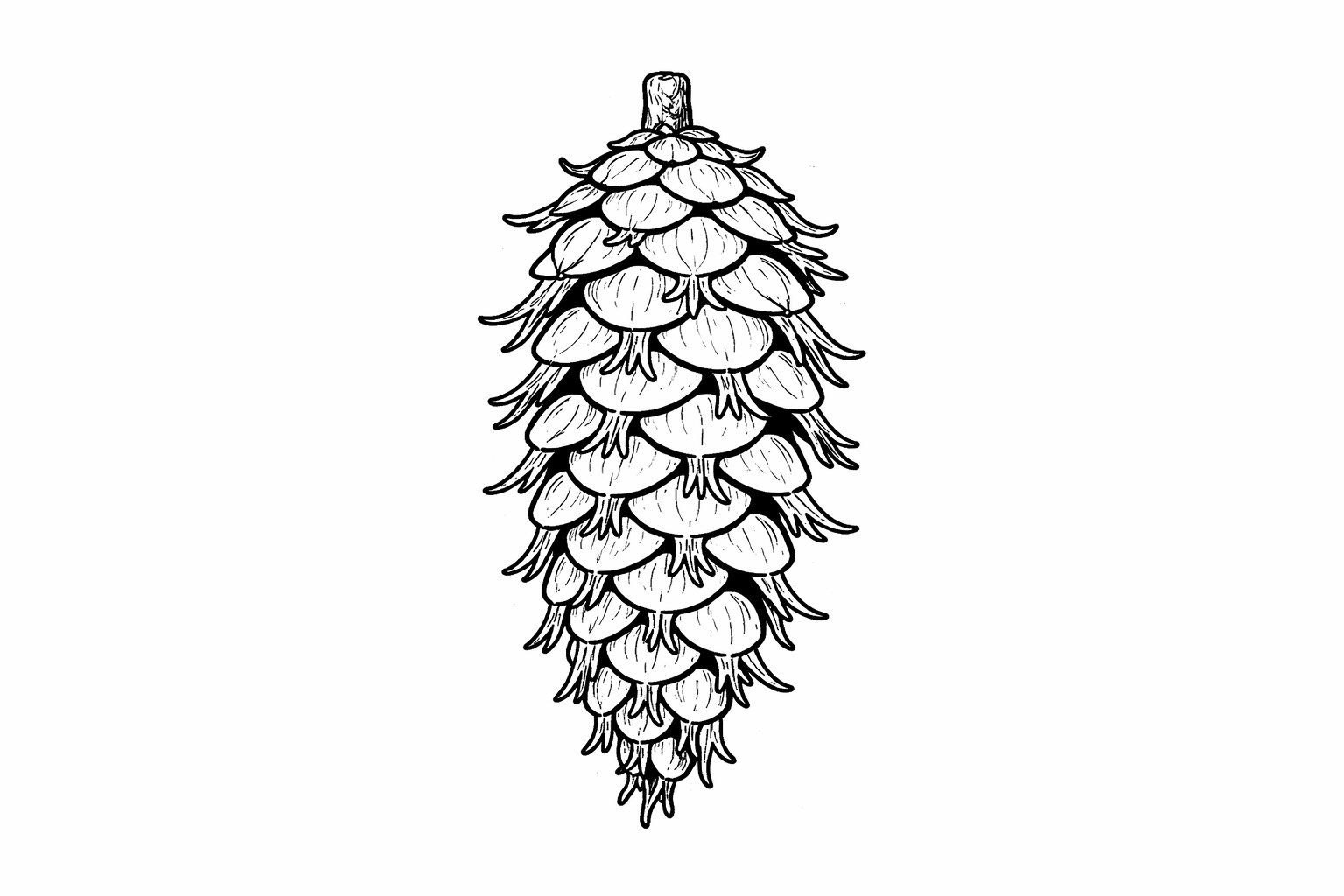
Cones: The diagnostic feature—pendulous cones 5-10 cm long with distinctive three-pointed bracts protruding between the scales. These bracts look like the back legs and tail of a mouse diving into the cone, which has led to the folkloric name “mouse-tail fir” in some languages.
Growth form: Straight trunk, conical crown when young, becoming more cylindrical with age. Branches somewhat drooping, especially lower ones.
The Italian Introduction: 1830 to Present
Douglas fir arrived in Italy in 1830, part of the broader European experimentation with North American timber species that characterized 19th and early 20th-century forestry.
The initial motivation was economic—Douglas fir grows fast and produces excellent timber.
In its native range, it’s one of the world’s most important timber trees, valued for strength, workability, and resistance to decay.
Early Italian foresters recognized that Douglas fir could potentially:
- Grow faster than native conifers
- Produce high-quality timber on relatively short rotations
- Utilize sites where other species performed poorly
- Provide economic returns from forestry plantations
The species found particularly suitable habitat in Italy’s mountain regions, roughly in the elevation zone where chestnut gives way to beech—typically 600-1,200 meters in Tuscany.
This corresponds climatically to certain zones in the Pacific Northwest, where Douglas fir thrives in cool, moist mountain conditions.
At Acquerino specifically, Douglas fir was planted as part of mid-20th century afforestation efforts.
The exact dates and extent of the original plantings aren’t always well-documented, but the mature stands visible today suggest planting likely occurred in the 1950s-1970s.
What’s remarkable is how well it has performed.
The trees have grown vigorously, some individuals reaching impressive dimensions for the Italian context.
They’ve naturalized in the sense of producing cones and viable seeds, though extensive natural regeneration appears limited compared to the native species.
What I Observe at Acquerino
During regular hikes through the reserve, I’ve developed a particular awareness of where the Douglas fir stands are and how they integrate with the surrounding forest.
The distribution isn’t uniform—Douglas fir occurs in distinct patches:
Some sections of trail pass through nearly pure Douglas fir stands, where the overhead canopy is dominated by these introduced conifers.
Other areas show mixed forest where Douglas fir grows interspersed with native beeches, chestnuts, and occasionally pines.
The understory beneath Douglas fir differs from native forest:
Light levels tend to be lower under dense Douglas fir canopy—the thick foliage intercepts more light than many native species.
The needle litter creates a distinctive forest floor texture and chemistry.
Certain native plants appear less abundant under Douglas fir, while others seem unaffected.
The fungal associations tell an interesting story.
Like all conifers, Douglas fir forms mycorrhizal partnerships with fungi, but the specific fungal community differs from native trees.
On Douglas fir stumps and logs, I regularly encounter Calocera viscosa—the yellow stagshorn jelly fungus that specializes in decaying conifer wood.
The presence of Douglas fir at Acquerino has essentially created new habitat for this and other conifer-specialist decomposers, species that would have less substrate available in the predominantly beech-dominated portions of the reserve.
What It Teaches About Forest History
One reason I point out Douglas fir to people during guided hikes is it reveals that even protected natural areas have management histories.
Acquerino isn’t primeval forest—it has a human history of use, alteration, and management.
The Douglas fir stands are physical evidence of mid-20th century forestry decisions.
They’re reminder that “natural” is often more complex than it appears, and that contemporary landscapes reflect layered histories of human choices.
This doesn’t diminish Acquerino’s value as a natural area.
It simply adds context.
Understanding that the forest includes both native species and introduced elements helps people think more critically about conservation, restoration, and management.
And it provides teaching moments about:
- How tree species are distributed globally and why
- The history of forestry experimentation in Europe
- The difference between native and introduced species
- How to assess ecological impact beyond simple “native = good, introduced = bad” framings
Identifying Douglas Fir at Acquerino
If you’re hiking at Acquerino and want to distinguish Douglas fir from native conifers:
Compared to native pines (Pinus species):
- Douglas fir has flat, soft needles arranged singly; pines have needles in bundles of 2-5
- Douglas fir cones hang downward with distinctive three-pointed bracts (see the cover image); pine cones are quite different in structure
Compared to silver fir (Abies alba, if present):
- Douglas fir cones hang downward; true fir cones stand upright and disintegrate on the tree
- Douglas fir has the distinctive mouse-tail bracts; true firs don’t
- The bark pattern differs—Douglas fir has deep furrows, true fir has a more plated appearance
The cone bracts are the absolute diagnostic:
If you find a cone on the ground beneath a conifer and it has those three-pointed bracts sticking out between the scales, you’ve found Douglas fir.
No native European conifer has this feature.
The Broader Italian Context
Acquerino’s Douglas fir stands are part of a larger story.
Douglas fir was planted extensively across Italy’s mountain regions from the early 20th century onward, particularly after World War II when rapid timber production was prioritized.
Current estimates suggest Douglas fir occupies roughly 10,000-15,000 hectares in Italy, making it one of the more successful introduced forestry species.
The distribution is concentrated in:
- Northern regions (Piedmont, Lombardy, Trentino-Alto Adige)
- Central Apennines (Tuscany, Emilia-Romagna, Marche)
- Scattered southern plantations
Tuscany hosts several significant Douglas fir stands, and ongoing research examines growth performance, genetic provenance, and long-term ecological integration.
The species has demonstrated remarkable adaptability to Italian conditions, growing well across a range of elevations and site qualities, though performance varies depending on the genetic provenance of the original seed source.
The Aesthetic Question
Separate from ecological considerations, there’s a purely aesthetic dimension to Douglas fir at Acquerino.
I find them beautiful trees.
The reddish bark catches warm light beautifully.
The soft foliage has an appealing texture.
The straight, tall growth form has a different visual quality than the more irregular native beeches.
During photography hikes, the Douglas fir stands offer distinctive opportunities:
Different light quality filtering through the dense canopy.
The contrast between reddish bark and green foliage.
The geometric quality of plantation spacing in some stands.
And there’s something thought-provoking about photographing a tree from the Pacific Northwest growing in the Tuscan Apennines.
It’s a reminder that landscapes are global, connected, shaped by human choices across continents and centuries.

The Forward Question
What happens to Douglas fir at Acquerino over the coming decades?
If actively managed:
The trees could be harvested on rotation, with decisions about whether to replant Douglas fir or allow native species regeneration.
If left unmanaged:
The stands will age, eventually producing large-diameter trees.
Natural disturbances (wind, disease, insects) will create gaps.
Native species may gradually recruit into those gaps, or Douglas fir may regenerate.
The long-term trajectory is genuinely uncertain.
European Douglas fir stands are still relatively young—most are less than 150 years old, while the species can live over 1,000 years in its native range.
We’re watching an ecological experiment in real-time, and the full results won’t be clear for centuries.
What I Tell People
When guiding hikes at Acquerino and we pass through Douglas fir stands, here’s what I emphasize:
This is an introduced species that’s now part of the reserve’s landscape.
Its presence reflects forestry history and the global movement of species.
It creates different ecological conditions than native forest, supporting some species (like certain fungi) while potentially limiting others.
It’s not inherently bad or good—it’s a component of a complex landscape with mixed native and introduced elements.
And it’s worth knowing about and recognizing, both for identification skills and for understanding forest history.
The yellow stagshorn fungi growing on fallen Douglas fir logs connect to broader stories about decomposition, species specialization, and how introduced trees create habitat for organisms adapted to their wood.
Everything connects—the North American tree, the European location, the fungi that decompose it, the human decisions that brought it here.
Acquerino’s forest is richer for having these stories to tell.
Would you like to experience a Douglas Fir forest?
let’s plan together a hike at Riserva Acquerino

or head to the contact page
Explore Hidden Tuscany
Guided hiking experiences combining expert trail knowledge, professional photography, and wilderness mindfulness.
Latest posts
 4 March 2026
Galium Aparine: Cleavers in Tuscan Hedgerows
4 March 2026
Galium Aparine: Cleavers in Tuscan Hedgerows 3 March 2026
Umbilicus Rupestris: Wall Pennywort in Tuscany
3 March 2026
Umbilicus Rupestris: Wall Pennywort in Tuscany 3 March 2026
Laurus Nobilis: Bay Laurel in Tuscan Landscapes
3 March 2026
Laurus Nobilis: Bay Laurel in Tuscan Landscapes 2 March 2026
Guided Tours for Exploring Marble Quarries in Apuan Alps
2 March 2026
Guided Tours for Exploring Marble Quarries in Apuan Alps 26 February 2026
Photographing Nottolini Aqueduct: Light & Geometry
26 February 2026
Photographing Nottolini Aqueduct: Light & Geometry