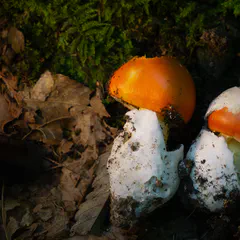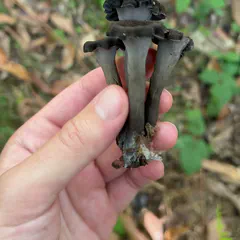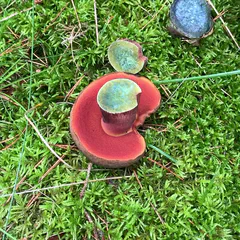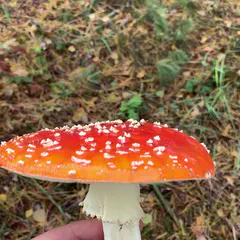

I'm Stefano, and I guide people through the Tuscany most tourists never see. Want to hike in Tuscany with me?
Last updated 30 September 2026
Cut or pull the mushroom? The knife camp cuts the stem at ground level, because pulling supposedly tears the mycelium underground and the spot stops producing. The other camp lifts the whole fruit body out and says the fungus never notices. Both sides argue their harvesting method as ecology, and one of them is defending a rule that does nothing at all.
Simon Egli and his colleagues at the Swiss Federal Research Institute WSL spent more than two decades testing exactly this in a real forest, with fences, weekly counts and an untouched control.
The experiment
The site was Chanéaz, a 74-hectare fungus reserve in mixed old-growth forest on the Swiss Plateau at around 600 metres, where beech and pedunculate oak grow alongside Norway spruce, silver fir, Scots pine and larch. The project started there in 1975.
The design is easy to picture. Five blocks of 300 square metres, each divided into three plots of 10 by 10 metres. In the first plot every mushroom of the harvested species was pulled up. In the second every one was cut at the base. In the third nothing was touched. Fences went round all of them so no passing forager could interfere with the treatment.
Then somebody walked those plots every week from May to December, identified and counted every fruit body of every species that had appeared, and dabbed each cap with methylene blue so the same mushroom wouldn’t be counted twice the following week. That routine ran from 1977 to 2003.
The counts at Chanéaz came to 97,700 fruit bodies from 436 species, of which 53,863 belonged to the 103 species that were actually being harvested.
The result: nothing
Harvested plots produced 1.03 times as many fruit bodies as the untouched controls, which on a dataset that size means the same. Species richness was flat too. Cutting came out slightly below pulling, at 0.81, and statistically that’s noise.
The paper’s own summary is that systematic harvesting “reduces neither the future yields of fruit bodies nor the species richness” of wild forest fungi, whichever technique was used (Egli and co-authors, Biological Conservation, 2006).
Nobody was picking politely, either. Every fruit body of the 103 harvested species, every week, for a quarter of a century, off the same hundred square metres. If removing mushrooms damaged the fungus underneath, that design had every opportunity to show it. It didn’t.
The same answer had already come out of Oregon, where members of the Oregon Mycological Society ran a 13-year study on golden chanterelles in the Mount Hood area and found no evidence that picking suppressed later fruiting.
Why the cutting rule sounds so convincing
What you carry home is the fruit body, the reproductive organ. The fungus itself lives as a network of hyphae threading through soil and leaf litter, and for porcini, chanterelles and most of what people come to Tuscany hoping to find, that network is fused to the roots of living trees in a mycorrhiza the tree depends on as much as the fungus does. That partnership outlives every mushroom it ever produces.
Egli’s paper draws the same line: the fruit bodies are the part we see and use, and the mycelium is the part that stays in the soil whatever we do with them.
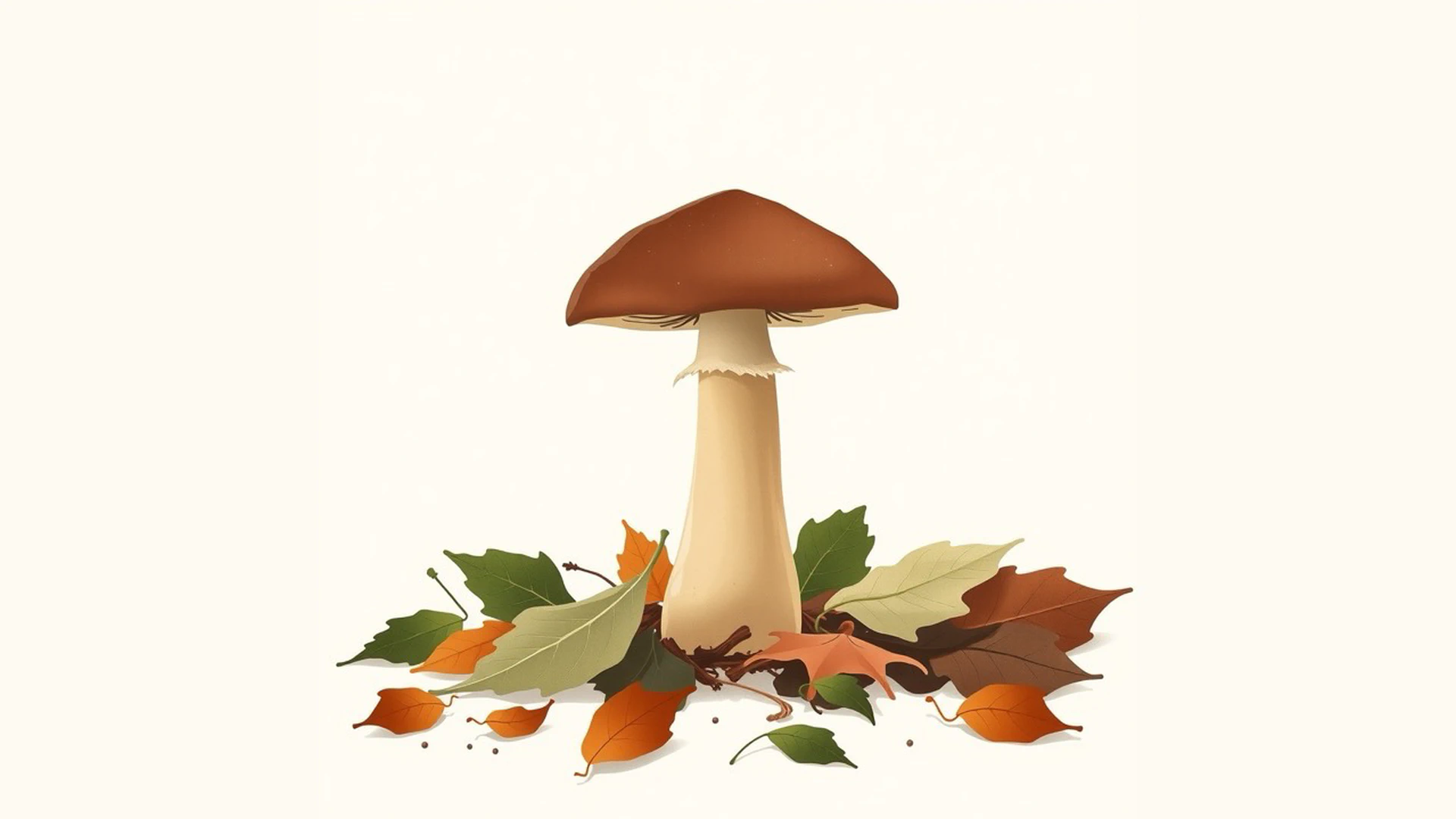
The stem base is a few millimetres of tissue at the bottom of a structure the fungus built in about a week and will discard anyway. Pulling it out is closer to picking an apple than to pulling up a carrot. That’s why the folklore fails: it quietly assumes the mushroom is the organism.
What did reduce the harvest: feet
The same project ran a second site, Moosboden, a 3-hectare Norway spruce stand at 1,250 metres, from 1990 to 2000, and there the question was different. Fourteen blocks were split four ways: picked and trampled, picked without trampling, unpicked but trampled, unpicked and untrampled. Catwalks went up over the no-trampling plots in April 1990 so that whoever did the counting never put a boot on that soil.
Trampled ground produced about 70% of the fruit bodies of untrampled ground. Fewer species fruited in any given year.
Then the part that matters. Across the ten years, 195 species fruited in the trampled plots and 189 in the untrampled ones. The list was intact. The mycelium was still down there, still alive, still tied to its trees, simply putting up fewer mushrooms. Egli’s team suspects the primordia, the pinhead-sized fruit bodies that form right at the soil surface, get crushed underfoot before they can grow.
An earlier trial on a single colony of yellowfoot chanterelle, Cantharellus lutescens, makes the point harder to dismiss. A researcher imitated a picker and harvested that colony twice a week for twelve years, walking on it each time. It stopped fruiting altogether, while control plots with catwalks over them carried on as usual. The treatments were switched after six years and again after eleven, and both times the fungus came back the next season in the quantities it had produced before.
Nothing had been killed. It had been stood on.
What to do in the field
- Take the whole fruit body, base included. David Arora’s advice in Mushrooms Demystified runs the same way, for identification instead of conservation: the volva and the shape of the stem base are diagnostic, and an Amanita whose base is still in the ground is an Amanita you can’t identify with confidence any more. Cutting destroys evidence you may need.
- Carry the knife anyway. It earns its place trimming soil off the stem before the mushroom goes in the basket, and slicing a specimen open to check the flesh for colour change and for the tenants that got there first.
- Italian law is stricter than the folklore, and about better things. Rakes, hooks and anything that turns over the humus layer are banned outright, the mushroom has to arrive with the features needed to identify the species, and baskets must be rigid and open so spores keep dropping while you walk. The permit rules for Tuscany cover the rest.
- Mind where you stand more than what you do with your fingers. On the ground I work regularly, the fewer crossings the better, and the productive patches are worth walking around.
- Leaving some behind is still sensible. The authors say plainly that nobody knows how many spores a species needs to persist, and they recommend keeping closed seasons anyway, partly as precaution and partly because a rule makes people treat forest fungi as something worth protecting.
What I’d rather you walked away with
The honest version is duller than the folklore and more useful. Take the mushroom however you like, keep the base attached so you can still identify it, and pay attention to where you put your feet.
There’s one real uncertainty left, and it belongs to everybody. Nobody knows how many spores a species needs to keep going: the authors say so in plain language at the end of the paper, and I can’t tell you either. That’s the honest reason to leave a few standing, and it has nothing to do with knives.
At Acquerino, the ground I work most often, the argument was never about the stem base. It’s about the ground it’s standing in.
Egli, S., Peter, M., Buser, C., Stahel, W. and Ayer, F. (2006). Mushroom picking does not impair future harvests – results of a long-term study in Switzerland. Biological Conservation 129(2), 271-276. doi.org/10.1016/j.biocon.2005.10.042
Come mushroom hunting in the Tuscan Apennines
A private day in the woods between Pistoia and Florence: identification in the field, the habitats each species needs, and time to photograph what you find. September to November, when the ground is actually producing.