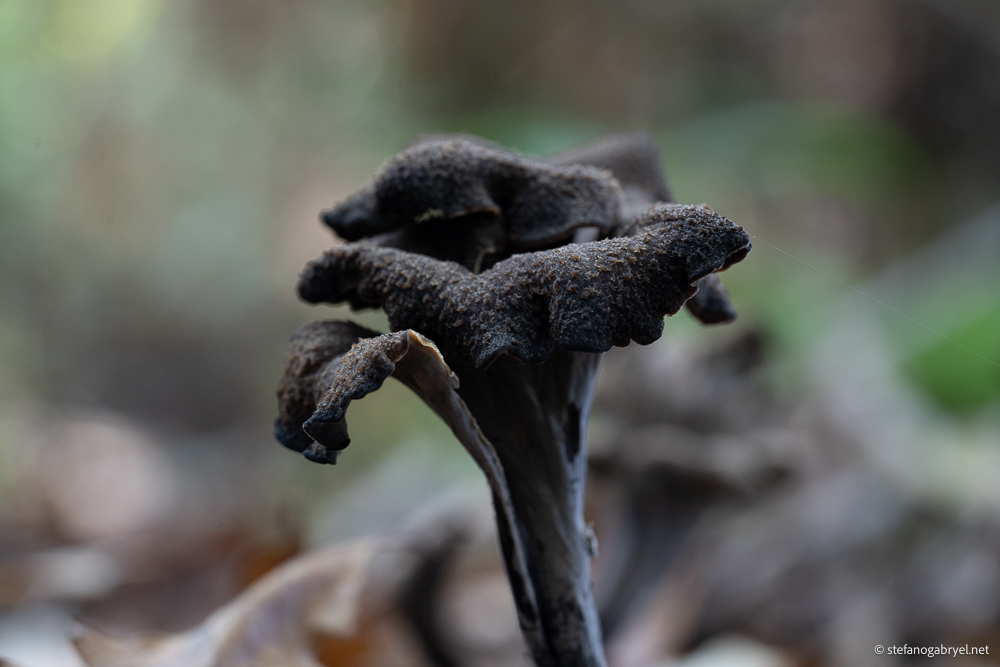
There’s a mushroom that grows abundantly in Tuscan forests yet remains invisible to most foragers who walk right past it: Craterellus cornucopioides, known in Italy as Trombetta dei Morti—the Trumpet of the Dead.
Despite its ominous name, this is one of our region’s finest edible mushrooms, prized by chefs throughout Italy for its intense, smoky flavor and elegant appearance on the plate.
The challenge isn’t that it’s rare—it’s that most people simply don’t see it.
Seasonality: Late Summer Through Autumn’s End
In Tuscany, Craterellus cornucopioides begins appearing in late August, but the prime season runs from September through November, often extending into early December if conditions remain mild and moist.
I’ve found the largest fruitings occur after significant autumn rains, particularly in October when the forest floor is damp and temperatures have cooled to between ten and fifteen degrees Celsius.
Unlike mushrooms that fruit in dramatic flushes after a single rain event, Black Trumpets tend to appear gradually and persist for weeks, making them more reliable than species like porcini that come and go quickly.
The extended season is one reason they’re so valuable—when other prized edibles have finished fruiting, Trombette dei Morti are often still emerging from the leaf litter.
Mycorrhizal Partnerships: The Oak and Beech Alliance
Craterellus cornucopioides is mycorrhizal, forming essential symbiotic relationships with specific broadleaf trees.
In Tuscany, I find them almost exclusively in association with oak, beech, and occasionally chestnut trees.
The relationship with oaks and chestnut is particularly strong—some of my most productive Black Trumpet locations are in mature oak and chestnut forests where the canopy is dense and the understory relatively open.
The mycorrhizal network connects the fungus to tree roots in that ancient exchange: the fungus extends the tree’s ability to absorb water and nutrients, particularly phosphorus, while the tree provides the fungus with sugars from photosynthesis.
This partnership is obligate—the Black Trumpet cannot grow without its tree hosts, and the trees, while not entirely dependent, benefit significantly from the relationship.
Soil and Habitat: Moisture, Moss, and Shadows
Craterellus cornucopioides shows distinct habitat preferences that, once you understand them, make finding productive patches much easier.
The mushroom favors moist, well-drained acidic to neutral soils, typically in areas where the leaf litter remains damp but not waterlogged.
Look for them in mature deciduous forests with established moss cover—the presence of thick moss mats is one of the most reliable indicators of good Black Trumpet habitat.
I’ve noticed they particularly favor north-facing slopes and areas where the forest canopy creates consistent shade, maintaining the cool, humid conditions the species prefers.
In the Apuan Alps and Appennines, elevation matters: I find them most reliably between 400 and 1000 meters, though they occasionally appear lower in particularly favorable microclimates.
The substrate is crucial: Black Trumpets grow directly from leaf litter and humus, often partially buried, which contributes to their camouflage.
Recognition: The Art of Seeing Black on Brown
Here’s what makes Craterellus cornucopioides challenging for beginners: it’s a dark gray to black mushroom growing in dark brown leaf litter, often partially hidden.
The shape is distinctive once you know it—a hollow, trumpet or funnel shape, wider at the top and narrowing to a stem that’s often quite thin.
The mushroom is entirely hollow from top to bottom, like a vuvuzela or medieval trumpet, which is exactly how it earned its common names.
The cap edge is typically wavy or irregular, giving each specimen a unique, sculptural quality.
The outer surface—the fertile surface where spores are produced—is smooth to slightly wrinkled, never gilled, ranging from dark gray to deep charcoal black, occasionally with a slight brownish tint.
The inner surface is usually slightly lighter, more gray than black, and has a smooth, almost waxy texture.
Size varies considerably: specimens range from just a few centimeters to ten or even twelve centimeters tall in ideal conditions, though most I find are in the five to eight centimeter range.
They often grow in scattered groups or loose clusters, and once you find one, scanning the immediate area carefully usually reveals more—your eyes need to adjust to seeing them against the background.
Culinary Excellence: Why Chefs Love Them
Craterellus cornucopioides is considered one of the finest culinary mushrooms in Italian cuisine, and for good reason.
The flavor is intense, rich, and distinctly smoky with subtle earthy notes—a little goes a long way in dishes.
Unlike some wild mushrooms that are best fresh, Black Trumpets actually improve when dried.
Drying concentrates the flavors and creates a product that rehydrates beautifully, making them popular in restaurant kitchens where reliability and storage matter.
The dark color adds visual drama to dishes, and the hollow shape holds sauces beautifully.
The texture when properly cooked is tender but substantial, never slimy or rubbery like some mushrooms can become.
During autumn in our mountain towns, you’ll see Trombette dei Morti at markets, often commanding prices nearly as high as porcini despite being less well-known among casual foragers.
Professional foragers guard their productive patches jealously, returning to the same locations year after year when conditions are right.
A Photographer’s Subject: Texture and Form
From a photographic perspective, Craterellus cornucopioides offers unique challenges and rewards.
The dark color means you need to be thoughtful about exposure—it’s easy to lose all detail in the shadows if you’re not careful with lighting.
Macro photography shows incredible detail: the subtle wrinkles on the outer surface, the smooth interior, the delicate rim where the trumpet flares.
The sculptural quality of the mushroom makes it an excellent subject for artistic photography—these aren’t the bright, obvious subjects that photograph themselves; they require intention and craft to capture effectively.
Foraging Strategy: When and Where to Search
If you want to find Craterellus cornucopioides in Tuscany, here’s my recommended approach based on decades of observation.
Start searching in late September through October in mature oak or beech forests, particularly on north-facing slopes or in valleys where moisture accumulates.
Look for areas with substantial moss cover and thick leaf litter accumulation.
The day or two after significant rain is ideal—the mushrooms often push up through the leaf litter when moisture is abundant.
Move slowly and scan systematically rather than covering large areas quickly—Black Trumpets reward patient, careful observation more than energetic hiking.
When you find productive habitat, mark it mentally or with GPS coordinates, as they tend to return to the same locations year after year when conditions align.
I have patches I’ve visited for fifteen years that continue producing reliably each autumn.
Harvest sustainably by cutting mushrooms above the base rather than pulling them out, and leave some specimens to complete their spore dispersal.
The species isn’t threatened, but respecting productive patches ensures they continue fruiting for future seasons.
Safety Note: Distinctive and Recognizable
One advantage of Craterellus cornucopioides for foragers is the absence of dangerous look-alikes.
The combination of features—hollow trumpet shape, completely smooth fertile surface (no gills or pores), dark coloration, and specific habitat—make it quite distinctive.
The closest relatives are other Craterellus species, all of which are edible.
Craterellus lutescens (Yellowfoot) is smaller and yellow-orange in color.
Craterellus tubaeformis is brown to gray and similarly trumpet-shaped but with a different color palette.
None of the black, hollow, trumpet-shaped mushrooms in our region are toxic, which gives this species a significant safety advantage for identification.
That said, as with all foraging, you should be absolutely certain of your identification before consuming any wild mushroom.
If you’re new to Black Trumpets, bring specimens to a local mycological expert or ASL mycologist for confirmation before your first meal.
Once you’ve learned them properly, they become one of the most reliable and rewarding species to forage in autumn’s late season, when many other prized mushrooms have finished fruiting and the forests seem to have gone quiet.
The Trombette dei Morti remind us that some of nature’s best gifts hide in plain sight, waiting for those patient enough to learn to see them.
Are you a beginner?
If you’re just beginning to explore mushroom foraging, Geoff Dann’s Edible Mushrooms is the field guide I recommend to all my clients. It’s an excellent starting point for learning safe identification. Read my full review here.
Want to learn in the field? Join me for a hands-on mushroom hunting experience ⬇️ ⬇️ ⬇️ ⬇️
Ready to move from photos to field identification?
Experience these fascinating fungi firsthand on a guided autumn hike through Tuscan woodlands. Learn professional identification techniques, understand ecosystem roles, and capture your own stunning mushroom photography.
Attention!
While the content of this blog post is aimed at providing you with information as accurate as possible, it should be treated as what it is: simply a blog post on the internet.
Mushroom identification should only be performed by experts, as a mistake can lead to dire consequences. Attempting to identify a mushroom on your own, without prior experience, based solely on the content of this blog post is strongly discouraged.
Explore Hidden Tuscany
Guided hiking experiences combining expert trail knowledge, professional photography, and wilderness mindfulness.
Latest posts
 5 March 2026
Salamandra Salamandra: Fire Salamander in Tuscany
5 March 2026
Salamandra Salamandra: Fire Salamander in Tuscany 5 March 2026
Pisa: Base for Exploring Tuscany's Hidden Nature
5 March 2026
Pisa: Base for Exploring Tuscany's Hidden Nature 5 March 2026
Montecatini Terme: Base for Exploring Tuscany's Nature
5 March 2026
Montecatini Terme: Base for Exploring Tuscany's Nature 4 March 2026
Galium Aparine: Cleavers in Tuscan Hedgerows
4 March 2026
Galium Aparine: Cleavers in Tuscan Hedgerows 3 March 2026
Umbilicus Rupestris: Wall Pennywort in Tuscany
3 March 2026
Umbilicus Rupestris: Wall Pennywort in Tuscany