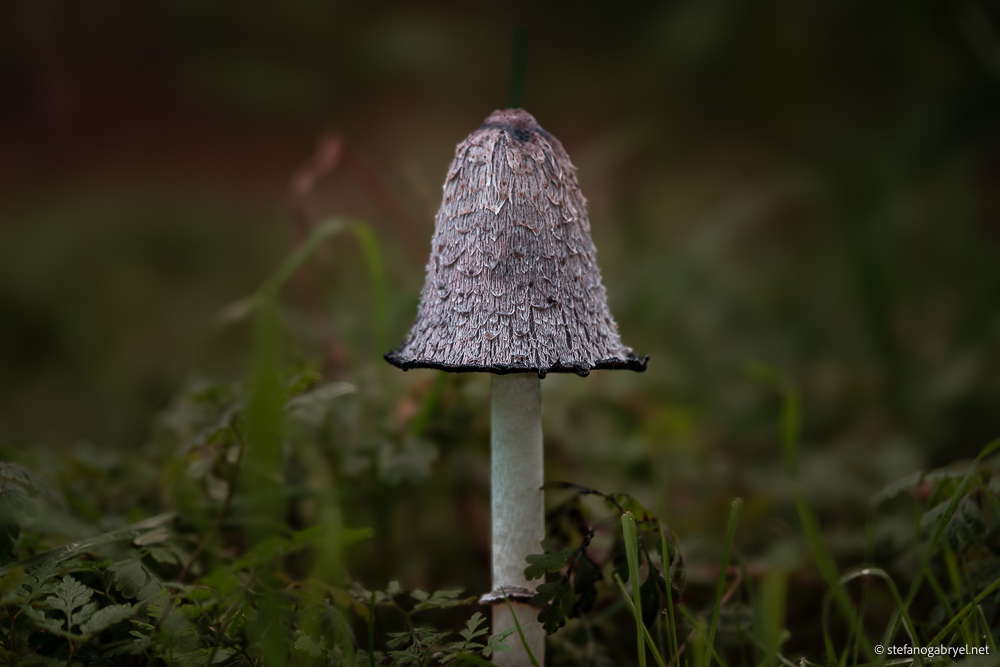
There’s a particular frustration every mushroom forager knows well—finding the perfect specimen at exactly the wrong moment.
For me, that mushroom has always been Coprinus comatus, the shaggy mane.
I’ve encountered it dozens of times during my guided treks through the Appennino Pistoiese and around Tuscany, always at the beginning of a hike when I know the day ahead will transform this pristine white cylinder into nothing more than black ink in my basket.
Despite being entirely edible and reportedly delicious, I’ve never tasted one.
The window of opportunity is simply too narrow, and this mushroom waits for no one.
A Mushroom That Writes Its Own Ending
Coprinus comatus earns its Italian name “fungo dell’inchiostro” honestly—the ink mushroom.
What makes this species remarkable isn’t just its distinctive shaggy appearance, resembling a lawyer’s wig (one of its many names) or a white pine cone, but its method of spore dispersal.
Unlike most mushrooms that simply drop spores from their gills, Coprinus comatus practices autodigestion.
The cap literally dissolves itself from the bottom up, turning into a black, inky liquid that drips away, carrying millions of spores with it.
This process, called deliquescence, begins within hours of the mushroom reaching maturity.
That stunning white column you photograph in the morning will be a black puddle by evening.
It’s nature’s built-in timer, and it’s unforgiving.
Where and When to Find Them in Tuscany
In our region, Coprinus comatus appears primarily in autumn, with a secondary but less abundant fruiting in spring.
The prime season runs from September through November, coinciding with the first substantial rains after summer’s heat.
Unlike many choice edible mushrooms that hide in forests, shaggy manes are opportunistic colonizers of disturbed ground.
I find them along trail edges, in recently worked agricultural fields, near compost heaps at agriturismi, and even pushing through gravel in parking areas.
This is a saprotroph—a decomposer that feeds on dead organic matter in the soil rather than forming partnerships with living tree roots.
That’s why you’ll never find it exclusively under oaks or chestnuts like porcini.
Instead, look for them where grass clippings have been piled, where soil has been recently turned, or along roadsides enriched with organic debris.
They particularly favor nitrogen-rich soils, which explains their fondness for areas where livestock have grazed or where organic fertilizers have been applied.
The Mycological Reality: Why I Keep Missing My Chance
Here’s what every guide knows but rarely discusses: the logistics of a day in the mountains don’t always align with what nature offers.
When I spot a cluster of perfect Coprinus comatus at eight in the morning, my day is just beginning.
We might be heading up to explore the autumn colors in the Appennines.
By the time I return to that spot, those pristine white mushrooms will have performed their vanishing act.
What Makes This Mushroom Special
Despite my personal inability to bring one home intact, there’s much to appreciate about this elegant fungus:
Unique characteristics that set it apart:
The autodigestion process produces genuine ink. Historically, this liquid was mixed with water and used for writing and drawing. Medieval scribes occasionally used mushroom ink, and modern artists have revived the practice for its rich, permanent black color.
It’s one of the safest wild mushrooms for beginners. The distinctive shaggy white appearance with black-edged scales is virtually impossible to confuse with anything toxic, provided you harvest it young before the deliquescence begins.
Culinary and cultural notes:
The flavor is reportedly mild and delicate, best prepared simply—sautéed in butter with a touch of garlic. The key is cooking it immediately. Some foragers carry a small camping stove specifically for preparing shaggy manes in the field.
In Tuscany, it’s less celebrated than porcini or ovoli, but knowledgeable locals prize it for its unique texture when properly fresh—firm and almost crunchy when young, completely unlike the soft texture of aged specimens.
The Photographer’s Perspective
From my work photographing nature, Coprinus comatus offers something special.
The transformation from pristine white youth to ink-black dissolution happens quickly enough to document in a time-lapse series.
I’ve returned to the same cluster at two-hour intervals, capturing the gradual upward curl of the cap edges, the darkening from the bottom, the way the gills seem to melt into shadow.
It’s a meditation on impermanence, really.
This mushroom embodies the Buddhist concept I often discuss during my mindfulness hikes—everything changes, nothing remains static, beauty exists precisely because it’s temporary.
I photograph it, I point it out to my hiking groups, I explain its peculiar lifecycle.
We appreciate it for exactly what it is in that moment—not what it could become in a pan, but what it is right now.
And then we continue our trek, knowing that by sunset, that mushroom will have completed its purpose, dissolved into ink and soil, having scattered millions of spores to begin the cycle again.
Are you a beginner?
If you’re just beginning to explore mushroom foraging, Geoff Dann’s Edible Mushrooms is the field guide I recommend to all my clients. It’s an excellent starting point for learning safe identification. Read my full review here.
Want to learn in the field? Join me for a hands-on mushroom hunting experience ⬇️ ⬇️ ⬇️ ⬇️
Ready to move from photos to field identification?
Experience these fascinating fungi firsthand on a guided autumn hike through Tuscan woodlands. Learn professional identification techniques, understand ecosystem roles, and capture your own stunning mushroom photography.
Attention!
While the content of this blog post is aimed at providing you with information as accurate as possible, it should be treated as what it is: simply a blog post on the internet.
Mushroom identification should only be performed by experts, as a mistake can lead to dire consequences. Attempting to identify a mushroom on your own, without prior experience, based solely on the content of this blog post is strongly discouraged.
Explore Hidden Tuscany
Guided hiking experiences combining expert trail knowledge, professional photography, and wilderness mindfulness.
Latest posts
 5 March 2026
Salamandra Salamandra: Fire Salamander in Tuscany
5 March 2026
Salamandra Salamandra: Fire Salamander in Tuscany 5 March 2026
Pisa: Base for Exploring Tuscany's Hidden Nature
5 March 2026
Pisa: Base for Exploring Tuscany's Hidden Nature 5 March 2026
Montecatini Terme: Base for Exploring Tuscany's Nature
5 March 2026
Montecatini Terme: Base for Exploring Tuscany's Nature 4 March 2026
Galium Aparine: Cleavers in Tuscan Hedgerows
4 March 2026
Galium Aparine: Cleavers in Tuscan Hedgerows 3 March 2026
Umbilicus Rupestris: Wall Pennywort in Tuscany
3 March 2026
Umbilicus Rupestris: Wall Pennywort in Tuscany