
I'm Stefano, and I guide people through the Tuscany most tourists never see. Want to hike in Tuscany with me?
Last updated 2 October 2026
“Boil it long enough and it’s fine.” The rule gets repeated in kitchens all over Italy, and the reason it survives is that heat really does destroy some mushroom toxins.
For the mushrooms that actually kill people, heat does nothing whatsoever.
The toxins that survive the pan
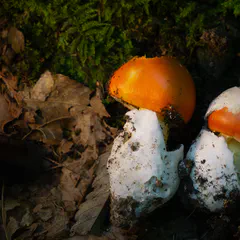
Amatoxins are the ones to know. They’re the poisons in Amanita phalloides, the death cap, along with Amanita virosa, several Lepiota species and Galerina marginata, and they account for the overwhelming majority of fatal mushroom poisonings worldwide. This matters locally, because the death cap likes the same oak and chestnut ground that produces the porcini everyone is out looking for in September. It’s the first species I’d want anybody to learn, which is why my poisonous mushrooms piece opens with it rather than working up to it.
They’re heat stable. Cooking doesn’t inactivate them, freezing doesn’t, drying doesn’t, and your digestive tract doesn’t break them down either. A death cap sautéed in butter for twenty minutes delivers its full dose, and so does one that spent a year drying in a jar.
The timing is what makes it lethal. Nothing at all happens for six to twelve hours, which is long past the point where anyone still connects a stomach ache to dinner, then come the violent gut symptoms, then an apparent recovery that has fooled emergency departments into sending people home, while behind all of it the liver is quietly failing. Treatment is supportive, and the outcome depends heavily on how early somebody started it.
Cortinarius poisoning is worse in one specific way: the kidney damage can take two to three weeks to show up, by which time the meal is a distant memory and nobody is thinking about mushrooms at all.
The toxins that heat really does destroy
Here’s where the folk rule comes from, because this half is genuine.
Some mushrooms carry thermolabile compounds, which is a long word for poisons that fall apart when you heat them. I run into this every autumn in the most ordinary way possible, because two of the species Tuscan families pick in the largest quantities sit in exactly this category. The blusher, Amanita rubescens, contains a haemolysin that ruptures red blood cells and is destroyed by cooking. Honey fungus, the chiodini that fill Tuscan baskets in October, causes real gastrointestinal trouble raw or undercooked. So do morels, and a 2023 outbreak in Montana traced illness to people who had eaten them raw or barely cooked.
So the tradition isn’t superstition. It’s a real chemistry, correctly observed over a long time by people who were paying close attention to what made them ill, and then generalised to a set of species it was never about.
The case that ruins the rule completely
The false morel, Gyromitra esculenta, is where this gets uncomfortable.
Its toxin, gyromitrin, is volatile, and boiling in changes of water removes much of it. That sounds like a cooking method that works. Yet in 2025 the Finnish Food Authority reported that nearly a fifth of the toxin can still be there after the recommended double boiling. Then you find the other half of the literature: people have been poisoned by standing over the pot and breathing the steam, because the toxin leaves the mushroom and goes straight into the air of the kitchen. I would not cook it and I would not stand in a room where someone else was.
A preparation that can poison you without you eating anything is not a safety procedure. It’s a risk being managed by people who accept the risk.

Come mushroom hunting in the Tuscan Apennines
A private day in the woods between Pistoia and Florence: identification in the field, the habitats each species needs, and time to photograph what you find. September to November, when the ground is actually producing.
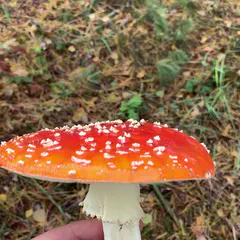
What this means when you’re actually holding a basket
- The kitchen is not a filter. Cooking corrects for a specific class of irritants and does nothing about the compounds that destroy organs. Identification is the only step that has ever protected anybody.
- Some species are toxic raw. Chiodini and morels will make you ill raw or barely warmed.
- Never pool species you’re unsure about. One misidentified cap contaminates the whole pan, and after cooking nobody can tell which one it was.
- Keep one raw specimen in the fridge whenever you eat something you gathered yourself. If anyone gets ill, that specimen is what lets a hospital work out what it’s treating. Leftovers from the pan work too.
- If someone does get ill after a wild mushroom meal, go to the Pronto Soccorso or call 112, take the specimen or the leftovers with you, and say what time the meal was. The delay between eating and feeling unwell is diagnostic information, so the timing matters as much as the symptoms.
Nobody carries a complete list of which species hold heat-stable toxins and which fall apart in a pan, and I’m not going to pretend I have one in my head either. That list would be the wrong tool anyway. You don’t cook your way past a bad identification, you identify first, and Geoff Dann’s Edible Mushrooms is where I’d start if you want to do that properly.
The rule that actually holds is much smaller than the folklore: leave what you can’t identify.
Attention!
While the content of this blog post is aimed at providing you with information as accurate as possible, it should be treated as what it is: simply a blog post on the internet.
Mushroom identification should only be performed by experts, as a mistake can lead to dire consequences. Attempting to identify a mushroom on your own, without prior experience, based solely on the content of this blog post is strongly discouraged.