Last Update: 01 Mar 2026
Everyone knows about the Camino de Santiago in Spain. Hundreds of thousands walk it every year, books have been written about it, and it has become almost a cultural pilgrimage for modern seekers.
But almost nobody knows that Tuscany has its own Camino—one that medieval pilgrims walked for centuries before boarding ships to continue their journey to Santiago de Compostela or Jerusalem.
The Cammino di San Jacopo connects Florence to Pisa across approximately 170 kilometers, passing through some of Tuscany’s most beautiful and historically significant cities. Unlike the famous Spanish route, this path remains genuinely uncrowded, allowing you to experience what pilgrimage walking felt like before it became mass tourism.
The Route: Florence to Pisa
The Cammino follows the ancient Via Cassia-Clodia, a Roman road that has connected these territories for over two thousand years. The official route is traditionally walked in five stages to reach Pisa, with historical extensions to the port of Livorno available for those who wish to continue:
Florence to Prato (27 km) - You leave the Renaissance capital through Etruscan gardens and ancient necropolises, passing noble villas and medieval parish churches. Prato welcomes you with its often-overlooked treasures: the Swabian castle, the multicolored marble cathedral, and the relic of the Holy Girdle.
Prato to Pistoia (27 km) - River paths, Romanesque churches, and protected natural areas guide you to Pistoia, the spiritual heart of this entire pilgrimage.
Pistoia to Montecatini/Pescia (20-30 km) - You walk ancient cobbled routes through fortified villages and Byzantine ruins, arriving either at the thermal waters of Montecatini Terme or continuing to the medieval town of Pescia.
Pescia to Lucca (26 km) - The spectacular cobblestone Via della Fiaba leads to Collodi and Villa Garzoni, then through the hills dotted with Lucchese villas and Romanesque churches before arriving at Lucca’s magnificent Renaissance walls.
Lucca to Pisa (25-29 km) - The final official stage crosses the Lucca plain, following ancient canals and the Serchio River through medieval villages. One of the most dramatic sections passes through the Castello di Ripafratta, a 12th-century fortress perched above the Serchio River gorge. This medieval stronghold once controlled the vital passage between the rival republics of Lucca and Pisa, and its ruined towers still command stunning views across the landscape. The castle sits where the river narrows through rock walls, creating a wild contrast to the surrounding agricultural plains. From here, the path continues past the elegant arches of the Nottolini Aqueduct or through the Monti Pisani hills before arriving at Pisa’s Piazza dei Miracoli—your official endpoint beneath the famous Leaning Tower.
Historical note: Some pilgrims historically continued from Pisa to the port of Livorno (an additional 36 km), where they would embark for Santiago or the Holy Land. The Church of San Jacopo in Acquaviva in Livorno served as a final “finisterrae” before boarding ships. While this extension is still walkable, the official Testimonium (completion certificate) is awarded upon reaching Pisa’s cathedral.
Pistoia: Little Santiago
The centerpiece of this entire pilgrimage is Pistoia, which holds something extraordinary: the only relic of St. James outside of Santiago de Compostela.
The relic arrived in Pistoia in 1145, a gift from Archbishop Diego Gelmírez of Santiago to Bishop Atto of Pistoia. This remarkable gesture—essentially a diplomatic and spiritual handshake between Spain and Italy—established Pistoia as a legitimate pilgrimage destination and made the city famous throughout medieval Europe. It earned Pistoia the nickname “Santiago Minor” or “Little Santiago.”
In Pistoia’s Cathedral of San Zeno, you’ll find not only the relic enshrined in the magnificent Silver Altar but also Italy’s only Camino de Santiago milestone—a stone marker indicating that 2,505 kilometers separate this Tuscan city from the cathedral in Galicia. Standing before that marker, you feel the weight of centuries, the footsteps of countless pilgrims who passed through this same space with their own burdens, their own questions, their own need for something beyond the everyday.
Why Walk This Path?
For spiritual seekers: This is a pilgrimage route with nine centuries of continuous devotion. You’re walking paths worn smooth by medieval pilgrims, stopping at churches that have welcomed travelers for a thousand years, following a route that connects the sacred geography of Europe.
For history enthusiasts: Every stage reveals layers of Italian history—Etruscan tombs, Roman roads, Lombard abbeys, medieval fortifications like Ripafratta, Renaissance villas, proto-industrial canals. You’re not just reading about history; you’re walking through it.
For those seeking challenge without extremity: The Cammino is accessible to most fitness levels. Daily distances range from 20-30 kilometers on terrain that mixes paved roads, dirt paths, and cobblestone streets. It’s demanding enough to feel accomplished but not so brutal that the journey becomes purely about survival.
For people who want authentic Tuscany: This route deliberately avoids the tourist corridors. Yes, you pass through famous cities, but you also walk through countless small villages, across working agricultural land, past places where local life continues exactly as it has for generations.
The Practical Reality
Terrain: Mostly flat to gently rolling, with some hilly sections between villages (particularly the Monti Pisani near Pisa). No technical difficulty, but daily distances require good fitness.
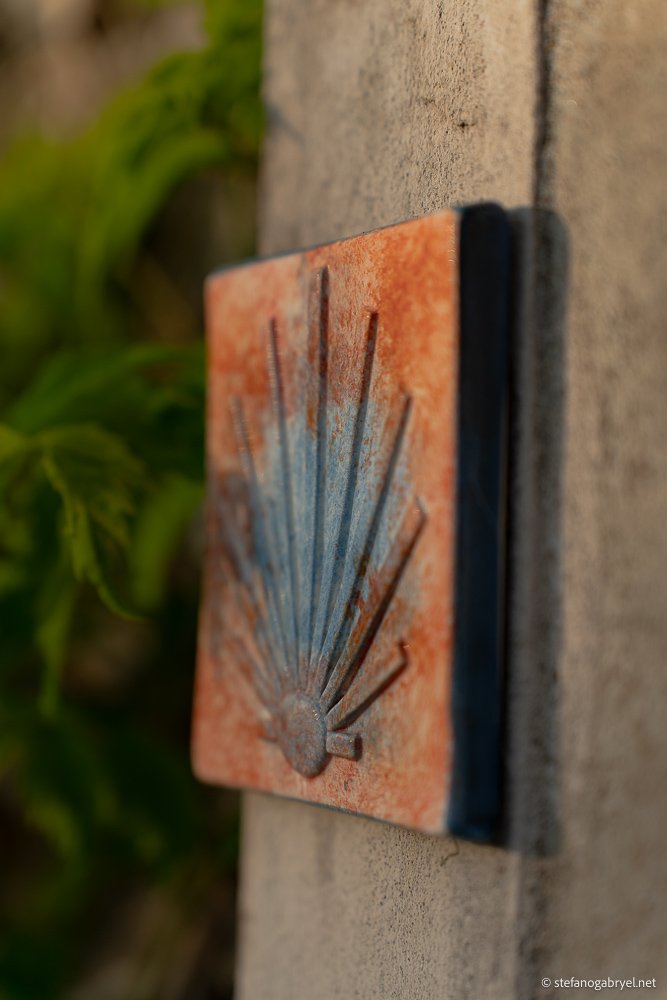
Waymarking: The route is marked with yellow scallop shells and two crossed pilgrim staves (bastoni), usually in yellow and blue colors to distinguish it from other pilgrimage routes like the Via Francigena. However, marking can be inconsistent in some sections, and in urban areas, following the correct path requires attention.
Accommodation: Unlike the Spanish Camino, donative hostels are limited. Most pilgrims stay in hotels, agriturismi, or B&Bs. However, Pistoia does offer the Spedale del Bigallo and some parishes with pilgrim rates. In Pistoia, I particularly recommend Villa Agnolaccio, a beautiful B&B that welcomes pilgrims and understands the needs of walkers on the Cammino—comfortable rooms, hearty breakfasts, and hosts who appreciate the significance of the journey you’re undertaking.
Season: The route is walkable year-round, though summer can be very hot, especially on stages crossing open plains. Spring (April-May) and autumn (September-October) offer ideal conditions.
Duration: Most people complete the full route to Pisa in 5-6 days. You can also walk individual stages or focus on specific sections.
Pilgrim credential: Like the Spanish Camino, you can obtain a credenziale (pilgrim passport) that gets stamped at churches, accommodations, and municipalities along the route. Upon completion in Pisa, you receive the Testimonium certificate.
What Makes This Different From the Spanish Camino
Solitude: Even during peak season, you’ll encounter far fewer pilgrims. Some days you might meet only a handful of other walkers. This creates a completely different experience—more contemplative, more intimate with the landscape.
Urban walking: Unlike the Spanish routes that often bypass cities, this path leads you directly through the historic centers of major Tuscan cities like Pistoia. You’re walking medieval streets, not around them.
Cultural density: Every few kilometers brings another church, villa, or historic site worth exploring. The challenge isn’t finding things to see—it’s deciding what to skip so you can maintain your walking rhythm.
Food: This is Tuscany. The food is extraordinary. Every stage offers opportunities for genuine Tuscan cuisine—not pilgrim menus, but the same restaurants locals use.
Language: In smaller villages and rural sections, Italian becomes essential. Unlike the Spanish Camino where English has become the lingua franca, here you’re more likely to need basic Italian for interactions.
Why Walk With a Guide
I understand the appeal of independent pilgrimage. There’s something powerful about navigating by yourself, making your own decisions about pace and stops, experiencing the journey entirely on your own terms.
But consider what changes when you walk with someone who knows this territory intimately:
Historical context transforms every site. That seemingly ordinary church in a small village? It houses frescoes from the 1300s and was a documented pilgrim stop. The ruined fortress at Ripafratta? It was the site of crucial battles between Pisa and Lucca. That section of cobblestone? It’s the original Roman road. Understanding these layers makes the walk resonate differently.
Navigation becomes effortless. You don’t spend mental energy consulting GPS or worrying about waymarking. You can focus entirely on the experience itself—the walking, the thinking, the observing.
Pace adaptation. Some stages are too long for comfortable walking; others could be extended with meaningful detours. Local knowledge allows intelligent modifications that match your fitness and interests.
Access to places others miss. I know which churches are usually locked but whose keys the local bar owner holds. Which villas offer private tours if you ask properly. Which restaurants serve authentic regional dishes versus tourist fare. Where to stop at Ripafratta for the best views and photographs.
Flexibility. Weather problems? A developing blister? Energy levels different than expected? We adjust the plan in real time rather than forcing you to complete a predetermined stage.
Photography. As a professional photographer, I can show you compositions and light that most walkers never see. If you’re carrying a camera, you’ll return with images that actually capture what this journey felt like.
The Deeper Reason
But there’s something else, something harder to articulate.
Walking alone, you’re inside your own head. Walking with someone who knows the path, you have the space to process what you’re experiencing without the constant low-level stress of navigation and decision-making.
The pilgrim experience isn’t about proving you can read a map. It’s about having the mental space to let the journey work on you—to think the thoughts that only come during long hours of walking, to feel the shift that happens when you move at three kilometers per hour through landscape for days at a time.
For Whom Is This Journey?
This path calls to people who:
- Want pilgrimage without crowds
- Appreciate historical and cultural depth
- Prefer comfortable accommodations over dormitory bunks
- Can walk 20-30 kilometers daily without injury
- Want to combine spiritual seeking with aesthetic beauty
- Appreciate Italian culture, food, and slower rhythms
- Seek something genuine rather than Instagram-famous
This path might not suit you if you:
- Need the community experience of a crowded pilgrimage
- Prefer wilderness over cultural landscape
- Want the specific rituals and infrastructure of the Spanish Camino
- Are on an extremely tight budget (though pilgrim accommodations exist in some locations)
The Journey That Waits
Every year, hundreds of thousands walk to Santiago. A few thousand walk the Via Francigena. Perhaps a few hundred complete the Cammino di San Jacopo.
Those few hundred experience something the masses don’t: a pilgrimage route that still feels like pilgrimage rather than organized tourism, cities that welcome you as a traveler rather than process you as a visitor, and the particular satisfaction of discovering what most people don’t know exists.
The path runs from Florence to Pisa whether you walk it or not. The relic—gifted by Archbishop Diego Gelmírez to Bishop Atto in 1145—sits in Pistoia’s cathedral regardless of who pays homage. The cobblestones wear smooth under footsteps both mindful and distracted. The ruined towers of Ripafratta stand guard over the Serchio gorge, as they have for nine centuries.
What changes is what you bring to the walk and what the walk gives back to you.
If you’re ready to discover Tuscany’s hidden pilgrimage—whether you want to walk all five stages or experience just a portion, whether you prefer independent exploration or knowledgeable guidance—the Cammino di San Jacopo waits.
Plan Your Cammino di San Jacopo Journey
Ready to walk Tuscany’s pilgrimage route? I offer customized experiences from single-day sections to the complete route, tailored to your pace, interests, and spiritual or cultural focus. Contact me to design your journey.

or head to the contact page
Explore Hidden Tuscany
Guided hiking experiences combining expert trail knowledge, professional photography, and wilderness mindfulness.
Latest posts
 4 March 2026
Galium Aparine: Cleavers in Tuscan Hedgerows
4 March 2026
Galium Aparine: Cleavers in Tuscan Hedgerows 3 March 2026
Umbilicus Rupestris: Wall Pennywort in Tuscany
3 March 2026
Umbilicus Rupestris: Wall Pennywort in Tuscany 3 March 2026
Laurus Nobilis: Bay Laurel in Tuscan Landscapes
3 March 2026
Laurus Nobilis: Bay Laurel in Tuscan Landscapes 2 March 2026
Guided Tours for Exploring Marble Quarries in Apuan Alps
2 March 2026
Guided Tours for Exploring Marble Quarries in Apuan Alps 26 February 2026
Photographing Nottolini Aqueduct: Light & Geometry
26 February 2026
Photographing Nottolini Aqueduct: Light & Geometry