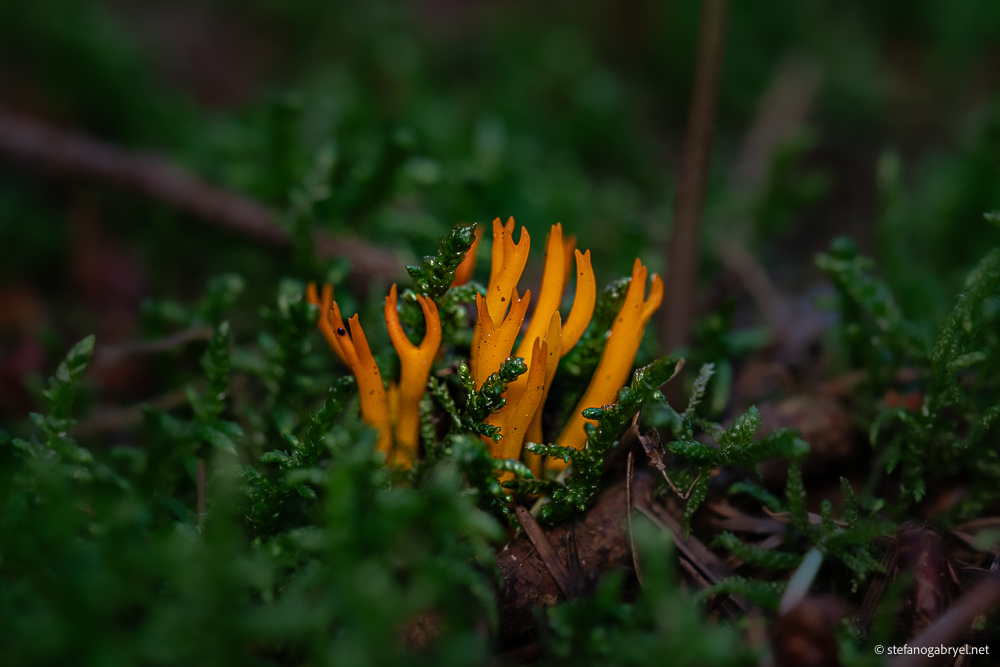
During autumn hikes through Riserva Acquerino, among the more familiar mushrooms fruiting in the beech and pine forests, there’s one that stops people in their tracks.
Not because it’s large or particularly valuable, but because it’s so visually unexpected.
Calocera viscosa—the yellow stagshorn or small stagshorn fungus—looks like bright yellow coral growing from rotting pine wood.
Or perhaps like tiny antlers, or branching fingers reaching up from a stump.
The Italian names capture this variability: “ditola gialla” (yellow little finger), “clavaria viscida” (sticky clavaria), or sometimes simply “fungo gelatinoso giallo” (yellow jelly fungus).
When you first see it, the immediate question is usually: “Is that a chanterelle growing on wood?”
The answer is no—Calocera viscosa is something entirely different, and understanding what makes it unique reveals how diverse fungal forms can be.
What You’re Actually Looking At
Calocera viscosa belongs to the jelly fungi—a group characterized by gelatinous, rubbery fruiting bodies that can rehydrate after drying.
This is fundamentally different from gilled mushrooms, pored mushrooms, or even typical club fungi.
The fruiting body consists of bright yellow to orange-yellow branches, typically 3-7 cm tall, emerging in clusters from decaying conifer wood.
For example, at Riserva Acquerino, Calocera viscosa is commonly found fruiting in dense clusters on decaying Douglas-fir stumps and logs, where it feeds on well-rotted conifer wood.
Each individual “finger” or “branch” is cylindrical, often forked or antler-like, with pointed tips.
The color is eye-catching—vibrant egg-yolk yellow to deep orange-yellow, standing out dramatically against the brown decay of pine stumps.
The texture is the giveaway that this isn’t a normal mushroom:
Touch it and it feels tough, rubbery, gelatinous—almost cartilaginous.
It’s flexible, bending rather than breaking, and has a sticky or viscid surface when fresh (hence “viscosa” in the species name).
When it rains or in humid conditions, the branches become even more gelatinous and sticky.
In dry weather, they can shrink and harden somewhat, but rehydrate when moisture returns.
This ability to “revive” after drying is characteristic of jelly fungi and completely unlike chanterelles or typical mushrooms, which simply rot when they deteriorate.
Where I Find It at Acquerino
Calocera viscosa is a saprotroph that specifically targets dead conifer wood—in Tuscany, primarily pine stumps and logs.
At Acquerino, I encounter it most frequently:
- On old pine stumps in various stages of decay
- On fallen pine logs, particularly where bark is peeling
- Occasionally on buried pine wood or roots
- Almost never on beech or other hardwoods (it’s a conifer specialist)
The fungus causes white rot in the wood, breaking down both cellulose and lignin as it slowly decomposes its substrate.
The bright yellow fruiting bodies emerge from the surface, but the real organism—the mycelium—threads throughout the rotting wood interior.
Seasonality runs from late summer through early winter (July-December at Acquerino), but the jelly-like nature means individual fruiting bodies can persist for weeks or even months, shrinking in dry weather and swelling again when it rains.
Growth pattern:
Typically appears in small clusters, with multiple branched fruiting bodies emerging from the same area of wood.
You might find a single cluster on a stump, or numerous clusters scattered across a large decaying log.
The Chanterelle Question: Why It’s Not One
The vibrant yellow color and forest habitat lead many people to assume Calocera viscosa might be a chanterelle or at least closely related.
This confusion is understandable but completely wrong.
Key differences from chanterelles (Cantharellus species):
Habitat:
- Chanterelles grow from soil, mycorrhizal with tree roots
- Calocera viscosa grows only from dead wood, saprotrophic
Texture:
- Chanterelles have firm, fibrous flesh that breaks cleanly
- Calocera viscosa is gelatinous, rubbery, bends without breaking
Form:
- Chanterelles have a cap and stem structure with false gills underneath
- Calocera viscosa has branched, antler-like form with no gills at all
Spore production:
- Chanterelles produce spores on the wrinkled “false gills”
- Calocera viscosa produces spores over the entire outer surface of the branches
Taxonomic relationship:
- Chanterelles belong to order Cantharellales
- Calocera viscosa belongs to order Dacrymycetales (jelly fungi)
They’re not even remotely related—they just happen to share a yellow color.
The similarity is purely superficial, like mistaking a yellow flower for a yellow bird simply because both are yellow.
Jelly Fungi: A Different Strategy
Understanding Calocera viscosa means understanding what jelly fungi are and how they differ from typical mushrooms.
Jelly fungi produce fruiting bodies with gelatinous, often translucent flesh that can desiccate and rehydrate repeatedly without dying.
This is a survival strategy for organisms growing in exposed positions on wood, where moisture conditions fluctuate dramatically.
The mechanism:
The cell walls contain polysaccharides that create the gelatinous texture and allow water absorption and retention.
When dry weather arrives, the fruiting body shrinks and hardens, entering a state of dormancy.
When rain returns, it swells back up, resumes spore production, and continues functioning.
A single Calocera viscosa fruiting body might go through multiple cycles of desiccation and rehydration over weeks or months.
This is completely unlike typical mushrooms, which have a brief period of growth, spore production, and then irreversible decay.
The jelly fungus strategy trades rapid growth for durability—slower but more persistent.
The jelly fungus group demonstrates how diverse fungal forms can be beyond the familiar cap-and-stem mushroom shape.
Edibility: The Answer is “Technically Yes, But Why?”
Calocera viscosa occupies a strange position regarding edibility.
It is not toxic.
Some sources list it as edible, others as inedible, and the truth is somewhere in the middle.
The reality:
It’s not poisonous, so eating it won’t harm you in that sense.
But it’s essentially tasteless and has a tough, rubbery, gelatinous texture that doesn’t improve with cooking.
There’s no culinary tradition of consuming it in Europe or anywhere else that I’m aware of, which tells you something—humans have been foraging mushrooms for millennia, and if Calocera viscosa were worthwhile eating, someone would have figured out how to prepare it.
The lack of recipes and traditional use suggests it’s just not worth the effort.
My recommendation: Leave it on the stump.
It’s beautiful, it’s interesting, it’s performing valuable ecological work breaking down dead pine wood.
But it’s not food in any meaningful sense.
Identification: Distinctive When You Know What to Look For
Key identifying features:
- Habitat: Dead conifer wood (stumps, logs), never on soil
- Form: Branched, antler-like or coral-like, 3-7 cm tall
- Color: Bright yellow to orange-yellow
- Texture: Gelatinous, rubbery, sticky/viscid when fresh
- Growth: Clustered, multiple branches from same area
- Season: Late summer through early winter (July-December)
- Spore print: White to pale yellow
Potential confusion:
The only real lookalike in Tuscany would be other yellow jelly fungi or possibly young yellow coral fungi (Ramaria species).
Compared to Ramaria (coral fungi):
- Coral fungi have more delicate, extensively branched forms
- Coral fungi are not gelatinous—they have normal mushroom texture
- Coral fungi grow from soil, not wood
The combination of yellow color, gelatinous texture, and growth on conifer wood is essentially diagnostic.
If you find something that looks like yellow antlers growing from a pine stump, feels rubbery and sticky, and bounces back when pressed, you’ve found Calocera viscosa.
What It Tells Us About Wood Decay
When I encounter Calocera viscosa during guided hikes at Acquerino, I use it to discuss the succession of organisms that colonize dead wood.
Dead wood doesn’t just rot uniformly—it goes through stages:
Early colonization (months to a few years):
- Primary decomposers like polypores (Fomes, Fomitopsis) begin softening the wood
- Wood is still relatively firm
Mid-stage decay (several years):
- Wood becomes softer, more fragmented
- Species like Calocera viscosa and various jelly fungi appear
- The wood is losing structural integrity but still recognizable as wood
Late-stage decay (many years):
- Wood becomes crumbly, heavily fragmented
- Saprophytic mushrooms like certain Mycena species appear
- Wood barely holds together, merging with soil
Finding Calocera viscosa indicates mid-stage decay—the stump or log has been decomposing for several years, the wood has softened sufficiently for this species to colonize, but it’s not yet completely broken down.
This succession pattern is important for forest ecology:
Different organisms extract different nutrients at different stages.
Early colonizers break down the most accessible compounds.
Later colonizers, including Calocera, continue the process, accessing more recalcitrant compounds.
The endpoint is soil—the wood’s nutrients returned to the ecosystem, available for new tree growth.
Calocera viscosa is one participant in this multi-year, multi-organism process.
Are you a beginner?
If you’re just beginning to explore mushroom foraging, Geoff Dann’s Edible Mushrooms is the field guide I recommend to all my clients. It’s an excellent starting point for learning safe identification. Read my full review here.
Want to learn in the field? Join me for a hands-on mushroom hunting experience ⬇️ ⬇️ ⬇️ ⬇️
Ready to move from photos to field identification?
Experience these fascinating fungi firsthand on a guided autumn hike through Tuscan woodlands. Learn professional identification techniques, understand ecosystem roles, and capture your own stunning mushroom photography.
Attention!
While the content of this blog post is aimed at providing you with information as accurate as possible, it should be treated as what it is: simply a blog post on the internet.
Mushroom identification should only be performed by experts, as a mistake can lead to dire consequences. Attempting to identify a mushroom on your own, without prior experience, based solely on the content of this blog post is strongly discouraged.
Explore Hidden Tuscany
Guided hiking experiences combining expert trail knowledge, professional photography, and wilderness mindfulness.
Latest posts
 4 March 2026
Galium Aparine: Cleavers in Tuscan Hedgerows
4 March 2026
Galium Aparine: Cleavers in Tuscan Hedgerows 3 March 2026
Umbilicus Rupestris: Wall Pennywort in Tuscany
3 March 2026
Umbilicus Rupestris: Wall Pennywort in Tuscany 3 March 2026
Laurus Nobilis: Bay Laurel in Tuscan Landscapes
3 March 2026
Laurus Nobilis: Bay Laurel in Tuscan Landscapes 2 March 2026
Guided Tours for Exploring Marble Quarries in Apuan Alps
2 March 2026
Guided Tours for Exploring Marble Quarries in Apuan Alps 26 February 2026
Photographing Nottolini Aqueduct: Light & Geometry
26 February 2026
Photographing Nottolini Aqueduct: Light & Geometry