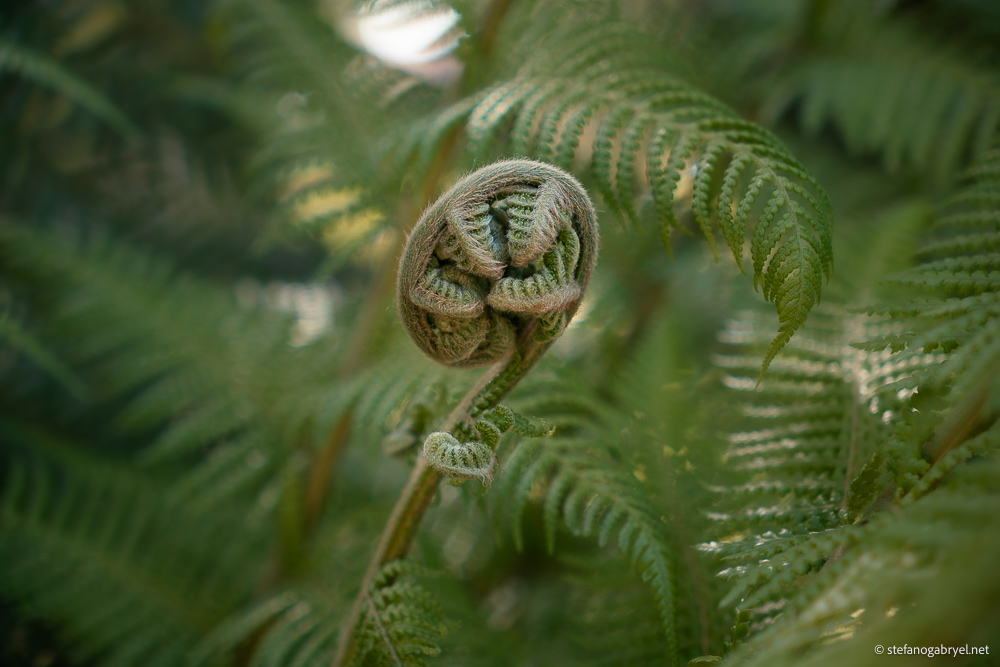
There is a plant you will encounter on almost every forest walk in Tuscany.
It lines trail edges. It fills meadow clearings. It colonises hillsides between the trees.
Most walkers step over it without a second glance.
But if you know what it is telling you, Pteridium aquilinum—bracken fern—becomes one of the most useful field indicators you can find.
It is not the destination. It is a clue.
And in the right context, it points directly toward porcini.
What Is Pteridium aquilinum?
Bracken is not a flowering plant.
It belongs to a far older lineage—one that was spreading across land before any flower ever opened, before any bee existed to pollinate it.
Ferns as a group appeared roughly 360 million years ago.
Pteridium aquilinum itself has fossil records going back at least 55 million years.
It has outlasted entire planetary extinctions.
Today it is one of the most widely distributed plants on Earth, present on every continent except Antarctica, from sea level to alpine zones, from the tropics to cold northern forests.
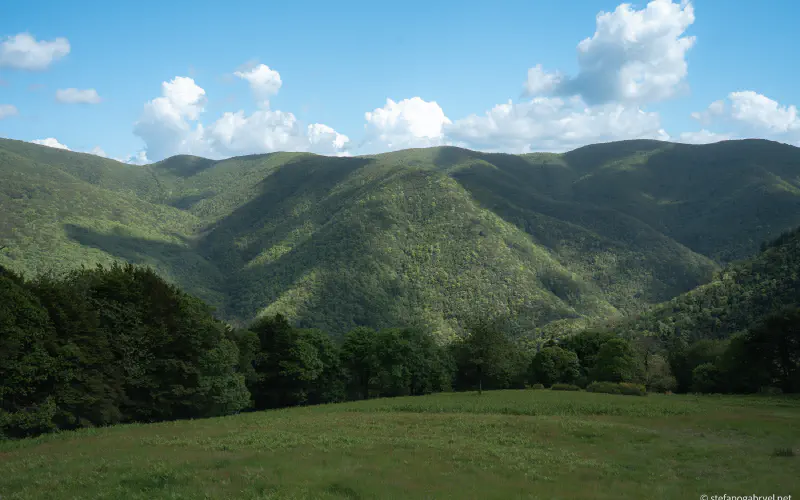
In Tuscany it is everywhere: along the Apennines, through the Apuan Alps, across the Appennino Pistoiese.
At Acquerino, it is particularly abundant.
The meadow clearings and forest margins of the reserve are often filled with it—sweeping stands of fronds that reach well above the knee in summer.
Book a private guided hike in Riserva Acquerino-Cantagallo. Expert trekking tours from Pistoia, Prato & Florence. Escape the crowds—reserve your tour!
Saprotrophic, Not Mycorrhizal
Before we go further, it helps to be precise about what bracken fern actually is in ecological terms.
Bracken is a vascular plant—not a fungus—and it is saprotrophic in the broadest sense.
It is not mycorrhizal itself.
Its roots do not form the symbiotic partnerships with fungi that trees like beech, oak, and pine rely upon.
What bracken does instead is tell you something fundamental about the ground beneath your feet.
And that is where the porcini connection begins.
What the Soil Is Saying
Bracken fern has a clear and well-documented preference for acidic, well-drained, relatively nutrient-poor soils.
It thrives where pH is low.
It tolerates poor drainage poorly—it wants soils where water moves through rather than sits.
When you see dense bracken, you are standing on soil that is light, aerated, and acidic.
This matters enormously for a forager.
Boletus edulis—porcini—forms mycorrhizal relationships with specific tree species.
In Tuscany, those include beech, chestnut, spruce, and pine.
All of these trees prefer or tolerate acidic soils.
David Arora in Mushrooms Demystified discusses at length how Boletus edulis habitat is shaped by these precise soil and vegetation associations.
The pattern is consistent: where you find the right trees, in the right soil conditions, porcini follow.
Bracken signals those conditions visually, from across a clearing, before you have even reached the trees.
It is not a guarantee.
Bracken grows in many places where porcini do not fruit, for reasons of altitude, rainfall, temperature, and timing.
But the absence of bracken in an otherwise forested area is a reason for caution.
The presence of it, in the right company of trees, is a reason to slow down and look carefully at the ground.
Chris Maser, Andrew W. Claridge, and James M. Trappe in Trees, Truffles, and Beasts explore in depth how soil chemistry and tree associations shape fungal communities across forest ecosystems.
The principle they describe—that fungal distributions are inseparable from soil and botanical context—is exactly what reading bracken teaches you on the ground.
Reading Bracken Alongside Other Indicators
In the field, I never read bracken in isolation.
It is one layer of a larger picture.
Alongside bracken, I look for:
- Mature beech and chestnut — primary porcini hosts in the Tuscan Apennines
- A thick, undisturbed leaf litter layer — sign of stable, managed forest
- Absence of standing water — confirming well-drained soil beneath
- Elevation between 600 and 1400 metres — the productive zone in this region
When bracken appears consistently alongside these elements, the habitat is worth noting.
At Acquerino, all these elements converge in specific zones of the reserve.
The bracken-filled clearings often give way to mature beech groves on the slopes above.
That transition—from open bracken to closed beech canopy—is a threshold worth paying attention to.
The Name: An Eagle Hidden in the Stem
The species name aquilinum comes from the Latin aquila: eagle.
The reason is hidden inside the plant itself.
If you cut a bracken stem cleanly in cross-section with a sharp knife, the vascular bundles inside form a pattern.
Some see an eagle in heraldic stance, wings spread, within the pith.
Others see the letter C, or simply an abstract form.
The eagle interpretation has persisted for centuries, across cultures that would have had no contact with each other.
It is one of the more remarkable pieces of natural folklore attached to any common plant.
One of Earth’s Largest Organisms
Bracken spreads almost entirely through its rhizomes—the underground stems that extend horizontally through the soil.
A single bracken colony can cover several hectares while remaining a single connected organism.
The rhizome network lies 20 to 30 centimetres below the surface, protected from fire, frost, and disturbance above ground.
This is why bracken is among the first plants to recolonise after a fire.
While everything above ground burns, the network below survives.
Within a season, fronds emerge as if nothing happened.
Some bracken colonies are estimated to be hundreds—possibly thousands—of years old.
You may be walking through an organism that began growing before medieval Tuscany existed as a concept.
A Warning: Bracken Is Toxic
One important fact for anyone walking with children or animals: bracken is toxic.
The plant contains ptaquiloside, a compound classified as a carcinogen.
It accumulates in grazing animals—particularly cattle and horses—causing bone marrow suppression and serious illness.
Pigs and sheep are similarly affected over time.
The young fronds, known as fiddleheads, have been eaten in some cultures—notably Japan, where they are called warabi.
But preparation requires specific neutralisation of the toxins.
In the context of a walk in Tuscany, this is not a plant to sample casually.
Leave it where it is.
Appreciate what it tells you about the ground.
Autumn: When Bracken Becomes Something Else
For most of the year, bracken is green—a deep, architectural green that fills every gap in the understory.
In autumn, it transforms.
As temperatures fall and the plant dies back, the fronds shift from green through yellow and amber to a deep, warm rust.
The same hillsides at Acquerino that are lime green in July become tawny gold in October.
For a landscape or nature photographer, this seasonal shift is one of the most dramatic in the Tuscan forest calendar.
The timing coincides almost exactly with the peak porcini season.
So while you are there for the fungi, the bracken is giving you something else entirely—light, texture, and colour that change with every hour of the autumn day.
How I Use Bracken When Guiding
In practice, bracken is part of the ecological reading I do continuously during any guided hike.
Not all forests in Tuscany are equal for porcini.
Soil chemistry, elevation, tree composition, recent rainfall, temperature patterns—all of these combine to produce or suppress a fruiting.
Bracken is one of the most visible pieces of that puzzle.
It is the kind of plant you learn to see as information rather than background.
Once that shift happens, a walk in the Tuscan Apennines becomes a completely different experience.
You are not simply moving through landscape.
You are reading it.
If you want to develop this kind of attention—to learn the plant indicators, the tree associations, the soil signals that experienced foragers use—a guided mushroom hike is the best place to start.
Unsure about regulations regarding mushroom foraging in Tuscany?
Everything you need to know about guided foraging in Tuscany is here.
Ready to move from photos to field identification?
Experience these fascinating fungi firsthand on a guided autumn hike through Tuscan woodlands. Learn professional identification techniques, understand ecosystem roles, and capture your own stunning mushroom photography.
Attention!
While the content of this blog post is aimed at providing you with information as accurate as possible, it should be treated as what it is: simply a blog post on the internet.
Mushroom identification should only be performed by experts, as a mistake can lead to dire consequences. Attempting to identify a mushroom on your own, without prior experience, based solely on the content of this blog post is strongly discouraged.
Explore Hidden Tuscany
Guided hiking experiences combining expert trail knowledge, professional photography, and wilderness mindfulness.


