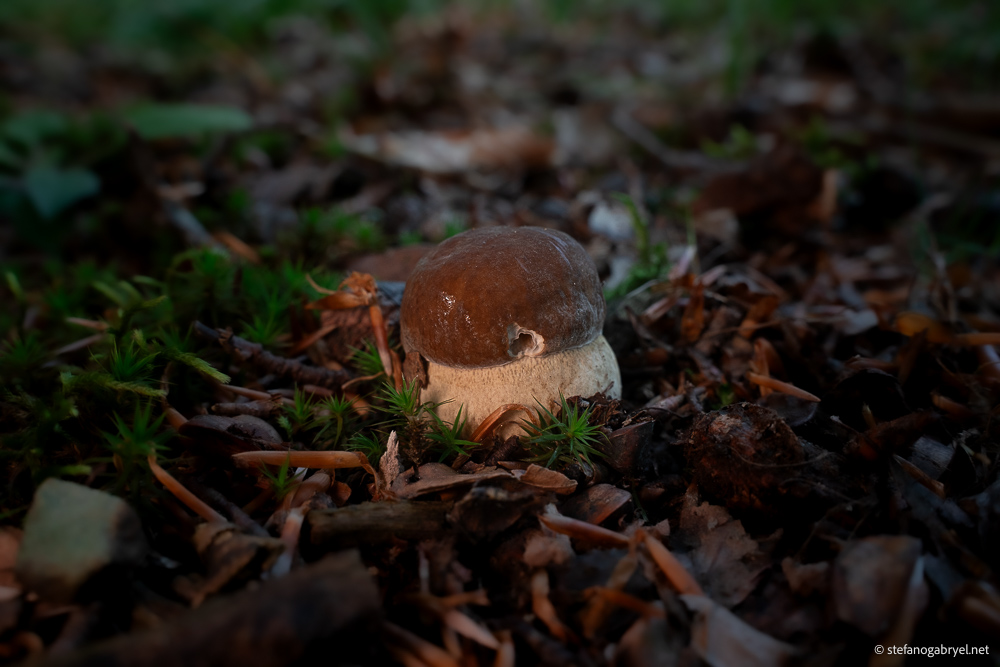
I need to be honest with anyone joining my mycology hikes in Tuscany: if you’re coming specifically to find porcini, you’re likely to be disappointed.
Not because they don’t grow here—they absolutely do—but because you’re competing with generations of expert foragers who know every productive spot and check them obsessively.
In regions like France and England, where Boletus edulis is known as cep or penny bun respectively, the mushroom might grow relatively unmolested in forests.
In Italy, and especially in Tuscany, porcini hunting is a serious pursuit backed by deep cultural tradition and significant economic incentive.
Mushrooms like Lactarius deliciosus—equally delicious in my opinion, no pun intended—grow abundantly and are largely ignored, while porcini are hunted relentlessly. It’s not purely about flavor; it’s about cultural status.
The mushrooms are here. Finding them before someone else does is the challenge.
Four Species, One Name: The Porcini Complex
Here’s something that surprises most people: when Italians say “porcini,” we’re not talking about a single species.
The term encompasses four distinct boletes, all in the Boletus edulis group:
- Boletus edulis (the true porcino) - typically associated with spruce and fir at higher elevations
- Boletus aereus (porcino nero) - the black-capped variety, preferring oak and chestnut forests in warmer areas
- Boletus aestivalis (porcino estivo) - the summer porcino, found under oaks and chestnuts from May onwards
- Boletus pinophilus (porcino dei pini) - associated with pines, often in sandy soils
All four are mycorrhizal, all four are excellent edibles, and all four command premium prices in Italian markets.
The Mycorrhizal Partnership: Reading the Forest
Understanding porcini means understanding their obligate relationships with specific trees.
These mushrooms cannot exist without their tree partners.
The mycelium forms a sheath around tree rootlets, creating the mycorrhiza—literally “fungus-root”—that gives both organisms advantages.
The fungus extends the tree’s effective root system enormously, accessing water and minerals from a much larger soil volume.
In return, the tree provides carbohydrates that the fungus cannot produce on its own.
This partnership is species-specific.
Boletus aereus partners primarily with oaks (Quercus species) and chestnuts (Castanea sativa).
When I’m leading groups through the chestnut forests of the Appennino Pistoiese in autumn, I explain that theoretically, the conditions are perfect for porcini.
Mature chestnuts provide the partnership, the soil is appropriately acidic, the elevation and climate are suitable.
But theoretical potential and actual discovery are very different things.
Indicators of Acidic Soil: What Grows Where Porcini Grow
One practical skill I teach during my hikes is reading the understory vegetation.
Porcini strongly prefer acidic soils, and certain plants are reliable indicators of this acidity.
Where you see abundant ferns—particularly Pteridium aquilinum (bracken)—you’re in acidic soil.
Heather (Calluna vulgaris and Erica species) is another excellent indicator.
Blueberries and their relatives, various mosses, and in our region, the presence of chestnuts themselves all suggest the acidic conditions porcini require.
This doesn’t mean the forest lacks value—different mushrooms thrive in different conditions—but it helps set realistic expectations.
Seasonality: The Three Windows
Unlike mushrooms with a single fruiting season, porcini offer three potential harvest windows in Tuscany, depending on species and conditions.
The spring fruiting (May-June) brings Boletus aestivalis and occasionally B. aereus in lower-elevation oak forests.
This is the least competitive season since fewer people are actively mushroom hunting.
The summer flush (late July-August) follows thunderstorms and brings mainly B. aestivalis.
These summer porcini tend to be wormy and less prized, but they’re porcini nonetheless.
The autumn harvest (September-November) is the main event.
All four species can potentially fruit, depending on habitat, and this is when competition reaches fever pitch.
I’ve watched foragers arrive at trailheads at dawn, headlamps illuminating the pre-sunrise darkness, racing to reach productive areas before others.
This is not casual nature walking. This is competitive foraging.
The Photographer’s Perspective: Beauty Beyond the Basket
From my work photographing Tuscan landscapes and nature, I’ve learned to appreciate porcini differently.
Yes, finding one is exciting, but not finding them doesn’t diminish the forest’s value.
The same oak groves that could harbor porcini also host dozens of other fungi—beautiful, interesting, sometimes edible species that receive far less attention.
I’ve photographed stunning Amanita muscaria under the same trees where porcini theoretically grow.
I’ve documented Russula species in every color imaginable, Leccinum species with their distinctive scaly stems, and countless other mushrooms that most foragers ignore entirely in their single-minded porcini focus.
The forest offers abundance, but only if we’re willing to see it.
A Different Approach to the Porcini Question
So here’s what I propose to anyone interested in porcini during my tours: let’s appreciate the complete story rather than just the prize.
I’ll show you the oak and chestnut partnerships, the acidic soil indicators, the seasonal patterns.
I’ll explain why that particular slope faces north and retains moisture, making it theoretically perfect.
We’ll read the forest like a text, understanding what creates porcini habitat.
And if—when—we don’t find any, that’s actually the more authentic Tuscan porcini experience.
Because the truth is, most searches end empty-handed.
The locals found them first, as they should.
They know these mountains in ways that take decades to learn.
But occasionally—very occasionally—we’ll round a bend and there it will be: that unmistakable brown cap, that swollen white stem.
And in that moment, you’ll understand what all the fuss is about.
Are you a beginner?
If you’re just beginning to explore mushroom foraging, Geoff Dann’s Edible Mushrooms is the field guide I recommend to all my clients. It’s an excellent starting point for learning safe identification. Read my full review here.
Want to learn in the field? Join me for a hands-on mushroom hunting experience ⬇️ ⬇️ ⬇️ ⬇️
Ready to move from photos to field identification?
Experience these fascinating fungi firsthand on a guided autumn hike through Tuscan woodlands. Learn professional identification techniques, understand ecosystem roles, and capture your own stunning mushroom photography.
Attention!
While the content of this blog post is aimed at providing you with information as accurate as possible, it should be treated as what it is: simply a blog post on the internet.
Mushroom identification should only be performed by experts, as a mistake can lead to dire consequences. Attempting to identify a mushroom on your own, without prior experience, based solely on the content of this blog post is strongly discouraged.
Explore Hidden Tuscany
Guided hiking experiences combining expert trail knowledge, professional photography, and wilderness mindfulness.
Latest posts
 4 March 2026
Galium Aparine: Cleavers in Tuscan Hedgerows
4 March 2026
Galium Aparine: Cleavers in Tuscan Hedgerows 3 March 2026
Umbilicus Rupestris: Wall Pennywort in Tuscany
3 March 2026
Umbilicus Rupestris: Wall Pennywort in Tuscany 3 March 2026
Laurus Nobilis: Bay Laurel in Tuscan Landscapes
3 March 2026
Laurus Nobilis: Bay Laurel in Tuscan Landscapes 2 March 2026
Guided Tours for Exploring Marble Quarries in Apuan Alps
2 March 2026
Guided Tours for Exploring Marble Quarries in Apuan Alps 26 February 2026
Photographing Nottolini Aqueduct: Light & Geometry
26 February 2026
Photographing Nottolini Aqueduct: Light & Geometry