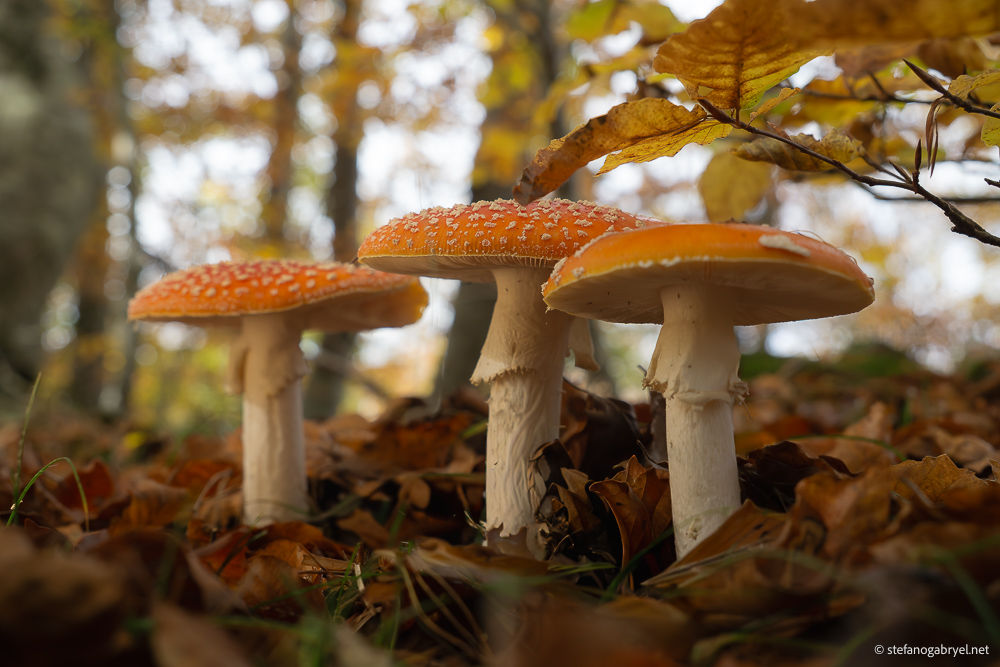
There’s no mushroom more instantly recognizable than Amanita muscaria, the Fly Agaric, with its brilliant red cap dotted with white spots.
After decades of guiding through the Apuan Alps and Appennines, I still feel a sense of wonder every time I photograph this iconic species emerging from the forest floor.
Seasonality: Summer’s End Through Late Autumn
In our Tuscan mountains, Amanita muscaria appears from late August through November, though I’ve occasionally spotted early specimens in July during particularly wet years.
The peak season is September and October, when cool nights and autumn rains trigger massive fruitings.
During our guided nature walks, this is when clients most frequently stop to photograph these fairy-tale mushrooms beneath the pines.
The Essential Partnership: Mycorrhizal Specialists
Amanita muscaria is strictly mycorrhizal, meaning it cannot survive without forming symbiotic relationships with specific tree roots.
In Tuscany, I find them almost exclusively associated with pine, spruce, and birch trees.
The relationship is fascinating: the fungus extends the tree’s root system, helping it absorb water and nutrients from the soil, while the tree provides the fungus with sugars from photosynthesis.
Without this partnership, neither can thrive in certain environments.
When you spot these mushrooms, you’re witnessing an underground network of fungal threads connecting entire groves of trees—what mycologists call the “wood wide web.”
Soil Preferences: Acidic Ground Beneath Conifers
Like its cousin the Panther Cap, Amanita muscaria prefers acidic soils.
In the Appennino Pistoiese, look for them in areas where you see blueberry bushes, bracken fern, and heather—all indicators of the low pH this species favors.
The Douglas fir groves at Acquerino provide ideal conditions, and I’ve photographed spectacular specimens there emerging from the needle-carpeted forest floor.
The presence of pine needles carpeting the forest floor creates the perfect acidic conditions, which is why you’ll rarely find Fly Agaric in our lowland oak and chestnut forests.
Recognition: More Than Just the Classic Red
Most people know the vibrant red cap with white warts, but Amanita muscaria shows remarkable color variation.
I’ve photographed specimens ranging from the classic scarlet to orange, yellow, and occasionally even white varieties in our mountains.
The white spots are actually remnants of the universal veil that covered the young mushroom—rain often washes them away, leaving older specimens plain red.
Key identification features include the white gills, the ring on the stem, and the bulbous base with concentric rings of tissue.
The Toxicity Question: Poisonous But Rarely Fatal
Amanita muscaria contains the same neurotoxins as the Panther Cap—ibotenic acid and muscimol—but typically in lower concentrations.
Consuming it raw causes nausea, confusion, visual disturbances, and lack of coordination.
However, unlike Amanita phalloides, it’s rarely lethal to healthy adults.
Some cultures have consumed it after special preparation methods that reduce toxicity, but I cannot recommend this under any circumstances—the risk far outweighs any culinary curiosity.
Cultural Icon: From Shamans to Santa Claus
Here’s a detail that fascinates many of my photography clients: some anthropologists believe Amanita muscaria influenced the modern image of Santa Claus.
Siberian shamans who used this mushroom in rituals wore red and white, traveled with reindeer (which also consume Fly Agaric), and entered homes through the smoke hole in winter when doors were blocked by snow.
Whether true or folklore, the connection between this mushroom and human culture spans millennia and continents.
In medieval Italy, the name “muscaria” comes from its traditional use as a fly poison—crushed in milk, it was left out to kill household flies.
A Photographer’s Delight
From a compositional standpoint, few subjects rival the Fly Agaric for visual impact.
I’ve captured some of my most striking closeup photographs of these mushrooms backlit by morning sun filtering through pine branches, the translucent red cap glowing like stained glass.
They represent the essence of what draws me to combine mycology with photography—nature’s beauty alongside scientific fascination.
Are you a beginner?
If you’re just beginning to explore mushroom foraging, Geoff Dann’s Edible Mushrooms is the field guide I recommend to all my clients. It’s an excellent starting point for learning safe identification. Read my full review here.
Want to learn in the field? Join me for a hands-on mushroom hunting experience ⬇️ ⬇️ ⬇️ ⬇️
Ready to move from photos to field identification?
Experience these fascinating fungi firsthand on a guided autumn hike through Tuscan woodlands. Learn professional identification techniques, understand ecosystem roles, and capture your own stunning mushroom photography.
Attention!
While the content of this blog post is aimed at providing you with information as accurate as possible, it should be treated as what it is: simply a blog post on the internet.
Mushroom identification should only be performed by experts, as a mistake can lead to dire consequences. Attempting to identify a mushroom on your own, without prior experience, based solely on the content of this blog post is strongly discouraged.
Explore Hidden Tuscany
Guided hiking experiences combining expert trail knowledge, professional photography, and wilderness mindfulness.
Latest posts
 5 March 2026
Salamandra Salamandra: Fire Salamander in Tuscany
5 March 2026
Salamandra Salamandra: Fire Salamander in Tuscany 5 March 2026
Pisa: Base for Exploring Tuscany's Hidden Nature
5 March 2026
Pisa: Base for Exploring Tuscany's Hidden Nature 5 March 2026
Montecatini Terme: Base for Exploring Tuscany's Nature
5 March 2026
Montecatini Terme: Base for Exploring Tuscany's Nature 4 March 2026
Galium Aparine: Cleavers in Tuscan Hedgerows
4 March 2026
Galium Aparine: Cleavers in Tuscan Hedgerows 3 March 2026
Umbilicus Rupestris: Wall Pennywort in Tuscany
3 March 2026
Umbilicus Rupestris: Wall Pennywort in Tuscany