Last updated 23 April 2026
In all my years guiding foragers through Tuscan forests, no discovery generates more excitement than finding Amanita cesarea—the Ovolo buono, or Caesar’s Mushroom.
This is the king of Italian edible mushrooms, revered since Roman times and still commanding premium prices in markets across Tuscany.
The Prize of Late Summer: Seasonality in Our Region
Amanita cesarea appears in Tuscany from late July through October, with the best hunting from mid-August to early September.
The timing is distinctive—it fruits earlier than porcini, often after the first significant summer thunderstorms that break the heat.
I’ve led countless foraging walks where clients find their first Ovolo emerging from warm, sun-dappled soil, the bright orange cap pushing through leaf litter like a treasure revealing itself.
Mycorrhizal Royalty: The Oak and Chestnut Connection
Amanita cesarea is mycorrhizal, forming essential partnerships with specific trees.
In Tuscany, the Ovolo grows almost exclusively beneath oak and chestnut trees, occasionally appearing under beech at higher elevations.
This relationship with oaks and chestnuts is so reliable that experienced foragers in our region don’t even bother searching pine forests—you simply won’t find Ovoli there.
The fungus exchanges nutrients with the tree roots in that ancient underground partnership, and both species depend on each other for optimal growth.
Soil Secrets: Warmth and Acidity
Unlike many Amanitas that prefer cool, moist conditions, Caesar’s Mushroom thrives in warm, well-drained acidic soils.
Look for them on sunny southern slopes, particularly in mixed oak and chestnut forests where morning sun warms the ground.
When you see wild strawberries, heather, or acidic-loving ferns in a chestnut grove, you’re in prime Ovolo territory.
The Mediterranean climate of Tuscany, with its warm late summers, creates perfect conditions—which is why Italy produces some of the finest specimens in Europe.
Recognition: Nature’s Warning in Reverse
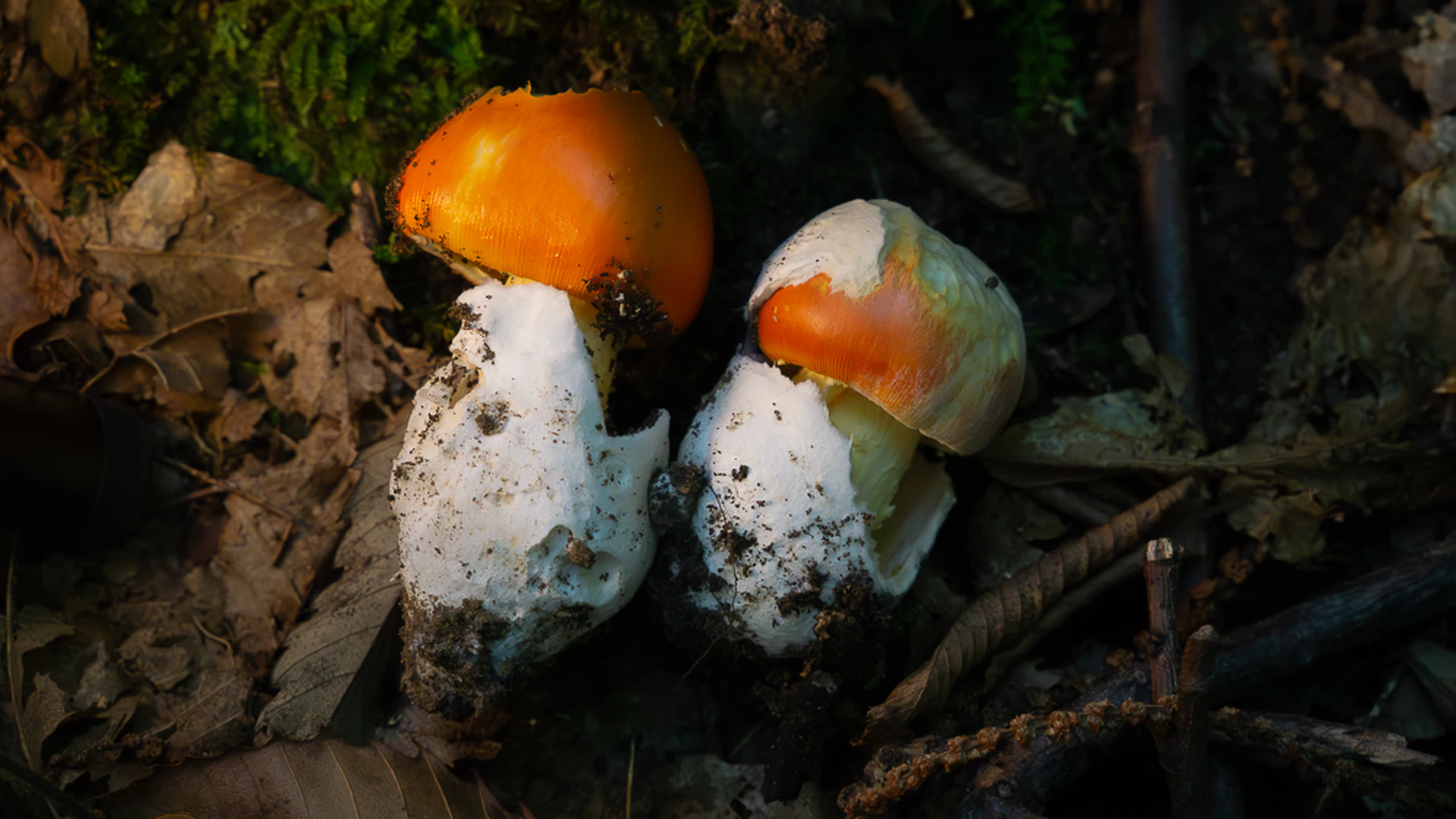
Here’s what makes Amanita cesarea extraordinary: it’s the only Amanita in our region with an orange-red cap, yellow gills, and a yellow stem.
The young button stage emerges from a distinctive white volva—a membranous sack that remains at the base as the mushroom grows.
The cap is smooth, never warted like its toxic cousins.
This combination of features is so unique that once you’ve seen a true Ovolo, you’ll never mistake it.
The yellow gills are critical—this is what separates it from any dangerous look-alikes, which have white gills.
Italian Culinary Treasure: From Emperors to Modern Tables
The name “cesarea” comes from the Roman emperors who considered this mushroom a delicacy worthy of their tables.
In Tuscany today, finding Ovoli is still cause for celebration.
Locals prepare them in the simplest way possible to honor their delicate, nutty flavor: thinly sliced raw with olive oil, lemon, Parmigiano-Reggiano, and a touch of salt.
This preparation—carpaccio di Ovoli—showcases what makes the mushroom special: a subtle, refined taste that needs no embellishment.
During September in our mountain villages, you’ll see Ovoli displayed proudly in market stalls, often commanding prices three or four times higher than porcini.
Families guard their Ovolo spots jealously, passing locations down through generations like inherited treasure.
A Note of Caution for Beginners
Despite its safety when properly identified, I never recommend that inexperienced foragers collect Amanitas of any kind without expert guidance.
The deadly Amanita phalloides (Death Cap) can appear in similar habitats, and young specimens of different Amanitas can look superficially similar in their button stage.
The consequences of misidentification in the Amanita genus are too severe to risk.
On our guided foraging walks, I teach clients to recognize the Ovolo’s distinctive features in various growth stages, always emphasizing the golden rule: when in doubt, leave it out.
The Photographer’s Perspective
From a visual standpoint, Amanita cesarea is stunning.
The contrast of colors—orange, yellow, white, and the deep browns of chestnut leaf litter—creates compositions that celebrate both the mushroom’s beauty and its cultural significance in our region.
Every autumn, the appearance of Caesar’s Mushroom reminds me why I combine mycology with my guiding work: it connects us to the land, to tradition, and to the ancient relationship between humans and the forests that sustain us.
Frequently asked questions
Ready to move from photos to field identification?
Experience these fungi firsthand on a guided autumn hike through Tuscan woodlands — learn professional identification techniques, understand their role in the ecosystem, and photograph your own finds.
Attention!
While the content of this blog post is aimed at providing you with information as accurate as possible, it should be treated as what it is: simply a blog post on the internet.
Mushroom identification should only be performed by experts, as a mistake can lead to dire consequences. Attempting to identify a mushroom on your own, without prior experience, based solely on the content of this blog post is strongly discouraged.