Most writing about hiking in Tuscany assumes a certain baseline of physical ability.
Strong legs, good balance, the capacity to walk for hours over uneven terrain. My own posts are no exception — I write about ridge crossings and mountain lakes and trails that gain hundreds of metres of elevation.
But not everyone experiences nature on those terms, and nature doesn’t require suffering to be meaningful.
The question of accessible outdoor experiences in Tuscany is one I’ve been asked about more than once. Visitors with reduced mobility, families with young children in strollers, elderly travellers who want forest air without forest obstacles — they all deserve honest, practical guidance about what’s actually available.
The answer, in this region, begins with one place: the Parco Regionale Migliarino San Rossore Massaciuccoli.
San Rossore: A Different Kind of Tuscan Landscape
San Rossore sits on the coastal plain between Pisa and Viareggio, stretching from the mouth of the Arno to the shores of Lake Massaciuccoli.
It is nothing like the Apennines or the Apuan Alps.
No elevation. No rocky paths. No exposed ridges.
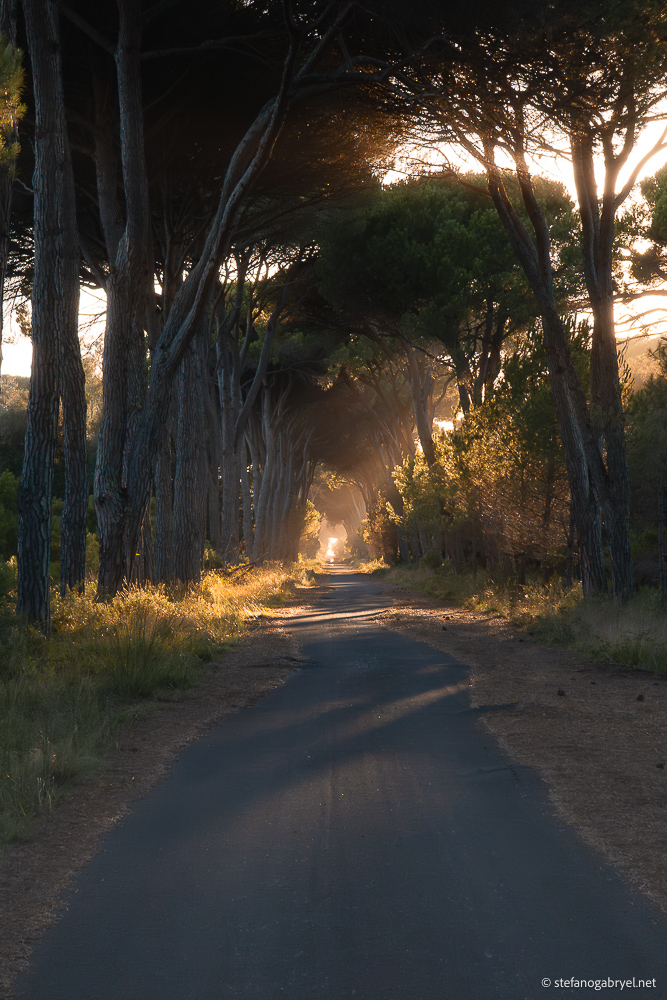
Instead: maritime pine forests, holm oak woodland, wetlands, dunes, and a coastline that has been protected from development since the park’s establishment. The estate has a long history — it served as a presidential residence, and before that as a royal hunting ground. That legacy of restricted access preserved a stretch of Tuscan coast that elsewhere was largely consumed by tourism and urbanisation.
The result is a lowland ecosystem of genuine ecological value — and one that happens to be unusually well-suited to accessible visits.
The Sabrina Bulleri Trail
The park’s most significant accessible route is the nature trail dedicated to Sabrina Bulleri.
This is not a token gesture — it is a properly engineered accessible path through a functioning natural environment.
The trail features:
- Compacted, stable surface suitable for wheelchairs and strollers
- Reduced gradients throughout, maintained below 8%
- Tactile guides for visually impaired visitors, allowing independent navigation along the route
- Rest points and interpretive stations along the way
The path moves through representative habitats of the park — pine forest, Mediterranean scrubland, transitional woodland — offering the same ecological richness that the park’s longer, rougher trails provide, but without the physical barriers.
What makes this trail worth writing about is not that it exists — many parks have an accessible path — but that it was designed with genuine care for the experience, not just compliance.
The tactile elements for blind and visually impaired visitors are particularly notable. They transform the trail from something passively accessible into something actively welcoming.
Spiaggia del Gombo: The Accessible Beach
San Rossore also includes access to one of Tuscany’s most remarkable beaches.
The Spiaggia del Gombo is a stretch of protected coastline within the park — no beach clubs, no umbrellas, no commercial development.
The beach is accessible to visitors with disabilities, equipped with adapted facilities. Access is by reservation and park-organised transport, which means the experience remains uncrowded and the environment protected.
For anyone who has tried to navigate a wheelchair across the sand at a standard Italian beach, the difference is significant.
The Gombo beach represents what coastal Tuscany looked like before mass tourism reshaped the shoreline. Dunes, native vegetation, clean water, and silence. The fact that this experience is available to visitors with reduced mobility — in a region where most beaches are either inaccessible or overwhelmed — is worth knowing about.
What Else San Rossore Offers
Beyond the accessible trail and beach, the park has a broader visitor infrastructure worth understanding.
Guided visits are available by foot, by horse-drawn carriage, and by electric vehicle — the latter being relevant for visitors who want to experience deeper parts of the park without walking long distances.
Lake Massaciuccoli, at the park’s northern edge near Torre del Lago, is a wetland of international ornithological importance. Birdwatching hides and boardwalks provide access to marsh habitats. Some of these are accessible, though conditions vary seasonally.
The park also hosts environmental education programmes, and the visitor centre near Cascine Vecchie provides orientation and booking services for guided experiences.
The scale of the park is substantial — over 23,000 hectares of protected land stretching across the municipalities of Pisa, Viareggio, Vecchiano, San Giuliano Terme, and Massarosa.
This means there is more here than a single visit can cover. The accessible trail is a starting point, not the whole story.
Getting There: Proximity to Pisa and Lucca
One of San Rossore’s practical advantages is its position.
The park sits immediately adjacent to Pisa. The San Rossore train station, on the Pisa–Lucca regional line, is literally inside the park boundary. You can step off a regional train and be among maritime pines within minutes.
From Pisa, the park is reachable by bicycle, by bus, or on foot from the city centre. For visitors staying in Pisa and looking for a nature day that doesn’t require a car or mountain fitness, San Rossore is the most immediate option available.
From Lucca, the park is roughly 25 minutes by train — making it a comfortable half-day or full-day trip. The Pisa–Lucca line runs frequently, and the combination of a morning in the park with an afternoon in either city works naturally.
For visitors based in either city who want accessible nature without driving into the mountains, this is the answer.
Honest Limitations
I should be straightforward about what San Rossore isn’t.
It is not a mountain experience. There are no views across valleys, no alpine meadows, no ridge walks. If you want the feeling of elevation and exposure that defines hiking in the Apennines, San Rossore won’t provide it.
The accessible trail is one route, not a network. You will not spend a full day exploring different accessible paths — the infrastructure, while well-designed, is limited in extent.
Summer heat is real. The coastal plain in July and August is hot and humid. Maritime pine provides shade, but the lowland position means no mountain breeze. Spring and autumn are significantly more comfortable.
Some parts of the park require advance booking. The Gombo beach and certain guided excursions need reservation — you cannot always arrive spontaneously and access everything.
None of this diminishes what’s available. It simply means planning matters, as it does with any worthwhile outdoor experience.
The Broader Picture: Accessible Outdoors in Tuscany
San Rossore is the clearest example of accessible nature infrastructure in this part of Tuscany, but it’s not the only option.
The Nottolini Aqueduct walk — which I’ve written about extensively — follows a flat, paved path alongside a neoclassical aqueduct between Lucca and the hills of Guamo. While not specifically designed as an accessible route, the surface and gradient make it navigable for many wheelchair users and all strollers. It is one of the most atmospheric walks in the region regardless of ability level.
The Padule di Fucecchio, Tuscany’s largest inland wetland, has boardwalk sections that provide level access to marsh habitats — though accessibility varies by entry point and season.
As the demand for inclusive outdoor experiences grows, I expect the infrastructure in this region to improve. But today, San Rossore and the Nottolini walk are the most reliable options I can recommend with confidence.
Why This Matters
The mountains I guide through most often are not accessible in any conventional sense. They require fitness, equipment, and the willingness to navigate rough terrain.
But the impulse that draws people to those mountains — the desire for space, for quiet, for contact with something older and larger than ourselves — doesn’t require a summit.
A maritime pine forest, a protected coastline, a path designed so that a blind person can navigate it independently — these offer something the mountains offer too, just in a different register.
Accessibility isn’t a compromise. It’s a different door into the same experience.
If you’re planning a trip to Tuscany and mobility is a consideration — whether for yourself, a family member, or someone in your group — San Rossore deserves a place in your itinerary. It’s one of the few places in this region where the natural environment has been made genuinely available to everyone, without losing what makes it worth visiting in the first place.
Planning an Accessible Visit to Tuscany?
If you’re looking for guidance on accessible nature experiences near Pisa or Lucca — or want to discuss what’s possible given your specific needs — feel free to get in touch. I’m happy to help you plan a day that works.

or head to the contact page
Explore Hidden Tuscany
Guided hiking experiences combining expert trail knowledge, professional photography, and wilderness mindfulness.